Category: Family


Forty-four percent of residents in Dallas/Fort Worth are New Americans—foreign-born and their children. Over 1 million immigrants moved to the metroplex during the past 10 years. They came from Europe, Asia, South America, Africa and, of course, Mexico and other Latin American countries. They speak 239 languages, and in 32 percent of the region’s homes English is not the language spoken.

Dallas’s strength lies in its diversity, according to Anne Marie Weiss-Armush, who will speak to GUSTO! on Monday, March 12, at 10 a.m. Weiss-Armush is founder and president of DFW International Community Alliance, an umbrella organization for 1,600 internationally themed groups across North Texas. Her presentation will bring the metroplex’s demographics into focus and reveal where these New Americans live and work and how they contribute to the community.

Through its web site, DFW International offers hundreds of links to global organizations and artists plus a calendar of 500 global cultural events each month. The organization also sponsors the annual Dallas International Festival and other special events and produces yearly demographic reports that give insight into the new global face of North Texas.

A Fulbright scholar to Mexico, a Spanish teacher, and an author of four books on Middle Eastern culture, Weiss-Armush lived 11 years in Saudi Arabia, where she lectured on Arabic culture for the national media. Her 20 years of work on behalf of North Texas refugees and immigrant communities have earned her numerous awards, including that of Dallas Peacemaker of the Year for 2003.

For more information or to see what’s going on in Dallas/Fort Worth’s multicultural and ethnic communities, visit the organization’s extensive web site, dfwinternational.org.

Come for coffee and conversation at 9:45 a.m. Everyone is welcome. More information about GUSTO! is at www.kingofglory.com/GUSTO.

NOTE: The follow-on activity, a tour of Dallas’s ethnic communities, has been rescheduled for Monday, April 23. Sign-up for the tour will begin at the April 10 GUSTO! meeting.

Peace be with you.

Our owl returned a few evenings ago. I say it is our owl. It looks the same, sounds the same, and is the same size. And it always returns to the same tree in our backyard, even though trees are numerous in our neighborhood. If it is our owl, then we also have a woodpecker, and several squirrels. Not that they are ours in a pet sense. They do not spend all their time here, with the possible exception of the squirrels. The squirrels are territorial and have our dog, Misty, to hassle.

Although we feed the squirrels inadvertently on occasion, we would not know how to feed the owl and the woodpecker, even if we wanted to or could. The woodpecker could fit in my hand (though I imagine it might be a bit painful), and is usually so high in the tree that we only know he’s there by the sound of his pecking on a branch. For a tiny bird, he, or she, is amazingly loud. She begins a little later in the morning and can be heard periodically through the day.

The owl, on the other hand – as you would expect – only visits at night. I have always wondered what owls do during the daytime. Be that as it may, it is comforting to walk out in the backyard at night to get some air and see him, a shadow against the night sky. Then he begins to expound his bird-ly wisdom, or at least his thoughts at the time.

While the owl and the woodpecker are not our pets in the traditional sense, they do seem to stop by to say “hi” occasionally. Which I think is not only an act of nature, but a subtle sign from God. It has been a particularly difficult time for us. As I have stated before, we have three teenage boys and problems can multiply in an instant. It’s frustrating not being able to post because nothing positive seems to be happening.

So when I went out in the backyard a few nights ago, I was greeted and comforted by the owl hooting overhead. He was on a branch lower than any branches he had perched on previously, not very far overhead. It was as if he was telling me that everything was okay and God was with me. It was the same feeling I get when I am greeted in the morning by the pecking of the woodpecker. And after all, who knows how God speaks to, or contacts, each one of us. So why not through an owl and a woodpecker?

Peace be with you.

I attended the funeral of an old family friend yesterday morning. She lived across the street from my parents. I went to school with her two sons and daughter. She and my mom have been close for years. Carolyn was cremated, so it was a memorial service – a very nice and appropriate service.

At some point during the service, as the pastor was talking, the sound of children talking and laughing came through the wall as they went out the door from the hallway into the playground. My first thought was how interruptive it was. But then I began to think that it was rather fitting. A festive counterpoint to the somber proceedings on the other side of the wall.

Carolyn’s grandchildren were beginning to fidget from having to sit still so long. Hearing the children in the hallway did not help. It was as if God was illustrating that as one life ends, another begins. Reassuring those assembled that Carolyn is still with us in a spiritual sense.

It is odd to me that funerals can seem like reunions. But then, funerals are, after all, more for the living than the departed. Which makes the interruption of the children more poignant. The cycle continues. Love comes into the world, even as the loved depart from it. And all will meet again.

God speaks in many ways. We just need to listen.

Peace be with you.

It is not uncommon for people to ponder the question of whether there can be good without bad or evil. Considering the fact that both good and bad obviously exist, it is almost begging the question. Theoretically though, if bad and difficult times did not exist, there would be no perception of good because good would have no qualification. There would simply be existence.

With that said, I do not think “would there be good without bad?” is the correct question. It certainly has no discernible answer. I think the proper question would be: without bad, would we have any appreciation for what we received or the life we lived? If there were no pain, would we know when we felt good?

The plumbing backed up in our home a few weeks ago. We have a home warranty, but the plumber could not come out until the next day. We soaked up water with towels, ringing them out as best we could. We were not sure we could run the washing machine without acerbating the situation. We lit scented candles and sprayed air freshener in an attempt to override the stench of sewage. The attempt was only partially successfully.

A couple of weeks ago the heater went out and we were without heat from sometime in the early morning on Monday until Tuesday evening. We had two space heaters, but in a two- story home they were not all that effective. Naturally, the temperature dropped to freezing overnight. Cyndy and I both work at home so there was no choice for us but to bear the uncomfortable situation. However, while we were forced to bear the situation, there was no grinning to speak of.

When the plumber left weeks ago, with everything flushing or draining, we felt relief, even though the stench took a little longer to get rid of. We relaxed as the tenseness of waiting for the plumber to arrive dissipated and the problem was rectified. The feeling returned when the heater technician left a week or so later. With the addition of the anticipation of warmth.

As Joni Mitchell said, “you don’t know what you’ve got ‘till it’s gone.” But what about when it comes back? When the power goes out, the plumbing backs up, or the heater or air conditioner stops working, one begins to appreciate things working when the switch is flipped, the toilet flushes, and the A/C cycles on. Knowing that at any given moment, something may stop working – causing inconvenience and added expense. The principle does not only apply to utilities, of course.

Whether I had a toothache, fractured jaw, gash in my knee, broken heel, or even an end of a relationship (of any kind), I embraced – in a manner of speaking – the pain or inconvenience. Not the misery, but the situation as it is presented. With a toothache, if the tooth is not abscessed, I put off going to the dentist. Not only because I am not fond of dentist’s offices, but also because by living with the pain for a time helps me to appreciate the times I do not hurt – and I know how much better I will feel when the situation is remedied. It did not help when the injuries coincided with times of financial deficit and conflicting schedules.

To put it another way, I am an optimistic realist. I hope for the best, but am prepared for the worst. Difficult or painful times are part of life. There is no reason to get worked up about it – it is no one person’s fault and getting upset will not change the outcome. I did not enjoy the toothache. But I had the comfort of knowing the dentist was there to ease the pain at some point.

Then there are painful times when relief cannot be seen on the horizon. A family member or close friend dies or is diagnosed with a terminal illness. Or one any of a number of calamities occurs. In those moments it is hard not to get worked up about the situation or be upset. The answers are not as clear. The problem cannot be fixed with a single visit when you are tired of the pain. The pain – physical or emotional – seems endless.

Whether or not good could exist without bad, the fact remains that both do exist. Evil can be seen rearing its head in daily life. It affects us in many ways. Fortunately, God also exists and is stronger than the worst evil. We are human, with free will. There will still be illness, death, and other forms of serious pain. But God, with his grace, will help us get through any circumstance and quiet the fear within us. When God helps us through a time of pain, we have a greater appreciation for his grace and the times when life is good.

Peace be with you.

When God Seems Absent

There is a rock in the flower bed outside the office door to the backyard. If you glance at it quickly, and use your imagination, it looks like a heart. If you look closer, it still resembles a heart – just a little misshapen. Each day I walk outside (except during inclement weather), I glance over at the rock and take comfort from its presence.

I cannot remember when I saw it for the first time, but I remember seeing it for the first time. It was not one of my better days and seeing the rock cheered me up. I thought it was there for me. A sign that God was with me.

Part of me feels a little silly getting comfort from a seemingly random vaguely heart-shaped rock. Regardless, I still feel that comfort. On a difficult day, when everyone seems to have me in their sights, the rock is still there. Letting me know I am never completely alone.

Then one day last week the rock was gone. There was an indentation in the flower bed where the rock had been. It had rained recently, but there was no corresponding deposit of soil. Our dog, Misty, often buries food and digs it back up later. Cyndy and I thought we knew most of her spots, and she usually covers it back up. Regardless of the reason, the rock was gone.

I felt lost. Which I feel rather silly admitting, but it is true. I walked around in circles, looking for where it might have ended up. The day did not seem right without the rock in its proper place. The rock had been a sign of hope. Was its absence a sign of the opposite? My mood was altered without a discernible reason.

The temperature was beginning to get colder. I would kick around and peer through the grass and leaves, but it was not a thorough search. I would tell myself that it really was not worth it and I would just have to get used to it not being there. But the feeling of emptiness did not go away. When I went back outside, I found myself circling the area again, with the scenario repeating itself.

A few days ago I was searching again – closer this time – and dug up a couple of rocks. I felt around and dug a little further. I do not know what caught my eye or caused me to dig where I did. But there was the heart-shaped rock. I placed it back up in a place of relative prominence near the bricks that border the flowerbed.

I do not know if the rock is from God, but I would like to think he is using the rock – so to speak – to get a message across. If not to me, then through me, by my telling of the story. But I do know that there is a message here – one way or the other.

We tend to take God for granted. We see the signs, and feel strangely warmed, but we simply come to expect them rather than appreciate them. We do not take time to thank God for the grace he bestows upon us. We take the fact that God is always with us, no matter what we do, way too literally. We forget our part of the covenant.

Then something happens and we think God is not there. We walk around in circles, looking for him. We shuffle the grass and leaves wondering where he could be. Then we get desperate, praying that we will find him. After digging a little bit, putting forth effort and praying, God makes himself known to us. Letting us know he never actually left us in the first place. He did not fail us. We failed to live up to the faith God has in us.

Peace be with you.

He walked through the streets in darkness,

Homeless but not alone,

A man on a mission of reverence

beyond the mundane chore of survival,

in a spirit of grace and mercy.

___

He stopped at Johnson’s Laundry

With it’s Closed for Christmas sign,

He knelt on the sidewalk outside the door,

Quietly saying the Lord’s Prayer,

the only prayer he knew.

___

Thanking “Papa” Johnson

For the clothes left unclaimed,

He left a small package – a crude, homemade cross

With a card on which was scrawled,

“Merry Christmas, from Jesus.”

___

Next was Garcia’s Grocery

For the leftovers not yet spoiled

He knelt and prayed –

Another crude cross,

And the card, “Merry Christmas, from Jesus.”

___

Ten blocks later, Miller’s Hardware,

For his sturdy, cardboard box dwelling,

and timber for his bed,

A kneel, a prayer, a larger crude cross,

And the card, “Merry Christmas, from Jesus.”

___

Too far from home, the mission closed,

He found a bench in the park,

after a passerby bought coffee

and he walked – recalling forgotten memories –

without knowing what they meant.

___

Early the next morning on Christmas Day,

he fought the wind and rain,

through the cold streets to the mission,

where Christmas dinner was served, the soul sustained,

and life again had purpose.

___

The rain stopped, the wind died down,

as he trekked on home,

home – an alley behind the church

white and made of stone,

with a view of the cross on the wall.

___

He turned into the alley

and stopped in his tracks.

Where his cardboard box had stood,

was a sturdy lumber shack,

with a roof, a window, and a door.

___

He opened the door to a sturdy wooden cot,

An orange crate table, his few possessions inside,

with something new on top.

A suit of clothes hung on a hook,

with the laundry marker still on it.

___

He closed the door because he could,

he’d forgotten what it felt like.

Walking to the table he turned on the lamp,

it had been years since he had his own light,

but then his breath went away.

___

Also on the table sat a Bible, brand new,

inscribed with a name he hadn’t used in years,

next to a picture of a family he’d forgotten he had.

He stood staring at them, his mind racing,

memories bombarding his thoughts.

___

He sat on the cot and picked up the Bible,

after staring at the picture a while.

He ran his fingers over the only thing he owned

that wasn’t worn by wear or weather,

with emotions he couldn’t control.

___

Through tears, with shaking hands,

he opened the Bible and read

“Merry Christmas, from Jesus.”

___________________________

© 2009  Daniel L. Roark

Merry Christmas!

Peace be with you.

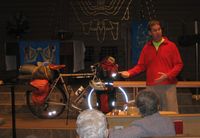
In 2010, at age 49, Bruce Moore quit his job and spent three months cycling the TransAmerica Trail from Virginia to Oregon. Moore shared pictures, memories, and learning experiences from the trip with the group at the December meeting of King of Glory Lutheran Church’s GUSTO! program on Monday. Following corrective heart surgery in 2009 for a previously undiagnosed pediatric condition, Moore became determined to accomplish his three main goals. Having cycled in college, he wanted to bike across the country. He also wanted to write a book and start his own company.

After planning and preparing all winter, and training during the spring, Moore departed from  Yorktown, Virginia on May 8. As he told the audience, the journey took 93 days. Moore rode  4,105 miles, riding for 79 days with 14 days rest. While he traveled by himself, with his wife, Kristin, meeting him a few times along the way, he was rarely alone.

Moore shared pictures and stories of fellow cyclists with whom he had ridden, as well as good Samaritans along the route who welcomed the travelers, giving them water, treats, and shelter for the night. One woman has been serving water, lemonade, cookies, and shelter to cyclists on the TransAmerica Trail for many of its 35 years of existence. The trail was mapped out in 1976 for the Bicentennial. Six thousand riders made the trip that first year. About 500 cyclists make the trek each year, some eastward bound and others headed westward.

An entertaining speaker, Bruce Moore described being dive-bombed by a hawk, seeing nothing in either rearview mirror but a huge wing. He spoke of the lack of vegetables in rural areas. Of being welcomed by three churches along the way whose congregations had formed a ministry to welcome cyclists traveling along the trail. Of his habit of eating at local diners for social interaction and friendly smiles.

On August 8, after 4,105 miles, 42 nights camping, 42 nights in hotels, 6 nights in hostels, and 3 nights in churches, Moore met Kristin in Florence, Oregon. He dipped his front wheel in the Pacific Ocean, having dipped his rear wheel in the Atlantic three months earlier, completing the journey from sea to shining sea. Moore launched his own software company upon returning to Dallas. Counting the blog as a book, he accomplished all three goals. He is now working on other goals.

Bruce Moore’s cycling adventure also raised funds for the National Multiple Sclerosis Society. His blog may be found here.

Peace be with you.

The Dartboard Incident

My family lived in Waco, Texas when I began attending elementary school. I had a friend whose family lived in one of the largest homes of anyone I have personally known. Although it might not seem as expansive now. While I do not remember his name (I’ll call him Rick) or how we became acquainted, I distinctly remember parts of the house and activities we were involved in. There were parts of the house I never saw.

There were small enclosed stairs at the back entrance – or one of the back entrances – that led to a small, seemingly hidden room on the second floor, and a larger room on the third floor. The smaller room was a reading room of sorts, and I think that the larger room was the entirety of the third floor. The only access to the rest of the house was through a short hall on the second floor leading from the stairs and reading room. The larger room had a large tv – for the time – an easy chair, a sofa, a coffee table, and little else I cared about noticing at the time.

Behind the easy chair was a cardboard box about 3’x3’x3′ that was always at least half full of candy of all sorts. When I spent the night at Rick’s house, we would wake up early and walk to what I think was one of the first 7-11s. Either way, it opened at 7 a.m. and closed at 11 p.m. If we were up before six, we would play in the large pile of dirt in the middle of the construction site next door to the convenience store.

At the store we would buy a bunch of candy, take it back to Rick’s house, and add it to the candy in the cardboard box. After a couple of visits, I discovered that Rick had rules for the box of candy. Regardless of how much candy I put in the box, I could only take out one piece at a time. And not whenever I wanted to. I did not contribute to the stash of candy after that.

On one such sleepover, the two of us were in the short hallway between the reading room and the door to the rest of the house – which was closed. On the back of the door was a dart board. Rick was being cruel for some reason and would not let me have a turn at throwing darts. Which was not how I had been taught to treat a guest.

I protested for what seemed to me like a good while. Certainly longer than I thought it should take to get my turn at darts. Exasperated, I stood in front of the dartboard with my hands out, telling him I would not move until he gave me the darts. I was not all that confident after Rick told me if I did not move he was going to throw a dart anyway. The interchange repeated several times. Until he threw the dart into the palm of my hand. I stood there with a dart sticking out of my palm, staring at him in disbelief, asking him why he would do that.

“You should have moved,” Rick said as he snickered and shrugged his shoulders.

My hand did not hurt until after I pulled the dart out. Then it stung considerably. I do not recall staying at Rick’s house after that. I may have, but if I did, it was never the same. The trust was no longer present. Granted, I might have continued protesting without standing in front of the dartboard, but that was having little effect. Then again, he could have been a kind host and let me take a turn. He also never apologized.

I was beginning to learn that not everyone lived – or tried to live – by the golden rule. Or by “loving thy neighbors as thyself” as the Bible says. I was also beginning to be the recipient of looks and remarks when I stuttered. I had often heard people say that I would grow out of my stuttering. Since that was beginning to look less and less likely, people were beginning to assume that something was wrong with me. I was certainly not normal. While I was used to snide remarks and looks, physical pain at the purposeful hand of another was something new. As to the dart situation, it was difficult to ascertain which hurt more – my pride or my hand.

Through the years, I have seen, and heard of, people making a sheer mockery of the golden rule. I have also learned how difficult the golden rule is to follow. I have long since forgiven Rick. I do not even remember his right name or the pain of the dart in my hand. Regardless of the difficulty, I keep trying to treat others as I want them to treat me. But I keep track of my own candy and I do not play darts anymore.

Peace be with you.

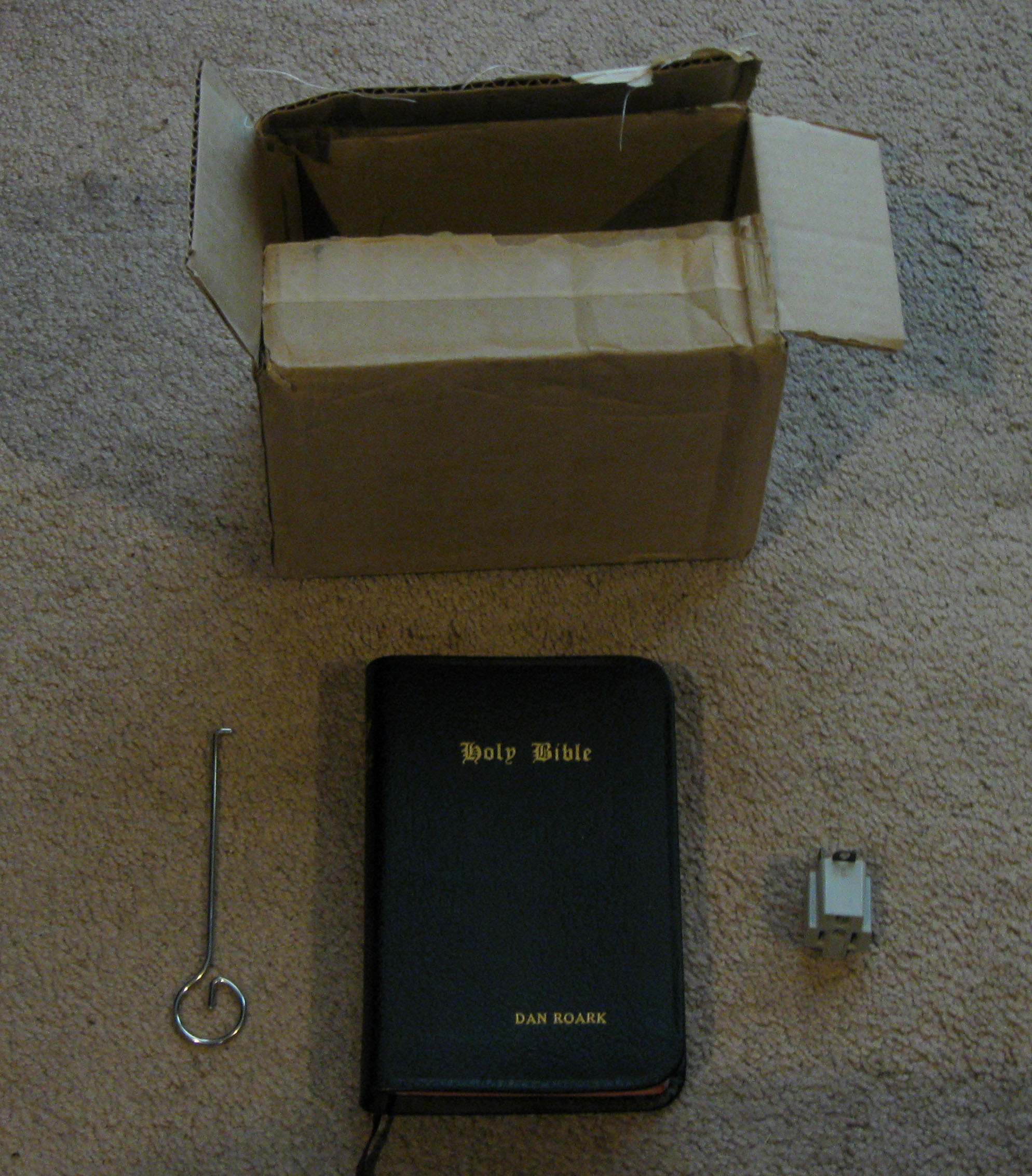
There are a number of boxes, gadgets, and doohickies in our shed, closets, and drawers that we have kept because they “might be useful some day.” They just sit there waiting – hoping that someday they fulfill their purpose – useless until useful. I walked out into the backyard this morning and discovered that Cyndy found a use for a box I decided to hang on to a few days ago. The box had acquired a secondary purpose. Like the doohickey – or thing-of-a-jig – that becomes the perfect “tool” to complete an odd job around the house.

Once a “might be useful someday” object serves a purpose it is no longer possibly useful. It is indispensable. It can collect dust for years, but it will not be thrown away. On the premise that because it has been useful once – or twice as the case may be – it will inevitably be useful again. Even though that might not be the case.

I have found that for some people, and some Christians, the Bible is simply one of those things to have around because it might be useful some day. They take it to church on Sunday if they remember it. “After all, they have one in the pew.” Then they never actual open it. Why bother when the lay reader is reading it to them. And the preacher will remind them if their thoughts happen to drift.

But – sure enough – a time comes when their Bible becomes useful. Tragedy strikes family or friends. A job is lost, a relationship ends, or any one of any number of life-changing events occur. Then their Bible again has purpose. It eases their mind, softens their heart, soothes their soul, or simply provides comfort. Their Bible has become indispensable.

Unfortunately, there are too many Christians to whom the Bible is something waiting to be useful. They have not discovered the life-changing story of the Israelite’s history, the life and death on the cross of Jesus, or the forgiving grace of God. They have not felt their “heart strangely warmed” as John Wesley did. They have not had their souls cleansed with God’s grace.

With persecuted Christians around the world clamoring for Bibles and materials to continue their spiritual journey with Christ, it is sad that many Christians in our part of the world have a Bible that they never use. I have had a Bible – and have been a Christian – for as long as I can remember. Beginning with the pocket-size New Testament I received when I began attending Sunday school. I have always had a Bible at hand. Unfortunately though, there were times when I felt I was keeping it around “in case it was useful.”

When I finally felt the Lord’s nudging and again opened my Bible for study and prayer, I ceased to think of the Bible as being “potential useful.” It is a part of my day, my life, my profession, and our family life. I feel uncomfortable when too much time has passed since our last visit. The Bible, once thought of as potentially useful, has become indispensable.

“In the beginning was the Word, and the Word was with God, and the Word was God.” John 1:1 NRSV.

Peace be with you.

I was walking to our sons’ school with the youngest son’s football gear stuffed in my backpack. Cyndy was running errands after dropping them off at school. In the waking up atmosphere of sleepy-eyed confusion in which things can slip teenage minds, J.D. had forgotten his gear on the couch. Of course, he had to have it right away. It was a hot and fairly humid day. Which was not conducive to walking long distances on sidewalks with slight, intermittent, shade.

When I am walking, I watch the ground ahead of me – for several reasons. For one thing, I walk quickly which requires watching the terrain. And by watching the ground ahead of me, I am not constantly reminded of how far away my goal is at any given time. I have also found a large number of coins over the years (albeit mostly pennies).

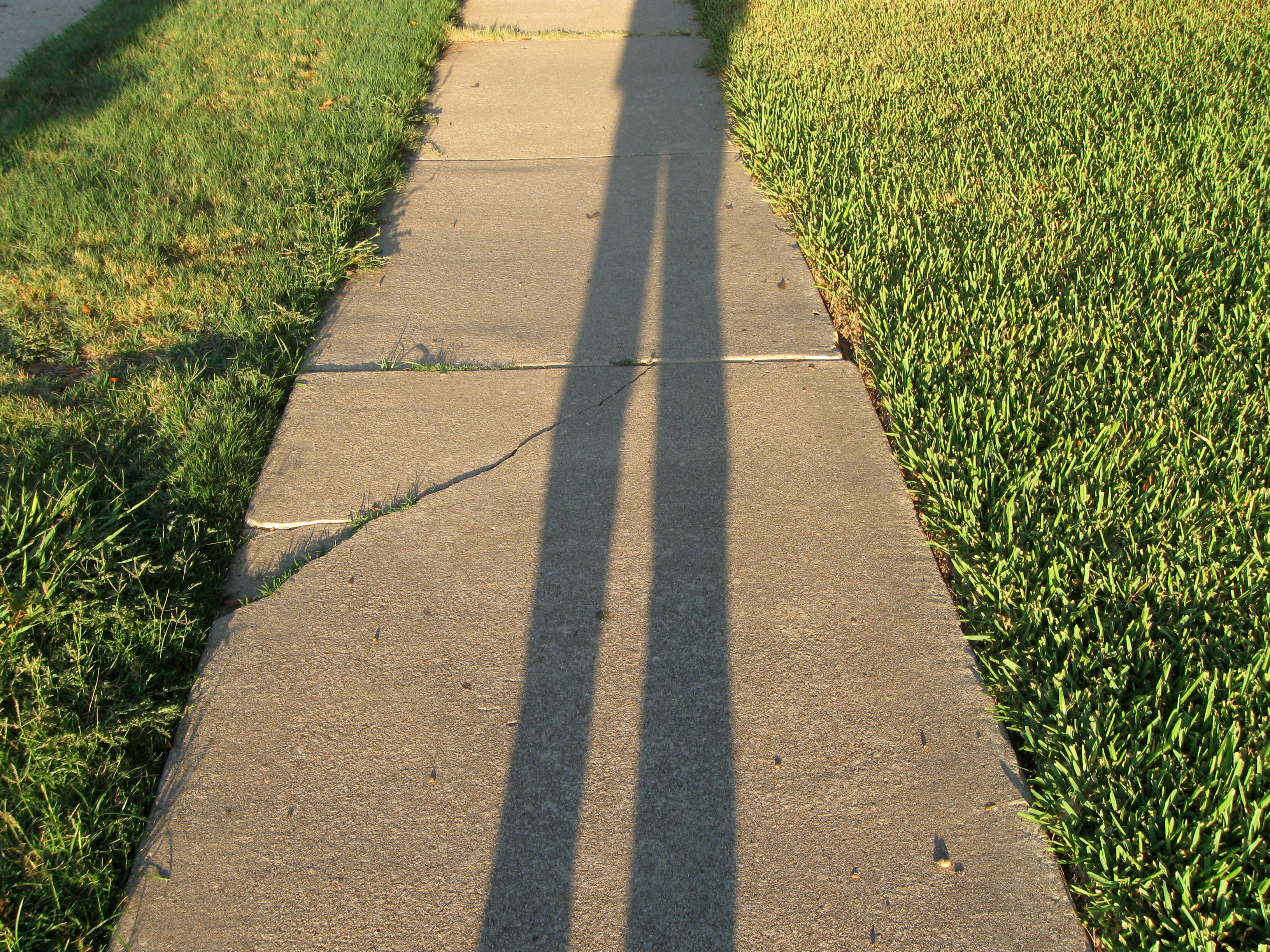
I walk in long strides, setting up a quick rhythm. Inevitably, I set my stride with the aim of missing the cracks in the sidewalk. Lengthening my stride when the situation requires it. At some point the superstition of my youth slips through – bringing to mind the phrase we used to say.

“Step on a crack, break your mother’s back.”

Do I believe it? Not really. Do I avoid the cracks? You betcha – just to be on the safe side. And I will have you know that to this day my mother has not broken her back. A few other things maybe, but not her back. I will also have you know that I do not think my avoiding cracks had a thing to do with it.

Yet, as I was walking to my son’s school, I was avoiding the cracks. Mostly to set up a rhythm in my stride, but avoiding the cracks nonetheless. That got me to thinking – as walking is wont to do – about avoiding cracks and hedging bets.

As a general rule, I can set a rhythm or pace and move quickly along while still avoiding the cracks. As we as Christians can go about our life in the secular world, avoiding the larger, more obvious sins. But then I come across a section of sidewalk – or life – that has begun to show wear, causing a conundrum. There are so many cracks that even a hop-scotch afficionado would have trouble traversing the area.

So which cracks count in the break your mother’s back scenario? If it is a natural part of the sidewalk which was purposefully made that way, is that considered a crack? Is it just the cracks that have developed over time from wear and weather that count? Or do all cracks count, causing the situation to be crucially problematic?

In our Christian lives the question – considering the cracks as sins – is which sins to avoid. Which cracks are actually sins? And which cracks are part of the sidewalk as it was made? When we come to the section with too many cracks to avoid them all, which do we choose not to avoid?

We are human and cannot avoid all sin. And not all the cracks in life’s sidewalk are sins. Some cracks are merely faults in the sidewalk. Fortunately, “step on a crack, break your mother’s back” is just a game. Unfortunately, life is not a game. Even though it might seem that way at one time or another. Some of the cracks we try to cross in life are wider and deeper than we could have imagined.

When we reach those rough spots in life’s sidewalk, we wonder if we took the wrong path – if we are on the wrong sidewalk. We are unsure which cracks to avoid and which cracks are okay to step on. What false idols we have succumbed to and need to avoid, and what we should be embracing more than we are.

During those times of rough spots, when our paths reach too many cracks in the sidewalk and other obstacles, we need to recall what Paul said to the Corinthians. “No testing has overtaken you that is not common to everyone. God is faithful, and he will not let you be tested beyond your strength, but with the testing he will also provide the way out so that you may be able to endure it.” Corinthians 10:13.

As we walk along life’s sidewalk, we need to put our faith in God, and trust the path we take. By the grace of God we make it to the end of the sidewalk.

 Peace be with you.