Category: Theology


The month of August was the most boring part of the summer when I was growing up. And, judging from my daughter and now my sons, it has not changed a whole lot – except for school beginning before Labor Day, rather than after. Were it not for football workouts, the tension would be unbearable. Even with cell phones, Facebook, email, and so on, the circle of close friends is smaller during the summer than during the school year. Partially because some of those friends are only close friends when you see each other at school. After school, they are not so close.

The only technological device I had was a transistor radio (not complaining – just explaining). There was as yet no such thing as FM radio. Since the few close friends I had during the summer planned their vacations for August, I was forced to resort to my “B” list. You know, the friends that I could put up with if I had to. But B list friends could lead you to do things you would not ordinarily do.

One particular August, hot as usual, I was stuck with a B list friend. He lived next door and I think his name was Jeffrey. He was a little younger than I was, which was partly why he was on the B list. Across the dirt alley behind our homes was a fairly large park without many trees.

Part of the park doubled as the schoolyard for the elementary school on the left as we walked out the back gate. A creek ran along the other side of the park across from the school. The alley where we were standing formed the eastern border of the park and ended on the right at the creek which was the northern border. A few houses to the left, the dirt alley ended when a side street between two houses became the drive behind the school.

The back of the cafeteria was at that corner of the building. There was a short stairway leading up to the kitchen door about a hundred feet from the corner. The door was only used for the kitchen personnel and smaller deliveries. The truck delivery door was to the right, between the stairway and the end of the building.

Jeffrey and I were walking through the parking lot from the alley, bored as always in August. We noticed a wooden “door” of sorts in the side of the building under the floor of the cafeteria four feet past the stairwell. An open lock hung in the latch of the door. We took out the lock, opened the door, and crawled through the 3′ x 3′ space, finding ourselves under the cafeteria. I worked my way through the pipes to where I figured the cafeteria was and found another door above me in the floor.

Surprisingly, that door was unlocked as well.  We climbed up into the middle of the kitchen. We headed straight for the refrigerator. Jeffrey and I helped ourselves to canned fruit,  olives, and pickles. Maybe a few slices of cheese – they were not individually wrapped then. After we had a snack, there was not much else to do. We had no interest in any other part of the school and we were not completely sure no one else was there.

Getting out was a little different than getting in – we did not know if anyone would be looking. But we made it out without incident and walked away quickly. We revisited the kitchen a few times that August – all without incident. I noticed after school began that the custodian had fastened the lock.

I have no doubt Tom Sawyer and Huck Finn engaged in the same type of questionable activity – the mischievous behavior of bored children. But I do not know how much guilt they felt. As for myself, I did not think about it too much, but I knew deep down that I was sinning at the time. Which made it worse that I did it anyway. I probably rationalized the actions by thinking that no one was hurt.

Yet it was a crime (albeit a misdemeanor) and a sin. Ironically, since I lived on the edge  of the schoolyard/park, I always went home for lunch. I was saved the feeling of regret when returning to the scene of the crime. Other than a cursory view from the kitchen, I never saw the cafeteria – just the kitchen and under the floor.

I could not be legally prosecuted now. The statute of limitations on school cafeteria theft of produce and condiments has surely expired. But God knows. It may be low on my list of sins in order of importance, but it is still on the list. Just another one of the things I continue to ask God’s forgiveness for, and that I have in common with Tom Sawyer.

Peace be with you.

* –  Tom Sawyer was one of the first books I read growing up. Things I Have in Common with Tom Sawyer is a series of posts about the activities of prepubescent and adolescent youth – mostly mine. Times when I was in a “Tom Sawyer” frame of mind. Read the first post here.
When I am troubled,

and in that contradictory, ironic place,

thinking that no one knows how I feel,

The Lord hears my prayers.


Yet the Lord very rarely

answers my prayers directly,

Sometimes I only see the answer

During reflection on the day’s events.


Regardless of the result,

The Lord hears my prayers,

He may not answer the way I would prefer,

But the Lord hears my prayers.


I may not be listening,

or I may be stubbornly wanting more,

I may not hear what he’s trying to tell me,

But the Lord hears my prayers.


The Lord hears my prayers,

However and whenever I pray,

Even if I refuse to hear the answer,

The Lord hears my prayers.


I lay head on pillow lightly,

Letting the Lord take my troubles,

I can rest easy in sleep knowing

That the Lord hears my prayers.

[Find part one here.]

Immediately upon spotting the gun, Antonio felt the man’s left arm come around and clamp his chest under his chin, reclaiming his vise grip on Antonio’s right shoulder. Although he  had an urge to turn his head to see where the pistol was pointed, the preacher decided instantaneously that it would not be the wisest choice he could make. His heart was beating so fast that it seemed determined to fly out of his chest. At the same time his brain struggled between telling his eyes to close tightly to feel the barrel of the gun should it be pointed at his head, and telling them to remain open to eliminate the element of surprise.

Francis dropped the coffee pot, which shattered, sending hot coffee and shards of glass onto her shoes and legs. Her fear of the man holding Antonio and the gun offset the pain in her legs. That, and she was praying harder than she ever remembered praying. She wondered if it would matter to the gunman if he knew Antonio was a preacher.

The instant the coffee pot shattered, Fred Martinez, the owner of the truck stop who was still at the cash register, stepped on the floor alarm under the register that signaled the police. He always had unruly customers, but he had the alarm installed when a late night birthday party got  out of control. With the use of credit and debit cards, the truck stop never had enough cash that he thought someone would rob the place at gunpoint. Especially with all the glass and traffic.

“Pull down the shades, and turn the sign around!” the gunman demanded, pointing the gun at Francis – who fought hard against the fainting spell, which along with her fear, was turning her legs to jello.

Francis was not sure how her legs kept moving, but she moved toward the windows as quickly as she dared. As she reached up for the shade on the last window by the door, she spotted Steve Striden at the pump putting gas in his blue Ford F150. He looked around toward the restaurant. Francis tried to catch Steve’s eye as she pulled down the shade. She turned the open sign around in the window, glancing again toward the pump.

“Lock the door,” said the gunman, who had backed up against the wall dividing the restaurant from the store. “Now this one,” he said after she locked the front door, nodding to the door to his right.

The gunman still held Antonio in front of him. Antonio had said so many prayers they had turned into one long prayer. When the gunman had relocated – pulling Antonio with him – the preacher nearly lost his balance. He was sweating buckets and knew the gunman was, too.

Antonio was struggling to keep his bladder in check against the fear and coffee. But that did not keep him from noticing that the man with the gun and arm around his chest was getting nervous. He took a deep breath and let it out slowly.

Which was when someone dropped something in the kitchen, Antonio felt the gunman twitch as he pointed the gun toward the kitchen, the gun fired, and Antonio’s ears rang.

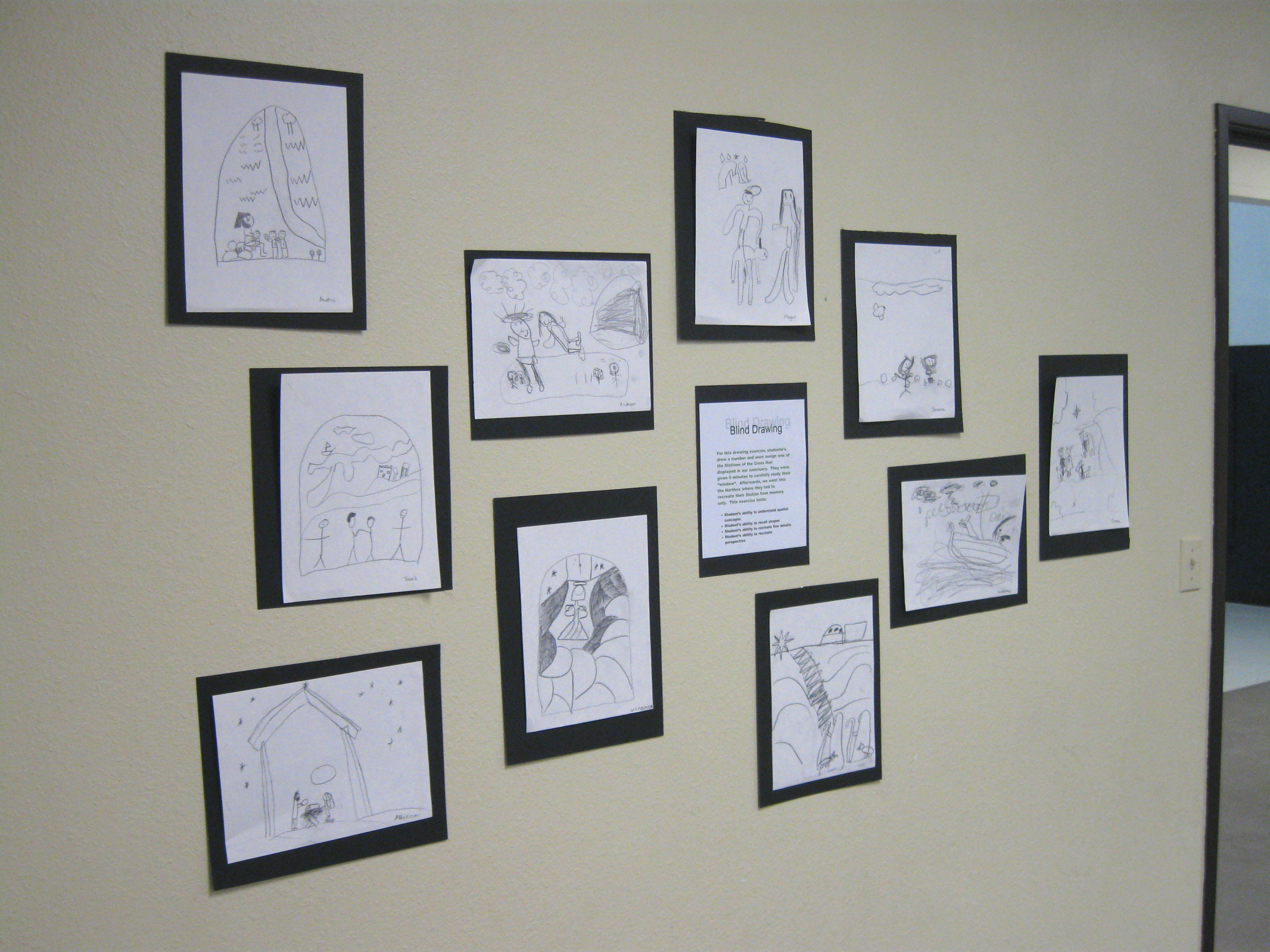
The Children’s Education Department of Christ UMC, Farmers Branch held the first summer children’s camp this summer, Rock Around the Clock. The camp was held for one week, Monday through Thursday. Monday they learned about the 50’s, Tuesday, the 60’s, Wednesday, the 70’s, and Thursday, the 80’s. Each day they had cooking, drama, P.E., art, science, and music classes, based on the day’s theme.

In art class one day, the children went into the sanctuary. They each picked a number out of a bowl and were assigned that station of the cross. The children were given five minutes to study their station window in the sanctuary. Then the children went outside the sanctuary and recreated their window on paper from memory.

As I was taking pictures of the Stations of the Cross art display, I recalled a project from elementary school in Wichita Falls. I was to draw the front of our family home from memory. I do not know how long it took, but I finished the drawing. It is highly possible that the drawings were displayed at an open house – as with the art gallery of summer camp projects.

When I took the drawing home and compared it to the front of our house, I was “right on the money” – down to the oil stain in the driveway. With the exception of drafting classes in junior high school, along with drawing imaginary funny cars and hot rods for fun with a friend, I  never drew anything really decent again. We moved to Dallas when I was in the eighth grade. In high school I began to write, leaving the artwork to those better suited for the task. I can doodle with the best of them, but anything resembling art that results is merely by accident.

Our house burned down on the Friday before I began my senior year. Of the many things I lost that night, the picture I had drawn was one of them. My parents recently went back to Wichita Falls and the house we lived in was gone. There was not even any sign that the house had ever been there. All the homes around it were still there and in fairly good condition, considering their age.

I had a sinking feeling when Dad told me the house was gone, as if a part of my life was gone. I am left without a visual reminder of our house other than my memory. It is not the first time and it certainly will not be the last. But it does remind me – and everyone when it happens to them – that material things mean nothing as long as we have our memory and faith in God.

It is our memory that makes our past experiences special and real. Even if I could take our sons to Wichita Falls and show them the house, they would not have a sense of what it meant to me. It would simply be the house where Dad used to live. But the memory of living in that house will remain special to me. And that is what is important. If my existence depended on the existence of places I have lived and have been to, a good part of my life would be wiped from the annals of history.

When the house burned, I lost everything I had except the clothes on my back and a small stereo that I had in the bathroom to listen to while taking a shower. As I stayed at a friend’s house  the night of the fire I had a strange sense of freedom. I was not tied down with possessions. Then I would begin to think of everything I had lost and the sense of freedom would turn to sorrow. It has been several decades now since that night. I have stuff again – too much stuff. Between the fire, a couple of robberies – and a rare repossession a really long time ago – I worry about my stuff. I cringe when I smell smoke of any kind except a grill. I’m slightly paranoid about checking the locks when I leave the house.

But with relatives, friends, associates, and acquaintances passing away with disturbingly increasing frequency, life – and material things – look a little differently now. Material possessions do not have the allure they did when I was younger. Books that I lugged around for years because I thought I would read them someday are now in someone’s home having been bought in a garage or library book sale. The objects I held onto because “they might come in handy some day,” never came in handy and have been recycled or given away.

With each passing day, I make the most of that day and I am thankful that I have my memories. Losing everything from my past in the fire did not mean I lost my past. I remember it, have pictures of some of it, friends and family remember parts of my past. But the emphasis lies on the fact that I remember it. Possessions, houses where I lived, clubs where I played, places I visited – they may be gone – but that does not matter. I have my memories and I can describe them to people. Maybe they can get something out of them. But I remember them, have faith in God, and have an appreciation for the life he gave me. Either things will take care of themselves or God will guide me through them. Anything else is just gravy.

Brother Antonio opened the chapel – a 52-foot semitrailer in the parking lot of the Traveler’s Treasure Truck Stop – at 6 a.m., as he did on most mornings. He liked to have himself and the chapel available for the truckers who were getting an early start and wanted to pray before heading out. As he walked up the stairs and unlocked the door in the wooden wall that replaced the metal doors of the trailer, Antonio recalled the pain of opening the original doors which would swing around and bang against the side of the trailer, knocking a few pictures off of the wall.

Leaving the door open, he flipped on the two window air conditioning units installed on the left wall. The units were a welcome benefit of the redesigned entrance. Taylor Perkins, a long hauler for a lumber company, donated a batch of leftover lumber to the chapel that the company did not want to pay him to haul back. Fred Mullins, the truck stop owner, paid his handyman, Jeff Purvis, to build the steps, the rear wall with the door, and add supports under the trailer.

Purvis, a deacon at the Community Christian Church, painted “The Church of the Necessarily Significant” on both sides of the trailer as a favor to Brother Antonio. He also was a handyman for the Restful Traveler Hotel across the road from the truck stop. The hotel had upgraded from window unit air conditioners in the past year and the owners were happy to donate two of the units to the chapel. Jeff Purvis attended Brother Antonio’s Thursday night Bible study.

The Mothers of Miracles group at the Community Christian Church sewed blue tarps together to cover the underside of the trailer. The women added crosses alternating with the words Jesus, Forgiveness, Redemption, Faith, and Love. Mavis Monahan, secretary of the group, was the evening shift manager/waitress at the diner in the truck stop.  The Mothers of Miracles met at the chapel on Tuesday evenings to crochet prayer shawls for the sick, the infirm, and babies when they were baptised.

Antonio walked out and closed the door behind him. He straightened the sign hung on a nail in the center of the top of the door. “I’m in the restaurant, 406-224-5893 (ask for Brother Antonio) or stop in.” When he was in the restaurant the waitresses would call him to the phone. It gave the drivers who wanted privacy the chance to pray alone in the chapel. We walked across the parking lot and  entered the truck stop through the main entrance – saying “hello” to Fred at the cash register – and turned left toward the restaurant.

“Good morning, Antonio.” Francis smiled brightly as she served his coffee – one sugar, one cream – while he settled into his usual corner booth.

“Good morning, Francis.”

“Do you want the usual on this beautiful morning?” She went ahead and wrote special on her order pad anyway. He had only been in town for four months, but the order had not changed.

“Yes, thank you. It is a good day that the Lord has made, isn’t it?”

“Better than yesterday.”

“Nature has a mind of her own, so to speak.”

Francis smiled, topped off Antonio’s coffee, and headed to the kitchen to turn in his order, stopping along the way to refill the coffee cups of other patrons. Antonio glanced around the restaurant, smiling at everyone who caught his eye, and nodding to the regulars. He pulled out his phone and checked the Church of the Necessarily Significant’s Facebook page. It was not a church, per se, although that was Antonio’s goal. The church had begun…

“Here you are, Antonio. Two eggs over easy, bacon, toast, and grits.” Francis slid the plate in front of him as he raised his hands to give her room. She filled his coffee, smiled, and walked to another customer.

Antonio bowed his head and said a quiet prayer. He added butter, salt, and pepper to the grits, stirred them, and tasted a spoonful. Then he cut a piece of an egg, broke off a piece of bacon, and put them on the corner of a piece of toast and took a bite. As he was preparing his second bite, Antonio felt the rush of air as the door to the restaurant opened behind him. He was chewing the second bite when he was suddenly jerked out of the booth and to his feet by a vise grip on his shoulder. The piece of toast went flying. Then he saw the gun.

The bird in the window was about half the size of this bird.

We had a small visitor at our old house. She spent most of the day outside each of our sons’ rooms going in rotation to all three windows. Cyndy and I thought at first it was a Finch, but Cyndy decided it was a female cardinal. I have large hands and could probably hold the bird in a loose fist without any part of the bird showing. I do not know much about birds, but I do know that this particular bird had the common sense of a tree trunk.

She began to visit in the early afternoon after lunchtime. Which is one of my main reflecting and writing times so the intrusion was quite unwelcome, at least at first. I mistakenly took the sound to be our dog, Misty, scratching at the window trying to get out at a squirrel. But the tapping was more melodic and deliberate and did not result in the harder thump that our medium-sized dog would make as she hit the wall.

The first sudden tap made me jump, expecting to hear glass hit the wood floor at any moment. Less than three minutes later, another tap. Sometimes it would stop for as long as five minutes, leading me to believe it had ceased. But sure enough, as soon as I started working again – another tap. I realized Misty was laying on the floor in front of the my desk so she could not be making the sound. Then I heard a deeper, heavier noise follow the tap, as if someone had thrown a rubber ball at the window.

I went down the hall quietly and stood in the doorway of Conner’s room at the front corner of the house. The bird was standing in the middle of the window sill of the window facing the side of the house. She would look at the window, look around the side yard, then back at the window. Then, suddenly, she would tap the window hard with her beak – as if she had forgotten it was there, or just to be sure she had not been wrong the first five times. It was also entirely possible that she had tapped her beak so hard she had rattled her brains.

Then, in between periods of tapping, so suddenly it made me jump, she backed up a step and flung her little four inch, 20 ounce body against the window as hard as she could. Only appearing to be dazed for a few seconds, she flew around in a small circle and landed back on the window. She looked at the window for a few minutes, looked around a bit, and the whole cycle began again. I stood transfixed, thinking surely she would not do it again. But sure enough, after a series of taps, she backed up and body-slammed the window.

I leaned against the doorframe and watched for a while. Either the bird was so daft that neither thought nor pain registered in her small brain or she was so stubbornly persistent that constant failure was not enough for her to give up her task, whatever it was. Regardless, her task was a painful and fruitless one. Stubborn persistence can sometimes be beneficial, but more often than not it is simply detrimental.

While I thought the bird’s actions were ridiculously naive and mistaken, they reminded me of our stubborn persistence in not listening to what the Lord is telling us. Rather than having faith and trusting in God, we insist on looking for an easier way. Which actually turns out to be more difficult in the long run.

We have a chance to fly free, as it were, and explore all that the Lord’s world has to offer. Yet we insist on constantly tapping on the glass representing the things that we think we want or should have, but would never give us the fulfillment we long for. In our stubborn persistence we “body-slam” the glass, throwing our entire body into the refusal to accept what is before us. But,  as if that is not enough, we turn right around and start the whole process over again.

Like the Israelites of the Old Testament, we keep giving in to our temptation to slip back into sinful ways. We begin to find excuses to not read the Bible, pray or attend church or volunteer regularly. When life is going okay, we’re too busy for God. Then, when tragedy strikes, we wonder where God is – when, in fact, he has been there all along.

After God saves the day, yet again, and life returns to normal, we begin the insistent tapping all over again. We need to have faith in God, trust in his mercy, accept the grace he freely offers, and strive to live the way we were taught to live by Jesus. What is on the other side of the glass is ultimately unimportant.

Peace be with you.

Nelson’s Illustrated Guide to Religions, written by James A. Beverley and published by Thomas Nelson is the ultimate comprehensive guide on religions of the world. It is the most thorough book on the numerous religions I have encountered. When I received the book at one o’clock in the afternoon, I spent the rest of the afternoon skimming  through the 740 page volume, reading much of it. I returned to other projects, but I kept picking Beverley’s book back up for another look. It is a book I will keep close at hand for future reference and referral.

It would be extremely difficult, if not impossible, to name a religion or cult that Beverley does not identify. The author is commendably objective in his reporting on the many religions and cults of the world, past and present. Other than the most common religions of Roman Catholicism, Protestantism, Orthodoxy, Judaism, Mormonism, Islam, Buddhism, Hinduism, and Baha’i, as well as Jehovah’s Witnesses, Christian Science, Scientology, Unification Church, and Sikhism, Beverley also includes chapters on groups of the New Age movement, Christian Sectarian groups, Satanism, and Witchcraft.

The Illustrated Guide to Religions includes a chapter on the Branch Davidians, their timeline, and the tenuous connection with the Seventh Day Adventist Church and Davidian Seventh Day Adventists (included in the section on Christian sectarian groups). Each section contains a history of the religion, movement, or cult, a timeline(s), chart of facts, and list of resources for those who wish to inquire further. A list of frequently asked questions follows many sections, particularly where misconceptions abound and are common.

In sections on religions not having a Christian worldview, Beverley provides ways for  Christians to respond to those religions. As Professor of Christian Thought and Ethics at Tyndale Seminary in Toronto, Ontario and Associate Director at the Institute for the Study of American Religion in Santa Barbara, California, Beverley is extremely knowledgeable on the subject and presents a thorough, in depth overview of religions of the world. The author’s research was extensive and thorough, even listing the top subgroups, histories, and myths/facts pertaining to each religion.

Nelson’s Illustrated Guide to Religions should be on the shelf of anyone desiring a knowledge of world religions, and Christians seeking  to know more about other religions in  order to dialogue with people of other faiths. The overall quality of the book itself is superior, with beautiful photographs and illustrations – combined with the text in an eye-catching layout. It is the most comprehensive guide for a Christian on the subject of other religions. It is, without a doubt, the book to suggest to anyone who only wants to buy or read one book on the subject of religions.

Peace be with you.

[Note: I was given the book for review by Thomas Nelson. I was not required to write a positive review and was not compensated in any way.]

I washed dishes two or three times the other day – I lost count. Which, with a family of five – three of whom are teenagers – is not unusual. I have a love-hate relationship with the task of washing dishes. I do not enjoy the task, per se, but it gives me a chance to think. Not surprisingly, no one seems to bother me when I am at the sink. I wash them by hand and use the dishwasher as a draining board.

Be that as it may, a thought occurred to me while I was washing dishes for what I hoped was the last time. I realized I was washing the same dishes for the third time. The same plates, the same glasses, and the same silverware. Over and over. Time after time. Day after day. So on and so on.

Looking back on my life, there have been quite a few things I thought I might be  remembered for doing. I have also thought about what my purpose in life might be. Yet I never actually considered washing the same dishes day after day for years on end to be my toil in life. True, it is not anywhere close to the only thing I do or have ever done in my life. But do I really want to put it on my resume?

Qohelet would say it does not matter. It is all vanity and a chasing after wind anyway. “This is what I have seen to be good: it is fitting to eat and drink and find enjoyment in all the toil with which one toils under the sun the few days of the life God gives us; for this is our lot.” (Eccl. 5:18 NRSV)

So should I try to find enjoyment in washing the dishes? Derive some pleasure from washing wasted condiments from plates and dried milk from bowls? Receive brief satisfaction from having clean dishes – albeit temporarily?

While it made for interesting thoughts during my dishwashing toil, my consternation at continually washing dishes was causing me to miss the point. The New International Version (NIV) says “satisfaction” in place of enjoyment. The New Living Translation (NLT) says “accept their lot in life.” Which I think might be closer to the point Qohelet was making. ;

In verses 13-15, Qohelet laments the fate of those who hoard wealth and find that they still – through circumstances during life and the finality, and pennilessness, of death, end up with nothing. “All their hard work produces nothing – nothing they can take with them.” In verse 19, he states that “whenever God gives people wealth and riches and enables them to enjoy it, to accept their place in the world and to find pleasure in their hard work – all this is God’s gift.” Concluding the chapter in verse 20, “people shouldn’t brood too much over the days of their lives because God gives an answer in their hearts’ joy.” (CEB)

The answer lies, not in my receiving some weird satisfaction from such mundane tasks such as washing dishes, but in enjoying the life that God gave me. Whether pleasure or toil, I am fortunate to have the opportunity to experience either one. Which is a theme Qohelet returned to more than once.

Earlier in Ecclesiastes, in 3 10-11, Qohelet says that “God has made everything fitting in its time, but has also placed eternity in their hearts, without enabling them to discover what God has done from beginning to end.” He ends the book of Ecclesiastes with “So this is the end of the matter; all has been heard. Worship God and keep God’s commandments because this is what  everyone must do. God will definitely bring every deed to judgment, including every hidden thing, whether good or bad.”

The fact that I am tired of having to wash the dishes – or any other task which I am required to undertake – is inconsequential. Having faith in God, attempting to live Christ-like to the best of  my ability, and enjoying the life I have been blessed with, both good and bad, is what is important. God will take care of the rest.

Peace be with you.

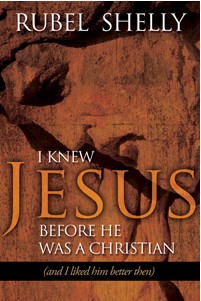
The full title of Rubel Shelly’s book published by Leafwood Publishers (ACU Press) is “I Knew Jesus Before He Was A Christian…and I Liked Him Better Then.” When I was asked to review the book, I was intrigued by the title. As I began to read, it became apparent that the title was not merely cute to boost sales, but was entirely appropriate for the material. Our small group was deciding what book to study next and I suggested this one. Rather than read through it before the group studied it, I waited to review the book in order to include it’s effectiveness for a small group study.

The conclusion is that I Knew Jesus… works well for small groups. Precisely because it compares the original churches to churches now and the Jesus of the Bible to the Jesus nonbelievers perceive to be preached in churches today. The subject is – and should be – on the minds of all church and small group members.

Shelly begins by asserting that we can be both pro-Jesus and pro-church simultaneously. But not as long as a perception exists of disconnect between the two. Changing the perception necessarily requires elimination of the disconnect. The author quotes Stephen King when he wrote, “And while I believe in God, I have no use for organized religion..”

That is what many Christians have heard, unfortunately, far too often. Then there is the oft-quoted “I’m spiritual, but not religious.” In chapter four, Shelly tells the story of author Anne Rice. Rice renounced the Catholic religion at age eighteen. After a series of tragedies, including  the near loss of her life, she renewed her commitment to the Catholic faith. Rice wrote a book about the experience, dedicated herself to “glorifying God,” and launched a series of Christ the Lord books.

On July 28, 2010, Anne Rice posted a statement on her Facebook page that she was giving up Christianity and doing it “in the name of Christ.” She said that she remained committed to Christ as always, but not to being ‘Christian’ or part of Christianity. Rice followed the next day with “my conversion from a pessimistic atheist lost in a world I don’t understand, to an optimistic believer in a universe created and sustained by a loving God is crucial to me. But following Christ does not mean following his followers.”

Which is precisely the point Shelly is making. The Jesus of the Bible – and by extension, of the original churches – is not the Jesus the people of the world see proclaimed by many of today’s churches. We should strive to be more like the Jesus of the Bible than the Jesus we portray through the filter of our organizational structure and polity. Rubel Shelly, in I Knew Jesus…, looks at different aspects of the disconnect and barriers between Jesus and the church. The author challenges and encourages the reader to work toward solutions in their own lives and churches, with questions found in the discussion guide.

Too many people have decided they are done with the church. They do not want to have anything to do with the church. “But you just might get attention with this radical, engaging, challenging, life-transforming, healing, rescuing person named Jesus of Nazareth. In fact, I think it is the only hope we have for communicating with a postmodern world. The best argument is…a living demonstration of kindness and acceptance, grace made incarnate, or love emptying itself for the sake of others.”

In I Knew Jesus Before He was a Christian, Shelly uses real-life and biblical examples to illustrate that while church membership may be declining, there are still souls searching for the life-affirming love of Christ. For a church to be a model of the first Christian churches and the life Christ displayed, they must first exhibit Jesus in the community and participate in ministering to those in need.

Peace be with you.

[I received this book free from Leafwood Publishers for a review. I was not required to write a favorable review.]

The GUSTO! program at King of Glory Lutheran Church (KoG) will be visiting the Museum of Biblical Arts on Tuesday, May 22nd, at 10 a.m. The program is usually held  on Monday, but the museum is closed on Monday. I visited the museum for a Religion Communicators Council  (RCC)  meeting last year. My comments will be after the following description.

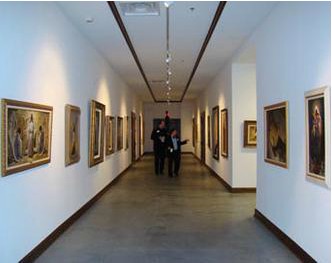
The Museum of Biblical Art, rebuilt after a devastating fire in 2005, is a cultural crossroads using art to promote tolerance and understanding of the humanities and Western culture. The museum today is larger than the original, featuring over 30,000 square feet of expanded art galleries and exhibits. It is located at 7500 Park Lane in Dallas, just west of NorthPark Center.

The museum hosts a broad array of painting and sculpture by premier artists, from Botticelli to John Singer Sargent to Andy Warhol. Its main attraction is a 40-foot wide mural of the Resurrection by internationally known artist Ron DiCianni. There is also an extensive collection of lithographs by Marc Chagall. Other galleries feature Biblical archaeology, Jewish and Israeli art, religious architecture, and African American, Hispanic and contemporary art.

The museum recently acquired a life-size replica of Michelangelo’s “Pietá,” cast in bronze and authorized by the Vatican. It came directly from the Michelangelo Museum in Florence. Another outstanding exhibit is the “Tapestry of the Centuries” mural by Vladimir Gorsky. This monumental painting illustrates the people and events that shaped world history, from the birth of Jesus through 1999 A.D.

The museum is truly fascinating, particularly the exhibits of art from other religions. The  King James Bible exhibit has been extended until June. The exhibit consists of original Bibles from the private collection of Dr. Charles Ryrie. Last year was the 400th anniversary of the King James Bible. I’m looking forward to having time after the tour to properly explore it. The tour does not allow sufficient time to effectively see everything. I was unable to stay after the RCC meeting.

The bus is most likely full at this point, but you can meet at the museum at 9:45 a.m. on Tuesday. Sharon Chapman will collect the $9 admission from each person and pay for the entire group. The tour will conclude with lunch on your own at Northpark Center if you would like. If you plan to meet the group there, e-mail gusto@kingofglory.com or call Sharon Chapman at 214-458-3271. If you do not get a chance to take the tour with the group, be sure to visit the museum on your own when you get the chance. You will not be disappointed.

Peace be with you.