Latest Entries »

Holocaust survivor Dr. Zsuzsanna Ozsváth will talk about her experience as a schoolgirl in Hungary during World War II at 10 a.m. on Monday, January 9 at King of Glory Lutheran Church. The presentation is part of the Gusto!  event series.

Ozsváth and her immediate family survived the final days of the war with the help of her nanny and dear friend, Erzsi, who found food and safe houses for them. More than half a million Hungarian Jews perished between 1941 and 1945 as part of the Nazis’ Final Solution.

Ozsváth recorded her experience in a memoir titled When the Danube Ran Red, which was released last year. She will discuss the events documented in the book and be available to sign copies.

Ozsváth is the Leah and Paul Lewis Chair of Holocaust Studies and professor of literature and history of ideas at the University of Texas at Dallas. She has written extensively about Holocaust literature and the Holocaust in Hungary. She holds music degrees (piano) from Bartók Béla School of Musical Arts and the State Academy of Music at Hamburg. She completed her Ph.D. in German language and literature at the University of Texas.

Come at 9:45 a.m. for coffee and conversation, and join us for a reception to follow the presentation. Everyone is welcome!

Never Forget: Tour of Dallas Holocaust Museum – Monday also begins sign-up for the trip to the Dallas Holocaust Museum/Center for Education and Tolerance on Monday, January 23. The self-guided audio tour will include permanent displays plus a traveling exhibit of children’s artwork from the Terezin ghetto, Czech Republic. Late KoG member Col. Gil Ackerman’s war crimes trial documents will be displayed especially for our group. Bus transportation and carpooling will be available. Cost is $6 at the door. The museum is located at 211 N. Record St. in downtown Dallas. More information is at www.kingofglory.com/gusto.

——– From the Gusto! media staff.

Peace be with you.

Happy New Year everyone, and I hope you had a wonderful Christmas! The past year was interesting, to say the least, for all of us. I do not make New Year’s resolutions, but I do set goals for the year ahead. There are the usual health related goals: walk more, eat better, and adjust the daily schedule. And the Christian goals: give more, use less, better Bible study, and more mission work. As well as the harder ones: be more sensitive to others’ needs and less attentive to my own, be more considerate and less quick to anger. Lastly, the writing related productivity goals: post more, write more, and publish more.

I will reach some of the goals. I may even surpass a few. Unfortunately, however, I am afraid that I may fall considerably short with others. But that does not mean I will cease attempting to accomplish them. Some of the goals I’ve been working on for years. One of these years, maybe I’ll accomplish all goals across the board. But then there will be more goals to work toward.

Whether you make new year’s resolutions, set goals for the year, or do not dwell on it at all, I hope the year goes well for you. A new year brings new experiences, new opportunities, and new chances to improve our lives. May God watch over you and bless you with grace.

Happy New Year! – peace be with you.

When God Seems Absent

There is a rock in the flower bed outside the office door to the backyard. If you glance at it quickly, and use your imagination, it looks like a heart. If you look closer, it still resembles a heart – just a little misshapen. Each day I walk outside (except during inclement weather), I glance over at the rock and take comfort from its presence.

I cannot remember when I saw it for the first time, but I remember seeing it for the first time. It was not one of my better days and seeing the rock cheered me up. I thought it was there for me. A sign that God was with me.

Part of me feels a little silly getting comfort from a seemingly random vaguely heart-shaped rock. Regardless, I still feel that comfort. On a difficult day, when everyone seems to have me in their sights, the rock is still there. Letting me know I am never completely alone.

Then one day last week the rock was gone. There was an indentation in the flower bed where the rock had been. It had rained recently, but there was no corresponding deposit of soil. Our dog, Misty, often buries food and digs it back up later. Cyndy and I thought we knew most of her spots, and she usually covers it back up. Regardless of the reason, the rock was gone.

I felt lost. Which I feel rather silly admitting, but it is true. I walked around in circles, looking for where it might have ended up. The day did not seem right without the rock in its proper place. The rock had been a sign of hope. Was its absence a sign of the opposite? My mood was altered without a discernible reason.

The temperature was beginning to get colder. I would kick around and peer through the grass and leaves, but it was not a thorough search. I would tell myself that it really was not worth it and I would just have to get used to it not being there. But the feeling of emptiness did not go away. When I went back outside, I found myself circling the area again, with the scenario repeating itself.

A few days ago I was searching again – closer this time – and dug up a couple of rocks. I felt around and dug a little further. I do not know what caught my eye or caused me to dig where I did. But there was the heart-shaped rock. I placed it back up in a place of relative prominence near the bricks that border the flowerbed.

I do not know if the rock is from God, but I would like to think he is using the rock – so to speak – to get a message across. If not to me, then through me, by my telling of the story. But I do know that there is a message here – one way or the other.

We tend to take God for granted. We see the signs, and feel strangely warmed, but we simply come to expect them rather than appreciate them. We do not take time to thank God for the grace he bestows upon us. We take the fact that God is always with us, no matter what we do, way too literally. We forget our part of the covenant.

Then something happens and we think God is not there. We walk around in circles, looking for him. We shuffle the grass and leaves wondering where he could be. Then we get desperate, praying that we will find him. After digging a little bit, putting forth effort and praying, God makes himself known to us. Letting us know he never actually left us in the first place. He did not fail us. We failed to live up to the faith God has in us.

Peace be with you.

He walked through the streets in darkness,

Homeless but not alone,

A man on a mission of reverence

beyond the mundane chore of survival,

in a spirit of grace and mercy.

___

He stopped at Johnson’s Laundry

With it’s Closed for Christmas sign,

He knelt on the sidewalk outside the door,

Quietly saying the Lord’s Prayer,

the only prayer he knew.

___

Thanking “Papa” Johnson

For the clothes left unclaimed,

He left a small package – a crude, homemade cross

With a card on which was scrawled,

“Merry Christmas, from Jesus.”

___

Next was Garcia’s Grocery

For the leftovers not yet spoiled

He knelt and prayed –

Another crude cross,

And the card, “Merry Christmas, from Jesus.”

___

Ten blocks later, Miller’s Hardware,

For his sturdy, cardboard box dwelling,

and timber for his bed,

A kneel, a prayer, a larger crude cross,

And the card, “Merry Christmas, from Jesus.”

___

Too far from home, the mission closed,

He found a bench in the park,

after a passerby bought coffee

and he walked – recalling forgotten memories –

without knowing what they meant.

___

Early the next morning on Christmas Day,

he fought the wind and rain,

through the cold streets to the mission,

where Christmas dinner was served, the soul sustained,

and life again had purpose.

___

The rain stopped, the wind died down,

as he trekked on home,

home – an alley behind the church

white and made of stone,

with a view of the cross on the wall.

___

He turned into the alley

and stopped in his tracks.

Where his cardboard box had stood,

was a sturdy lumber shack,

with a roof, a window, and a door.

___

He opened the door to a sturdy wooden cot,

An orange crate table, his few possessions inside,

with something new on top.

A suit of clothes hung on a hook,

with the laundry marker still on it.

___

He closed the door because he could,

he’d forgotten what it felt like.

Walking to the table he turned on the lamp,

it had been years since he had his own light,

but then his breath went away.

___

Also on the table sat a Bible, brand new,

inscribed with a name he hadn’t used in years,

next to a picture of a family he’d forgotten he had.

He stood staring at them, his mind racing,

memories bombarding his thoughts.

___

He sat on the cot and picked up the Bible,

after staring at the picture a while.

He ran his fingers over the only thing he owned

that wasn’t worn by wear or weather,

with emotions he couldn’t control.

___

Through tears, with shaking hands,

he opened the Bible and read

“Merry Christmas, from Jesus.”

___________________________

© 2009  Daniel L. Roark

Merry Christmas!

Peace be with you.

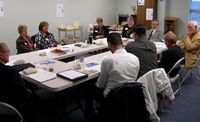
What do an alumni e-newsletter, a Holocaust museum, and gusto have in common? They are past, current, and ongoing projects of RCC D-FW Chapter members. The December DFW Chapter meeting, held this year at Christ UMC in Farmers Branch, is traditionally a time of sharing the year’s accomplishments and trials. The Chapter furnished the lunch and presented each member with a gift (chocolate covered pecans). Members shared samples of their best work, some of which they are considering entering in next year’s DeRose-Hinkhouse Memorial Awards, to be awarded at the RCC Convention in April in Philadelphia.

Alice Dykeman, of Dykeman Associates, Inc., discussed her past year’s work. Her current intern, Emrah Yildiz, is no stranger to the group, having attended meetings for several months. Dykeman also introduced her guest, Reverend Charles Curliss. Rev. Curliss is founder and pastor of The One Church. Debbie Tull, marketing and advertising consultant, brought the group up to date on her work at Patheos.com. Patheos.com is the premier online destination to engage in the global dialogue about religion and spirituality and to explore and experience the world’s beliefs.” Tull explained that, in an effort to be all-inclusive, the website has recently added an atheist channel. They also created Patheos Press to publish e-books. The site has titles already available.

Tim McLemore, Associate Director of Public Affairs at Perkins School of Theology, presented each member with a Perkins marketing eco-sack containing a folder with informational brochures. The Begin Your Journey With Us brochure, a recent addition introducing the school to potential students, illustrates the diversity among faculty and students. McLemore displayed the Perkins website, concentrating on the alumni pages – specifically, the Perkins Precis, an e-newsletter for Perkins alumni/ae. Even before he took the page and e-newsletter live, McLemore was contacted by alumni who had searched on Google, found the page, and asked to be put on the list.

Chris Kelley, principal of The Kelley Group and PR Consultant with the Dallas Holocaust Museum, provided clips from the video of his interview with Frank Risch. Risch was the 2011 Honoree at the museum’s Hope for Humanity dinner. His parents, Herbert and Irma Risch, fled Nazi Germany in 1937 to escape the Holocaust. Risch has been a member of the Board of Directors of the Dallas Holocaust Museum/Center for Education and Tolerance (DHM/CET) for nearly twenty years. “He has been instrumental in transforming the organization from a memorial and resource center located in the Jewish Community Center to a creative museum in the West End Historic District.” The clips were emotionally moving, leaving the room in momentary silence.

Kay Champagne shared the work she and fellow chapter member, Sharon Chapman, have been doing to market the King Of Glory (KOG) Lutheran Church’s Gusto! series. “Gusto! Is a Life Group at KOG for the mature adult community (all are welcome) that creates and promotes enrichment programs that stimulate intellectual growth and expand personal interactions in a supportive and nurturing Christian environment.” Past guest speakers were Martin Marty, Walter Brueggemann, and a series of speakers on Dwight D. Eisenhower. A Holocaust survivor will speak in January, and the group will visit the Dallas Holocaust Museum in February.

During lunch, between small talk and presentations, members of the group discussed the changes in communications methods over the years. From the manual typewriter and mimeograph machines to bulky pcs running on MS-DOS and floppy discs to smartphones that have more power than previous mainframe computers. Several members admitted to still having outdated equipment in a closet or garage. Yet reminiscence is not indicative of a willingness to re-live the times discussed. It is simply a fondness for days that, while they were perhaps simpler, were also the stepping stones to the lives we know and enjoy now.

The meeting was an appropriate ending to the year. It went over the allotted time, due to the continually interesting conversations. Members shared pride and appreciation for past accomplishments as well as excitement for current and future projects. Members left with smiles and exclamations of Merry Christmas or Happy Holidays, looking forward to another year in the world of communication.

Peace be with you.

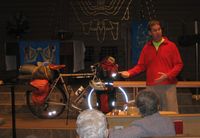
In 2010, at age 49, Bruce Moore quit his job and spent three months cycling the TransAmerica Trail from Virginia to Oregon. Moore shared pictures, memories, and learning experiences from the trip with the group at the December meeting of King of Glory Lutheran Church’s GUSTO! program on Monday. Following corrective heart surgery in 2009 for a previously undiagnosed pediatric condition, Moore became determined to accomplish his three main goals. Having cycled in college, he wanted to bike across the country. He also wanted to write a book and start his own company.

After planning and preparing all winter, and training during the spring, Moore departed from  Yorktown, Virginia on May 8. As he told the audience, the journey took 93 days. Moore rode  4,105 miles, riding for 79 days with 14 days rest. While he traveled by himself, with his wife, Kristin, meeting him a few times along the way, he was rarely alone.

Moore shared pictures and stories of fellow cyclists with whom he had ridden, as well as good Samaritans along the route who welcomed the travelers, giving them water, treats, and shelter for the night. One woman has been serving water, lemonade, cookies, and shelter to cyclists on the TransAmerica Trail for many of its 35 years of existence. The trail was mapped out in 1976 for the Bicentennial. Six thousand riders made the trip that first year. About 500 cyclists make the trek each year, some eastward bound and others headed westward.

An entertaining speaker, Bruce Moore described being dive-bombed by a hawk, seeing nothing in either rearview mirror but a huge wing. He spoke of the lack of vegetables in rural areas. Of being welcomed by three churches along the way whose congregations had formed a ministry to welcome cyclists traveling along the trail. Of his habit of eating at local diners for social interaction and friendly smiles.

On August 8, after 4,105 miles, 42 nights camping, 42 nights in hotels, 6 nights in hostels, and 3 nights in churches, Moore met Kristin in Florence, Oregon. He dipped his front wheel in the Pacific Ocean, having dipped his rear wheel in the Atlantic three months earlier, completing the journey from sea to shining sea. Moore launched his own software company upon returning to Dallas. Counting the blog as a book, he accomplished all three goals. He is now working on other goals.

Bruce Moore’s cycling adventure also raised funds for the National Multiple Sclerosis Society. His blog may be found here.

Peace be with you.

The Dartboard Incident

My family lived in Waco, Texas when I began attending elementary school. I had a friend whose family lived in one of the largest homes of anyone I have personally known. Although it might not seem as expansive now. While I do not remember his name (I’ll call him Rick) or how we became acquainted, I distinctly remember parts of the house and activities we were involved in. There were parts of the house I never saw.

There were small enclosed stairs at the back entrance – or one of the back entrances – that led to a small, seemingly hidden room on the second floor, and a larger room on the third floor. The smaller room was a reading room of sorts, and I think that the larger room was the entirety of the third floor. The only access to the rest of the house was through a short hall on the second floor leading from the stairs and reading room. The larger room had a large tv – for the time – an easy chair, a sofa, a coffee table, and little else I cared about noticing at the time.

Behind the easy chair was a cardboard box about 3’x3’x3′ that was always at least half full of candy of all sorts. When I spent the night at Rick’s house, we would wake up early and walk to what I think was one of the first 7-11s. Either way, it opened at 7 a.m. and closed at 11 p.m. If we were up before six, we would play in the large pile of dirt in the middle of the construction site next door to the convenience store.

At the store we would buy a bunch of candy, take it back to Rick’s house, and add it to the candy in the cardboard box. After a couple of visits, I discovered that Rick had rules for the box of candy. Regardless of how much candy I put in the box, I could only take out one piece at a time. And not whenever I wanted to. I did not contribute to the stash of candy after that.

On one such sleepover, the two of us were in the short hallway between the reading room and the door to the rest of the house – which was closed. On the back of the door was a dart board. Rick was being cruel for some reason and would not let me have a turn at throwing darts. Which was not how I had been taught to treat a guest.

I protested for what seemed to me like a good while. Certainly longer than I thought it should take to get my turn at darts. Exasperated, I stood in front of the dartboard with my hands out, telling him I would not move until he gave me the darts. I was not all that confident after Rick told me if I did not move he was going to throw a dart anyway. The interchange repeated several times. Until he threw the dart into the palm of my hand. I stood there with a dart sticking out of my palm, staring at him in disbelief, asking him why he would do that.

“You should have moved,” Rick said as he snickered and shrugged his shoulders.

My hand did not hurt until after I pulled the dart out. Then it stung considerably. I do not recall staying at Rick’s house after that. I may have, but if I did, it was never the same. The trust was no longer present. Granted, I might have continued protesting without standing in front of the dartboard, but that was having little effect. Then again, he could have been a kind host and let me take a turn. He also never apologized.

I was beginning to learn that not everyone lived – or tried to live – by the golden rule. Or by “loving thy neighbors as thyself” as the Bible says. I was also beginning to be the recipient of looks and remarks when I stuttered. I had often heard people say that I would grow out of my stuttering. Since that was beginning to look less and less likely, people were beginning to assume that something was wrong with me. I was certainly not normal. While I was used to snide remarks and looks, physical pain at the purposeful hand of another was something new. As to the dart situation, it was difficult to ascertain which hurt more – my pride or my hand.

Through the years, I have seen, and heard of, people making a sheer mockery of the golden rule. I have also learned how difficult the golden rule is to follow. I have long since forgiven Rick. I do not even remember his right name or the pain of the dart in my hand. Regardless of the difficulty, I keep trying to treat others as I want them to treat me. But I keep track of my own candy and I do not play darts anymore.

Peace be with you.

There are no pessimists on the TransAmerica Trail. That’s the conclusion of Bruce Moore, a King of Glory (KOG) member who spent a summer biking across America. Moore will share memories and photos of his three-month trek at King O f Glory Lutheran’s  GUSTO! meeting on Monday, December 12, at 10 a.m.

In 2010, at age 49, Moore quit his job and embarked on a bicycle tour from the Atlantic to the Pacific Ocean. He left Yorktown, Virginia, on May 8. Three months, eight flat tires, two bike chains, a bunch of hot days and cold nights, a hailstorm, and more than a few cold showers later, he arrived in Florence, Oregon—a trip of 4,100 miles.

Moore camped four or five nights a week and stayed in motels the other two or three—when he needed to do laundry, when it was raining, or when it was over 95 degrees. He blogged the entire trip, followed online by many friends and King of Glory members back home. His ride raised funds for the National Multiple Sclerosis Society.

Moore will talk about his journey—both physical and mental—and about how our society grossly undervalues shelter, cold water, hot water, vegetables, and high quality toilet paper. He’ll have stories about some of the places he visited and people he met—stories that will make you laugh, cry, and think. He’ll also bring a loaded bike to give a flavor of his trek.

At the end of his biking adventure, Moore launched his own mathematical modeling software and consulting business. He continues to be an active member of King of Glory.

Come at 9:45 a.m. for coffee and conversation, and join us for a reception after the presentation. Everyone is welcome!  The sanctuary can be chilly at this time of year. We recommend you bring a sweater or coat.

[From the KOG Gusto! staff]

Peace be with you.

 Tyndale House Publishers is having an NLT Facebook page giveaway. Here are the details:

Starting on November 29th until December 24th at the New Living Translation Facebook page Tyndale is giving away lots of great prizes and something free for you just for singing up.

By visiting the giveaway entry page (located on the NLT Facebook page, the link is under the profile picture) and entering your name and e-mail address you’ll be entered to win the following prizes:

One random person each day will win a Life Application Study Bible Family Pack (Guys Life Application Study Bible hc, Girls Life Application Study Bible hc, Student’s Life Application Study Bible hc, Life Application Study Bible hc, Life Application Study Bible Large Print hc).

One Random person each week will win an Apple iPad 2!

Everyone that signs up gets a free download copy of the Life Application Bible Study – Book of Luke!

Good luck!

Peace be with you.

Will journalism survive the digital age? If it does, what will it look like? Will it be profitable or subsidized? These were the questions discussed by the panel that included David Sedeno, editor of The Texas Catholic/El Catolico de Texas, Sam Hodges, managing editor of the United Methodist Reporter (UMR), and Jeff Weiss, reporter (and past religion writer) for the Dallas Morning News (DMN). The journalists were speaking to members of the Dallas-Ft. Worth Chapter of the Religion Communicators Council (RCC) at their October meeting, held at Christ United Methodist Church, Farmers Branch.

Moderating the informal discussion was Cherrie Graham, Chapter President and advertising manager at UMR. “Looking at the first question, Will journalism survive? Well, it has to, it doesn’t have any other choice.” The question is not will it survive, but how will it survive?”

During his response to the question, David Sedeno discussed the elements for successful publications in today’s media environment. “Let’s not give up on printed product yet, in terms of niche [religion] publications. The four things I look at [for success of print publications] are content – not content as content, it has to be relevant. So the second thing is relevance. The third, obviously, is technology. You have to take a look at the capabilities you have to extend your reach. The third, and probably the most important one, is partnerships.” Sedeno went on to explore the avenues of partnership.

Media applications on tablets are partnerships, using advertising from both sources to affect the financial outcome. In 2001, DMN entered into a partnership with a website in Mexico that wanted their content to translate into Spanish. Which illustrates not only a partnership, but content that is relevant to readership. Sedeno added that while he does not think that paper products will come to an end, “tablets are certainly taking a big bite out of everything.” Tablets are portable and you can take them places you couldn’t take a laptop. In addition, the applications open up new avenues of revenue. But it all goes back to content that is relevant, and partnerships.

Jeff Weiss, “the only one [of the three panelists] still employed by the Dallas Morning News,” began by saying that when he woke up that morning, “it was cold and wet.” “I picked up my iPad…and opened the e-edition of DMN and it looks exactly like the print version. And that’s how I have increasingly read the newspaper. I’ve been comfortable with the title ‘content producer’ long before some of my colleagues were. Because that’s what I do – I generate content.” Addressing the religion communicators directly, Weiss stated that with fewer and fewer people and less and less money, mainstream media has a smaller and smaller stream of what they can cover. “Which makes what religion publications do so much more important to their target audiences and people who want to get the word out for them.”

In response to the question – how will journalism be paid for – Weiss stated that he does not know “where we (Dallas Morning News) will be in five years time.” The newspaper continually has less people and less content while asking people to pay more for it. “At a certain point, we can no longer be producing enough content that people will be willing to pay to read it.”

“Are we there yet?” Weiss asked. “I don’t think we are. Even in its diminished form the Dallas Morning News is still producing way more general content than anybody else in the area. And there is still an audience for that. And as a business proposition, we have more advertising dollars than anyone else in the area. So advertisers are going to be willing to pay for that as long as they see results.” While he is fairly certain that he could make a decent living writing for online publications and websites, he would not receive the benefits that he does with DMN.

“I think the larger truth, that David was speaking to, and Jeff, too, is the decline of mass media and an era of fragmentation,” said Sam Hodges. “It’s a wild frontier out there. And I think journalistically there are advantages to having fewer gate-keepers, and some real disadvantages. I think the question mark is the economic model. What underwrites professional journalism, the gathering of news, analysis, etc.?

The world is becoming flat and also fragmented at the same time. You can communicate instantly with anybody in the world and yet we all seem to be in our little villages at the same time. If you are passionately interested about [a particular subject] there is something on the web that will satisfy you. Journalism might be part of a bigger shift in American life that disadvantages the middle class.

Because, it seems to me, that we had an era where what went away were pension plans. What you got next were 401K plans, and then, suddenly, employers weren’t contributing to 401K plans anymore. And now I think phase three is that salaried, benefitted jobs, especially in journalism, are going to continue to decline. You’ll have people working as freelance writers or maybe on contract and they’re responsible for their own benefits and vacation pay.”

While the discussion was lively and informative, there were few clear answers. Religion and niche publications have a more secure future than mainstream media, but what form that future may take is still an unknown factor. The emphasis, however, will be on adjusting focus to attract succeeding generations in a changing world, such as The Texas Catholic’s Texas Catholic Football publication to engage the younger generation. As well as broadening the options available, like UMR, with advertising partners and printing services. But the future of journalism will still depend on what has kept it alive and vibrant for years. Content, relevance of that content, technology, and partnerships.

Peace be with you.