Latest Entries »

September Meeting

The Future of Journalism will be the subject of the October  meeting of the Dallas-Ft. Worth Chapter of the Religion Communicators Council (RCC), an interfaith organization. The presentation will be a panel discussion with panelists including Sam Hodges, managing editor of The United Methodist Reporter, David Sedeño, editor of the Texas Catholic / El Católico de Texas, and Jeff Weiss, long-time reporter and religion writer for the Dallas Morning News. Also invited is Jake Batsell, assistant professor for digital journalism at SMU. Providing additional input (although a schedule conflict precludes his attendance) is Ken Camp, managing editor of The Baptist Standard.

Questions to be considered include:

Will journalism will survive the digital age? If so, what will it look like or in what form?

How will journalism be paid for? Is it possible to make a profit or will it be a non-profit or subsidized “public good”?

Will the news be good? Why?

The meeting will be held at Christ United Methodist Church in Farmers Branch on Thursday, Oct. 27 from 12 – 1:30 p.m. The $15 fee will include lunch. Please email or call Deb Christian, RCC Secretary, at dchristian@umr.org, 214.630.6495 x147 by Monday, Oct. 24 to make reservations. Bring your own thoughts and answers to these timely, pertinent questions.

I will be the host for the meeting. The discussions are always lively and informative with timely, relevant topics. This particular topic is of major concern to communicators, journalists, and writers as we look forward to the future with technological advances, social media, blogs, news feeds, etc.

Peace be with you.

Which is safer, bottled water or tap water? Who or what causes over 85 percent of the lung-damaging ozone air pollution in the D/FW area? How is your “rain tax” used? What is the rain tax? Myron Knudson, Senior Policy Advisor of the Environmental Protection Agency, will answer these and other questions at King of Glory Lutheran on Monday, October 10 at 10 a.m. as part of the Gusto! event series. Coffee and conversation will be served at 9:45 a.m.

Knudson will discuss health and environmental conditions in the D/FW Metroplex relating to air and water quality. How can we trust that these life-giving essentials—air and water— will not harm us? Knudson is senior policy advisor to the EPA’s regional administrator. He is a 40-year veteran of the EPA, serving as director of the surveillance and analysis division, the water management division, and the Superfund division. He has held his present position since 2003. Before joining the EPA, he worked for the U.S. Public Health Service and the Federal Water Pollution Control Administration.

The Gusto! Series, presented by King of Glory Lutheran Church, began its 2011-2012 series on Wednesday, September 7th, at 2 p.m. by attending Theatre Three for a production of Wild Oats. The events continued on Monday, September 12th at 10 a.m. with Jac Alder, Executive Producer-Director of Theatre Three presenting 50 Years in the Round: Jac Alder and Theatre Three. GUSTO! programs are diverse and designed to stimulate intellectual growth and expand personal interactions in a Christian environment.

Although GUSTO!’s programs are directed primarily at mature adults and retired and semi-retired people, all are welcome to attend. Activities focus on intriguing topics that inspire learning, follow-up activities that explore special interests, and opportunities to share skills, talents and life experiences. GUSTO! meets regularly at the church on the second Monday of each month, September through May. Additional field trips, workshops and special events are offered at other times during the month. Guests are always welcome.

Peace be with you.

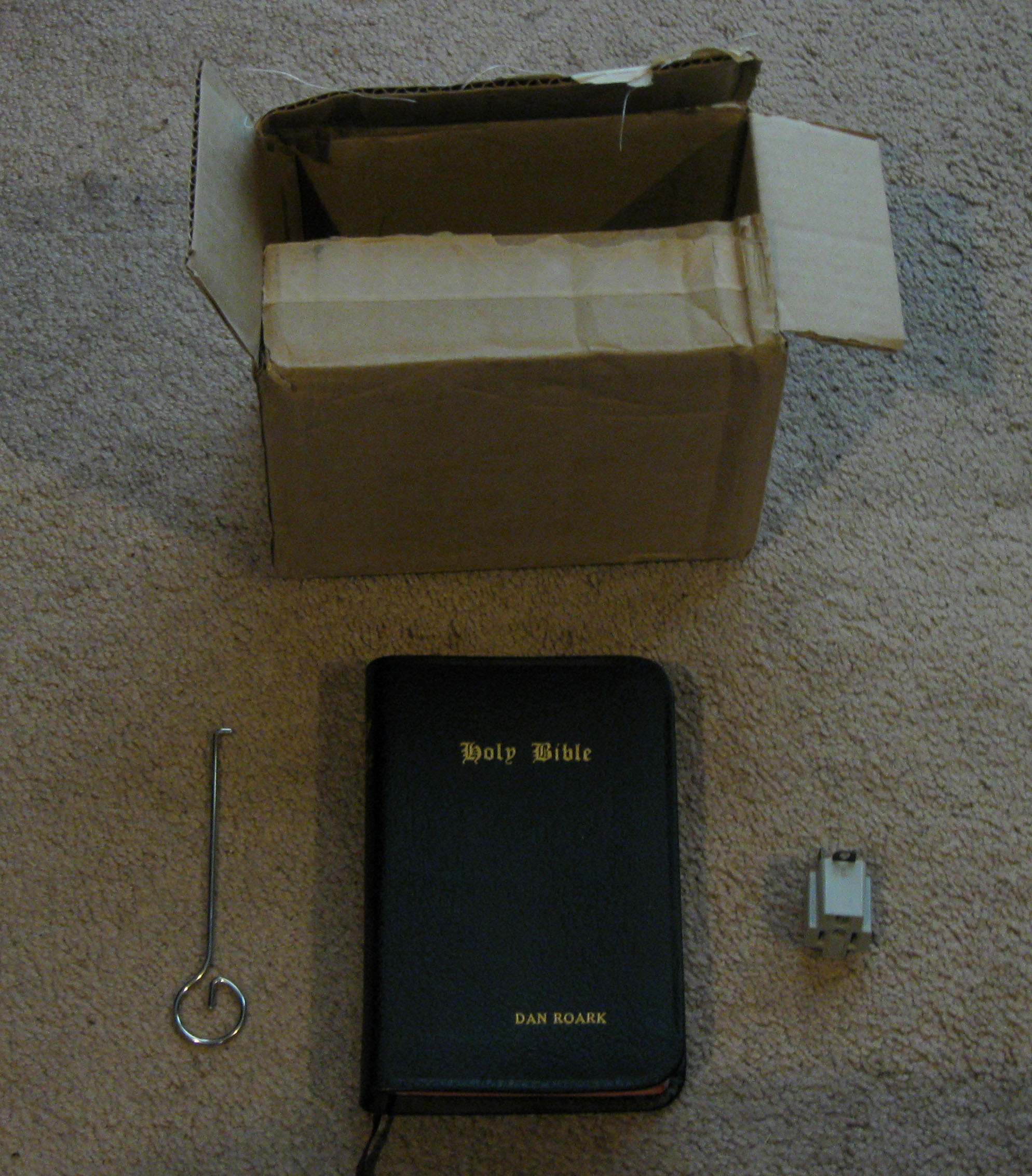
There are a number of boxes, gadgets, and doohickies in our shed, closets, and drawers that we have kept because they “might be useful some day.” They just sit there waiting – hoping that someday they fulfill their purpose – useless until useful. I walked out into the backyard this morning and discovered that Cyndy found a use for a box I decided to hang on to a few days ago. The box had acquired a secondary purpose. Like the doohickey – or thing-of-a-jig – that becomes the perfect “tool” to complete an odd job around the house.

Once a “might be useful someday” object serves a purpose it is no longer possibly useful. It is indispensable. It can collect dust for years, but it will not be thrown away. On the premise that because it has been useful once – or twice as the case may be – it will inevitably be useful again. Even though that might not be the case.

I have found that for some people, and some Christians, the Bible is simply one of those things to have around because it might be useful some day. They take it to church on Sunday if they remember it. “After all, they have one in the pew.” Then they never actual open it. Why bother when the lay reader is reading it to them. And the preacher will remind them if their thoughts happen to drift.

But – sure enough – a time comes when their Bible becomes useful. Tragedy strikes family or friends. A job is lost, a relationship ends, or any one of any number of life-changing events occur. Then their Bible again has purpose. It eases their mind, softens their heart, soothes their soul, or simply provides comfort. Their Bible has become indispensable.

Unfortunately, there are too many Christians to whom the Bible is something waiting to be useful. They have not discovered the life-changing story of the Israelite’s history, the life and death on the cross of Jesus, or the forgiving grace of God. They have not felt their “heart strangely warmed” as John Wesley did. They have not had their souls cleansed with God’s grace.

With persecuted Christians around the world clamoring for Bibles and materials to continue their spiritual journey with Christ, it is sad that many Christians in our part of the world have a Bible that they never use. I have had a Bible – and have been a Christian – for as long as I can remember. Beginning with the pocket-size New Testament I received when I began attending Sunday school. I have always had a Bible at hand. Unfortunately though, there were times when I felt I was keeping it around “in case it was useful.”

When I finally felt the Lord’s nudging and again opened my Bible for study and prayer, I ceased to think of the Bible as being “potential useful.” It is a part of my day, my life, my profession, and our family life. I feel uncomfortable when too much time has passed since our last visit. The Bible, once thought of as potentially useful, has become indispensable.

“In the beginning was the Word, and the Word was with God, and the Word was God.” John 1:1 NRSV.

Peace be with you.

I was walking to our sons’ school with the youngest son’s football gear stuffed in my backpack. Cyndy was running errands after dropping them off at school. In the waking up atmosphere of sleepy-eyed confusion in which things can slip teenage minds, J.D. had forgotten his gear on the couch. Of course, he had to have it right away. It was a hot and fairly humid day. Which was not conducive to walking long distances on sidewalks with slight, intermittent, shade.

When I am walking, I watch the ground ahead of me – for several reasons. For one thing, I walk quickly which requires watching the terrain. And by watching the ground ahead of me, I am not constantly reminded of how far away my goal is at any given time. I have also found a large number of coins over the years (albeit mostly pennies).

I walk in long strides, setting up a quick rhythm. Inevitably, I set my stride with the aim of missing the cracks in the sidewalk. Lengthening my stride when the situation requires it. At some point the superstition of my youth slips through – bringing to mind the phrase we used to say.

“Step on a crack, break your mother’s back.”

Do I believe it? Not really. Do I avoid the cracks? You betcha – just to be on the safe side. And I will have you know that to this day my mother has not broken her back. A few other things maybe, but not her back. I will also have you know that I do not think my avoiding cracks had a thing to do with it.

Yet, as I was walking to my son’s school, I was avoiding the cracks. Mostly to set up a rhythm in my stride, but avoiding the cracks nonetheless. That got me to thinking – as walking is wont to do – about avoiding cracks and hedging bets.

As a general rule, I can set a rhythm or pace and move quickly along while still avoiding the cracks. As we as Christians can go about our life in the secular world, avoiding the larger, more obvious sins. But then I come across a section of sidewalk – or life – that has begun to show wear, causing a conundrum. There are so many cracks that even a hop-scotch afficionado would have trouble traversing the area.

So which cracks count in the break your mother’s back scenario? If it is a natural part of the sidewalk which was purposefully made that way, is that considered a crack? Is it just the cracks that have developed over time from wear and weather that count? Or do all cracks count, causing the situation to be crucially problematic?

In our Christian lives the question – considering the cracks as sins – is which sins to avoid. Which cracks are actually sins? And which cracks are part of the sidewalk as it was made? When we come to the section with too many cracks to avoid them all, which do we choose not to avoid?

We are human and cannot avoid all sin. And not all the cracks in life’s sidewalk are sins. Some cracks are merely faults in the sidewalk. Fortunately, “step on a crack, break your mother’s back” is just a game. Unfortunately, life is not a game. Even though it might seem that way at one time or another. Some of the cracks we try to cross in life are wider and deeper than we could have imagined.

When we reach those rough spots in life’s sidewalk, we wonder if we took the wrong path – if we are on the wrong sidewalk. We are unsure which cracks to avoid and which cracks are okay to step on. What false idols we have succumbed to and need to avoid, and what we should be embracing more than we are.

During those times of rough spots, when our paths reach too many cracks in the sidewalk and other obstacles, we need to recall what Paul said to the Corinthians. “No testing has overtaken you that is not common to everyone. God is faithful, and he will not let you be tested beyond your strength, but with the testing he will also provide the way out so that you may be able to endure it.” Corinthians 10:13.

As we walk along life’s sidewalk, we need to put our faith in God, and trust the path we take. By the grace of God we make it to the end of the sidewalk.

 Peace be with you.

Being Between Holes

Occasionally, I begin to notice that I keep adjusting my belt. It is not due to a major shift in my weight. I weigh about the same as I did in high school – give or take five pounds at any given time. And I am way past high school. 

When I buy a belt, it fits snugly. Maybe right after my jeans have been washed, the belt might feel a little loose, but when my jeans work back out, it fits fine again. Inevitably, at some point in time, I begin to notice that I need to tighten up the belt a little. But sure enough, when I try to tighten it, I find that I cannot do so without discomfort. I find that I am once again in my personal twilight zone of being “between holes.”

When I bought the belt I had a two hole leeway. Both worked okay, but one a little better. Where did that leeway go? Okay, the belt is leather and leather will flex a bit after time – I get that. And jeans tighten and loosen – I get that, too. But the holes are the same distance apart they always were – within a fraction of an inch. And although I am at the age that my body is beginning to shift, it has not as yet affected my waist.

It is not a recent occurrence. The situation is the same with our son’s belts – when they wear them. Many times I have taken out my pocket knife and fashioned a new hole in a belt. But that is only a temporary solution and does not work for any thing resembling a formal event. And, unlike the original holes, it tends to grow, sometimes splitting the belt in the middle to the next original hole or simply splitting it in half.

Unfortunately, it is not a problem for which I think there will be an easy solution. But it did get me to thinking about the times in our lives when we find ourselves “between holes.” We receive life with all the right holes – with a two hole leeway. We keep going back and forth between one hole and another. Because we do not keep on a steady path, our faith stretches, the human factors flex, and we find we need another hole. Which we try to make ourselves. But the holes we make are inferior to the original holes and do not stand up to wear and tear.

The “between hole” theory can apply to our bodies, the planet, and our faith. We take what we are given, as perfect as it can be, and flex it, stretch it, use it, and abuse it until we suddenly find ourselves between holes. Then we think we can solve it on our own. We make another hole. But our solutions are only temporary and usually do not stand the test of time.

We need to work within the boundaries of what we were originally given. Stay within limits and follow the path we know we ought to and take care of what we have been given. We should listen to the Lord and demonstrate – toward others and our planet – a “love that comes from a pure heart, a good conscience, and sincere faith.” 1st Timothy 1:5.  

Peace be with you.

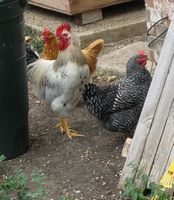
There is a rooster next door. Which would be insignificant if we lived in the country, but that is not the case. The family thought they were buying a third hen. I am not quite sure how that worked, but I have to assume it is possible. The rooster is apparently not so sure himself that he is, indeed, a rooster. His crowing has not been tremendously loud – though still annoying – but it is also not refined. He almost sounds hoarse.

I do not know whether it is attributed to his lack of experience or his cognitive insufficiency, but this rooster has no idea when he is supposed to crow. While he does crow in the morning, the crowing does not coincide with the rising of the sun. He is also prone to crow at any time of day, particularly if the hens are clucking. He began crowing about 11:30 the other night. Apparently, to this rooster, porch lights, airplane lights, or even lightning bugs resemble the sunrise to our neighboring rooster.

The rooster’s annoying crowing got me to thinking that we all go about our daily lives “crowing” about insensitive drivers, people who will not put their phones on vibrate during meetings or services, those who make us wait for no apparent reason, and the person who looks at us as if it is our fault when we know darn well it certainly is not. At the same time, we pray, and ask for God’s help to get us through some – ultimately at least – minuscule situation. A situation which must appear to God as relatively insignificant as those fleeting incidents that tick us off during the day.

All of us must admit that we know someone who constantly crows. About how good a Christian they are perhaps. About how they do not understand why people do not see things their way. And so on and so forth. Unfortunately, we must also admit that we do some crowing ourselves.

When it occurs to me – often in mid-sentence – that I am crowing on, shall we say, I try to quickly change course. After, that is, finishing the sentence that gave my mouth a bad taste. If I tarried too long over the line, my face goes flush with embarrassment. At least it feels like it does. I can recall times in which it was evident in the look on the listener’s face that I had indeed blushed. Their look also let me know that I had been caught crowing. Which made me want to become part of floor and slide away.

Maybe the rooster’s crowing irritates me because he reminds me how irritating I can be sometimes. Even though I’m not the only one he irritates with his incessant shouting. But when I am walking around the backyard complaining out loud about the people who bothered me throughout the day, I feel my face slowly become flushed. If I could see God’s face, I would see that knowing look. The look that makes me realize the only one I am fooling is myself. I am merely crowing needlessly. It then occurs to me that praying sincerely might be a good idea.

Peace be with you.

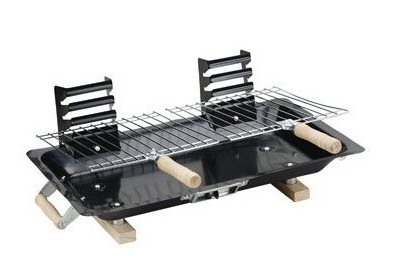
When I was a single father, and my daughter was at her grandparent’s house, I fixed a steak on the small hibachi on the front porch. It was a covered wooden porch but the roof was ten feet high and, like I say, it was a small hibachi. The steak I was cooking covered a majority of its surface area. When the steak was ready, I ate it along with the vegetables I had fixed, then put the dishes in the sink. All the while the front door was wide open.

I laid down on the couch, the left two feet of which faced the front door, and fell asleep watching television. At some point, I was awoken from a deep sleep to the foggy place in between deep sleep and fully awake. I heard a sound, some running steps, and doors slamming. I got on my feet, clawing through the fog, and headed for the open door. I watched the car pull away.

The hibachi was gone. Which was not a tragic loss – I had not paid much for it. But there had been burning coals and ashes in it! I looked around on the porch and over the side where I figured they would dump it. There were, however, no ashes to be found. Not even between the porch and the middle of the street. The two young men had just shoved a grill with a burning fire in their car.

As I stood there looking in the direction in which they had driven and shaking my head, I had a vision of these two guys driving around with steaks, looking for a grill to cook them on. In my mind I saw them driving to a park, pulling out the hibachi and blowing on the coals to cook their steaks. Why else would they take a cheap hibachi costing less than fifteen dollars – with a fire in it no less? It is doubtful they were looking for a grill for their family.

Most likely they were just stealing it for a prank. When they realized it had burning embers in it they did not have time to dump them out before escaping, as it were, in their car. But did they dare each other? Remember, I had the front door open and was laying on the couch facing the door (albeit asleep). What about the hibachi was worth taking the chances they took? Had I thought fast enough, and cared about the hibachi enough, I could have read the number on their license plate.

Thinking back on the occasion, the situation calls to mind those times when we commit sins and think that no one knows or we “got away with it.” Getting too much money in change from an inexperienced or overworked employee at the store, for example. Or being charged less than the actual price and keeping silent. Parking in a handicapped parking space when not at all disabled would be another example. There are many other examples.

We inwardly dare ourselves to not say anything, while at the same time we know it is morally wrong. We think no one notices. We tell ourselves that makes it “okay.” But God is standing on the front porch, shaking his head, watching as we walk or drive away – wondering why we think we have “gotten away” with anything.

Peace be with you.

The monthly meeting of the Dallas-Ft. Worth Chapter of the Religion Communicators Council (RCC) will be held on Thursday, September 22, at Christ United Methodist Church in Farmers Branch. Alice Dykeman APR, principal with Dykeman Associates, Public Relations Consultants, (and charter member of the chapter) will talk about how to establish and operate a successful intern training program. She is a seasoned veteran in Public Relations and is accredited by the Public Relations Society of America in Public Relations.

Dykeman has mentored many young people who desired to learn the art, practice, ethics and business of Public Relations. She will share where she finds interns, what and how she teaches them and give some ideas of how others can do the same. Dykeman Associates was established in 1974 and is a full service advertising, public relations and marketing firm. Services include crisis planning, video production, media relations, media and presentation training.

The meeting will be held from 12 – 1:30 p.m. and the $15 fee includes both lunch and presentation. Please RSVP to Deb Christian, dchristian@umr.org (214.630.6495 x147) by close of business on Wednesday, Sept. 21. The Religion Communicators Council is an interfaith association of more than 500 religion communicators working in print and electronic communication, advertising and public relations. Recent meetings have been held at the Biblical Arts Museum and the Holocaust Museum.

Peace be with you.

Micaela Danielle White

Sadly, Micaela Danielle White, 18,  passed away Wednesday, the 17th.  The funeral Mass will be at 11 a.m. on Saturday, August 20th at Prince of Peace Catholic Church in Plano, TX.  A vigil service will be at 7:00 p.m. this evening at the church.  The family will receive friends during the visitation beginning at 6:00 p.m.

I’ve been getting a lot of hits on my posts about Micaela and wanted to pass this along when I received the news. My prayers are with her family. This has been an especially tough year for them for several reasons.  As for Micaela, after her long battle with leukemia, she is in a place without pain in the arms of the Lord.

Peace be with you.

“(JSB* – “And lo, the Lord passed by.”) “Now there was a great wind, so strong that it was splitting mountains and breaking rocks in pieces before the Lord, but the Lord was not in the wind; and after the wind an earthquake, but the Lord was not in the earthquake; and after the earthquake a fire, but the Lord was not in the fire; and after the fire a sound of sheer silence.”NRSV – (“a soft murmuring sound.”*)

A week ago last Sunday, our pastor, Kenny Dickson, gave a sermon on 1 Kings 19:1-18. He relayed the story of Ahab, Jezebel, and Elijah. Concerning the above passage, he concluded that God was in the silence and it is in times of silence that we can hear the Lord the loudest. I thoroughly enjoyed his sermon, but while the lay reader was reading the scripture, verses 11 and 12 brought a thought to my mind that deserved returning to at a later time. Which would be now.

With all the disasters that have occurred in the past couple of years, the question – does God bring or cause disasters? – has come up on considerably more than one occasion. I think the two verses above not only play a significant role in Elijah’s story, but also answer the question of “where is God” when natural disasters occur. The term natural is deceptive, not duly taking into account the effect of the human race on the planet. Either way, it refers to the actions of nature over the course of time. But when disasters occur, God is not sitting on a golden throne causing the destruction of his creation to unfold.

I find it interesting that the Jewish Study Bible (JSB) begins the second half of verse 11 – after God tells Elijah to come out of the cave and “stand on the mountain before the Lord” – with “And lo, the Lord passed by.” Without this sentence, the NRSV translation seems to imply that God is not present until the “sound of sheer silence.” Conversely, the JSB translation says “There was a great and mighty wind, splitting mountains and shattering rocks by the power of the Lord…” implying that the Lord was the ultimate cause. The NRSV indicates that the great wind came “before the Lord,” intimating that the Lord was not the cause, just an observer.

On the surface, as far as the plot is concerned, the mighty wind, the earthquake, and the fire – even the sheer silence – are unnecessary. Elijah gave God the same answer to his question “Why are you here?” both before and after the four examples of nature’s force. The sheer silence immediately following the violence of the earth was a sudden, terrifying silence – not knowing what might come next. But in verse 13 we learn that Elijah did not emerge from the cave until “hearing” the sheer silence or upon hearing the soft murmuring sound.

The passage does not give any indication as to whether Elijah was coming out of the cave before the mighty display of nature or not. Certainly he would have stayed in the cave when the “storms” began, regardless. Then, as is stated, he “wrapped his face in his mantle” and walked to the cave entrance. And God asks him the same question. To which, as we have said, Elijah gives the same answer. Then the Lord tells Elijah how to proceed.

So why include verses 11-14 if not to emphasize that the mighty wind, the earthquake, and the fire were not of the Lord. But after the acts of nature – as Pastor Dickson surmised – God could be found in the sheer silence (or the soft murmuring sounds). Which is why “when Elijah heard it,” he came out of the cave – where the Lord was waiting. Quite possibly the Holy Spirit, but the Old Testament did not include the concept.

As a result of free will and “having dominion” over the earth (Gen. 1:26 & 28), the world is to a large extent – and for better or worse – in our hands. And although God created nature, it too has “mind of its own” as it were. How else could God be disappointed in us? Because we let our faith and trust in God falter, not to mention ignoring his gift of grace.

When a natural disaster occurs, it happens “before the Lord,” but the Lord is not in the disaster (he did not cause it). But after the disaster, depending on the circumstances, the Lord appears in the sheer silence or soft murmur. Which is when we come out of the cave and listen to the Lord. He helps us get over the trauma, gather together as children of God, and move on. The effect of our existence on the earth is, literally, our “cross to bear.” But the Lord is there in the resulting silence, waiting to comfort us and help us persevere.

Peace be with you.

* Jewish Study Bible