Tag Archive: Association


IMG_1710[Re-post from DSA blog] Larry Beaird presented his “Arranging the Hit” songwriting workshop on Saturday, October 24 at the Kitchen Café. The workshop was held from noon – 4 p.m. The start was delayed for several minutes – through no fault of Larry’s. The restaurant offered a limited lunch menu for the workshop attendees. Quite a few people took advantage of the lunch offerings. The waitress, Maria, took care of business well, while taking care not to disturb the workshop.

When he began his presentation, he introduced himself while passing out entry forms for a drawing to win a $625 demo session at his Beaird Music Group recording studio in Nashville. He charted the number one country songs for the past two years. He used standards such as the Nashville number system, and the length of time between certain components of each song, as well as the structure of those components.

It was apparent at times, from the questions, that some of the songwriters in the room were concerned about their songs. Beaird was careful to point out several times that he was just talking about songs that had reached number one on the charts.

“Write your songs for you. I’m not telling you how to write your songs. I’m just talking about number one hits. There are aIMG_1711 lot of good songs out there. They just don’t make number one for whatever reason.”

I hesitate to give too much away out of respect to Larry and those in attendance. But I will let you in on a couple of key points. Every line of a song should point to the title. And the title should be in the last line of the chorus and the last line of the song.

Larry Beaird and DSA President, Michael Brandenberger

Larry Beaird and DSA President, Michael Brandenberger

Beaird spent the last hour of the workshop critiquing the songs that he had received beforehand. After locating the songwriter, he played the song, after which everyone applauded. Larry then critiqued the song, while also telling the songwriter what he liked. He made suggestions as to what they could do to improve the song. His suggestions were very good and well received.

The workshop went past 4 p.m. with people excited about the subject of songwriting. Question after question was asked. And answered fully by Larry. An enjoyable, successful day was had by everyone in attendance, with good food, good conversation, and an informative songwriting workshop. The workshop participants and DSA want to thank Larry for coming to Dallas to present his workshop for us. We will announce the winner of the drawing for the demo session when Larry lets us know.

Keep writing the songs that are in your heart.
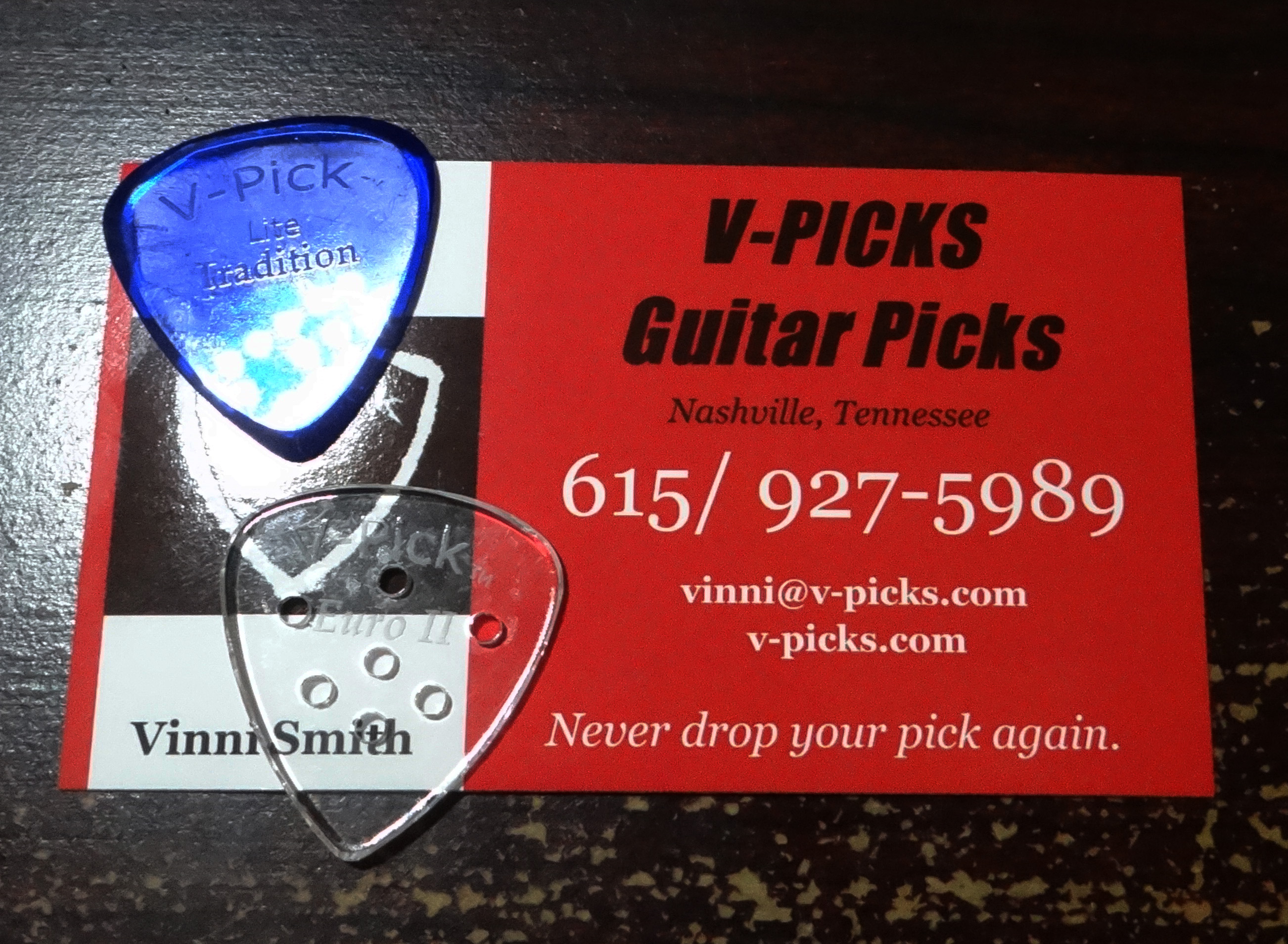
V-PicksAs my post on the DSA blog (re-posted here) stated, I worked the booth at the Arlington Guitar Show. I enjoy working the booth at guitar shows, because it’s a chance to play guitars I will never own. Some of them were worth so much money, I just look at them from a distance. If I see a good deal on a guitar that looks, sounds, and plays really nice, I take two deep breaths and move on. If I take another guitar home, I’ll need to take divorce papers with me. So I look at the newest gadgets, like capos, picks, etc.

For many years, most guitar players used Fender medium picks. Of course it was not entirely universal, but “as a general rule.” The shape would change, depending on the instrument. If you wanted a new sound, you changed the brand or gauge of string you used, or even the guitar. There weren’t as many different picks back then, so changing picks usually never crossed a guitar player’s mind. I did, however, change from Fender medium to John Pearse medium, which I still use. It has an offset point which is easier for me hold and attack the strings.

My statement about “most guitar players,” refers mainly to acoustic guitarists. Although a lot players I knew used medium exclusively, more and more guitarists began using heavy gauge picks for playing electric guitars. Now it’s all over the map as far as shapes, gauges, and types of materials for picks are concerned. Which is precisely my point.

Since I had to set my sights on lower cost items, I started looking into different picks at guitar shows. It’s incredible how many different materials they make picks with. Now I have a lot of different picks. But I’m still married! Then I was introduced to V-Picks. Each of the picks has a different tone or resonance. I am experimenting with different picks in their line, but my mainstays are the blue Lite Tradition and the Euro II. I stocked up at Arlington show because they always have their biggest booth there.

I also like to see the different picks they’ve come up with. Even though they’re made of an acrylic/glass type of material, they still wear down. It takes a little doing, mind you, but they still wear down. One of the good points of the picks in general – other than the unique sound – is that it sticks to your fingers with the heat in your hand. It’s hard to lose these picks while playing. Give them a try. At the very least you’ll make some good sounds and have fun.

Peace be with you.

[Re-posted from DSA blog]
Bobby Montgomery at DSA BoothThe second special event of October was the DSA booth at the Arlington Guitar Show on Saturday, October 17, and Sunday, the 18th. Bobby Montgomery set up the table on Saturday – and worked all day both days, God bless him! I joined him shortly thereafter – after waiting in line to park. I helped with the booth until about 12:30.

I was watching the booth when Bobby stepped out for a bit. I looked at my phone and saw a notification from Facebook. It was one of those “what you were doing last year” posts that Facebook does, with a picture from a year ago. It was the picture I took of Bobby behind the booth last year at the guitar show. It looked similar to the picture above, but I think the table looked better this year.

After a couple of hours I had to leave in order to host the DSA Showcase at the Farmers Branch Manske Library. I don’t know if any volunteers showed up to help Bobby after I left. I didn’t have a chance to browse the booths before I left. I did do one thing, but that is a different post.

On Sunday, Bobby and I opened the booth again with a little help from my son, Cameron. Then I had the chance to wander around and drool at the guitars, amps, and accessories. Among the wandering and drooling, I stopped at the Guitars for Vets booth. I met George Jordan, head of the Dallas Chapter.

George told me how the program worked. They give each vet ten guitar lessons. If the vet completes all ten lessons and shows interest, they give him a guitar. When I told him I was with the Dallas Songwriters, he got excited. They were trying to come up with something, after giving the vet the guitar, to keep the interest and effectiveness going.

I told him the DSA would be happy to support them in any way we could. We have worked with many veterans over the years. If music and playing guitar can help them maintain, then surely songwriting would help. Without a doubt, they have stories to tell. For several years, Dallas Songwriters distributed a cd entitled Songs from the Soul of Service: A Collection of Songs written by U.S. Soldiers, Sailors, Airmen, and Marines. Surely telling those stories through song – or even spoken word over guitar – would be comforting in nature. I will be contacting George soon. Stay tuned for future development.

Dickey Johnson and Michael Brandenberger arrived at the booth before I left in time to get Cameron back home to go to work. We talked to quite a few people at the booth over the two days. We have two pages of names and emails to enter into the mailing list and into a drawing for a chance to win a free year’s membership. If you are on that list, you should receive an email from me before too long.

Keep writing the songs that are in your heart.

11064659_10152721017857172_5984720308632017596_n [Re-posted from DSA blog] October has been a busy month for Dallas Songwriters Association (DSA). There were several special events in addition to the regular weekly events (all of which went well). The first was a visit by Skype with Tirk Wilder at the 2nd Tuesday meeting at the Center for Community Cooperation. Board member, Ken Duren, invited Wilder to speak at the meeting and Tirk graciously accepted.

Once the technical difficulties – such as they were – were worked out and we could see him and he could see us, the presentation began. Ken introduced him by saying that they had been friends since the 70s. The two of them reminisced a bit before Wilder told the story about writing the theme song to Walker: Texas Ranger. During the meeting, he told several stories about songwriting and Nashville – some hilarious and some horrifying.

After answering questions from the attending group, Tirk critiqued three members’ songs. He had offered to do song critiques and they were the songs he was sent. He had each songwriter move to a chair in front of the computer so the two of them could talk face to face. Wilder had some very helpful suggestions for the songwriters. According to the three songwriters, Tirk was right on with his critique.

Wilder also recommended Broadjam for songwriters wanting to get an honest critique of their songs. Tirk himself is one of the pro reviewers listed on the site. Then it was time to wrap things up. After those in attendance expressed our thanks to him for visiting with us, the Skype connection was broken.

As the meeting wound down, Harry Hewlett said that Wilder was right about Broadjam. Harry had paid to have Tirk review his song. While it had taken some time – he’s a busy man – his review of Harry’s song was right on the mark as well. Not only is Tirk Wilder a good songwriter, but he is a very likeable person and tells a good verbal story as well. He even took time to go into another room and come back with one of the BMI awards for the “Eyes of the Ranger” to show us.

Stay tuned for the other special events….

Keep writing the songs that are in your heart.

[Peace be with you.]

Tracie MerchantOn almost every night of the week, an open mic can be found in the Dallas area and often more than one, sometimes several. Some of the open mics include spoken word, playing cover songs, etc. On the other hand, some may prefer original songs, but talented covers are usually allowed. The majority of open mic hosts are friendly and welcoming. Most open mics have their regulars, even if it’s just a few people that show up all the time.

A number of open mics and similar events are hosted by members of the Dallas Songwriters Association (DSA). There is a supportive songwriting community in the Dallas area, a good number of whom are members of DSA. Some of us have been writing songs for years. Some are younger and just getting started playing live at open mics. Quite a few members of the DSA perform at other open mics in addition to DSA events.

But it’s the community that I want to emphasize here. The songwriting and open mic communities are very supportive in every way a community can be. One good example is the open mic at Poor David’s Pub (PDP), hosted by Mr.Troll. It helps, of course, that it is one of best listening rooms in town, and Carlos Sanchez is one of the best sound men in town. Samantha Sanders is one of the best bartenders, too.

A good illustration of my point came about recently. On Monday, I arrived at PDP, ready to play in the open mic. I said hi to a couple of people from DSA at the bar. Troll asked me to step aside and talk to him privately. He needed to go home to take care of his dad, and asked me to guest host the open mic. Of course I said I would.

Troll played first, as usual. He played two songs, but we persuaded him to play a third song. Then he introduced me and slipped out, and I took over as host. On the list were regulars – some older, some newer. The featured artist was Tracie Merchant. I introduced her about 8:45. In the middle of her set, Tracie picked up her phone and began to make a call.

“Does everybody know my friend, Bill Nash?” Many of us did. Bill is a singer/songwriter with MS. He has been in the folk scene in Dallas for quite some time. He has come up with different tunings using capos and key changes to enable him to keep playing the guitar and writing songs. He had to leave SWRFA a little early due to health issues and within a week was in the hospital. He was hoping to get out of the hospital soon when Tracie called.

“We’re here at the open mic at Poor David’s Pub. We wanted to tell you something,” she said when Bill answered. She motioned to all of us and at the same time we said:

“Get well, Bill!” He asked her if we would do it again so he could record it. Which we gladly did.

During the evening a harmonica player was hanging around, hoping to join someone. Vince Alexander is from Atlanta and is here working at the State Fair. He was looking for a break from the fair to do what he loved the most – playing music. Toward the end of the evening he got his chance and stayed on stage to play with Tin Man Travis. Vince had the pleasantness on his face and in his upbeat and friendly attitude of one who is away from home in an unfamiliar place and finds a music community to be a part of (albeit temporarily).

See what I mean about community? And you’re all welcome – to play or listen. At any of the open mics or DSA events.

Peace be with you.

asglogo    I attended the Texas Songwriters Conference in Austin a couple of weeks ago. I’m just now getting caught up enough to post about it. The conference is put on by the Austin Songwriters Group (ASG), of which I am a member. I am also a member of Dallas Songwriters Association (DSA), where I am on the board as the lyric contest director and the showcase director. The two organizations have not, as of yet, had a joint event, but they support each others organization and mission in various ways.

I spend a lot of my time talking to people in one form or another (in person, on the phone, email), promoting myself or either organization. When I am promoting DSA, for example, I can “brag” a little more openly since I am referring to a group of people. When promoting myself, it’s necessary to be a little more subtle to straddle the fine line between promotion and braggadocio. As a result, some people don’t understand what I’m trying to say and have blank looks on their faces. Then there are the condescending “of course you’re a songwriter” looks.

So it was nice to – not only get out of town – but to spend a weekend with people who know what I’m talking about. People who are like-minded, accepting, and non-judgmental. At music and songwriting conferences there are always things I already know – since the conference is for all levels of experience. However, since things are changing constantly, it’s nice to know what has changed. As to the things that haven’t changed, I enjoy being assured that what I’m doing is what I should be doing.

I like hearing other songwriters, publishers, and other music industry people tell their stories, making me think “thank God I’m not alone.” That, I think, is the main purpose of any conference – making the attendees realize they are not alone. And the ASG did that. They are an accepting and supportive group (as is the DSA – just saying). It was all about the songs and careers of the songwriters. A few of the events and conversations I would like to share with you – and will – in upcoming posts.

Peace be with you.

20131103_132007I recently joined the Board of the Dallas Songwriters Association (DSA) after having been a member for several years. I am now the Lyric Contest Director, as well as helping out in other areas. I was given the entries to the recently completed contest (it is run quarterly). My job is to read all the lyrics and pass along to another member of the board the songs I think are worthy to be considered in the final judging. After reading the lyric contest entries, I have a few thoughts to pass along to those planning to enter a lyric/songwriting contest.

If you are just writing lyrics, find someone to write or play the melody. Make sure that it is a song, not just a poem. Granted, sometimes the line between the two is blurred. But even in those instances, one can tell the difference between a poem and song. Read it out loud.

If it sounds good to you, then have a few other people read your song. It is your choice to accept or reject suggestions or criticism. But if more than one person says the same thing, it would be prudent to follow their advice. If you read your song out loud and it sounds “sing-song-y,” you might want to work on it a little more.

At the very least – and I mean the very least – read your song several times before you submit your entry. Use spell checker and check the grammar. When I’m reading the song entries, I can forgive a misspelled word or single grammatical error. But if you misspell the same word in the chorus each time you type out the chorus, the song instantly goes in the rejection pile. It’s the same with the gramatical errors. If you are using slang purposely, or  are misspelling words to imitate an accent, use quotation marks. But make sure  it fits the song.

If you are going to take the time, make the effort, and spend the money, you might as well make it worth it. Present yourself and your song in as professional a manner as possible. A song should fit on one page, maybe one and a half. Certainly not more than two pages. You do not need to type out the chorus each time it occurs, if it is the same each time. Using 12 pt. type is quite sufficient – anything larger is unnecessary.

The first thing you should consider before submitting an entry is whether or not you have written an actual song. I do not have time to tell you how to write a song. There is so much already written on the subject, I do not need to. If you’re in the Dallas area, you could join the DSA and attend meetings. Every major city should have a songwriting association. Keep writing and learning as you go along.

Along the journey, when you decide to submit to a lyric or songwriting contest, you need to do four things. Make sure it is actually a decent song. Present yourself and your song professionally. Read it over carefully a couple of times before sending it. And follow the entry rules  to the letter.

Peace be with you.