Tag Archive: Dan Roark


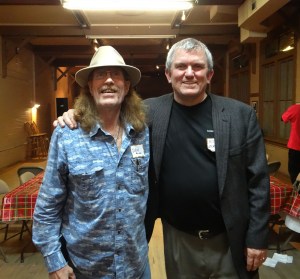
Dan Roark and Roy Elkins

Dan Roark and Roy Elkins

People began to arrive at Sons of Hermann Hall at 6:30 on Tuesday, December 8 for the Dallas Songwriters Association (DSA) Song Contest Award Ceremony and Christmas party. Board members Barbe McMillen, Bobby Montgomery, Ken Duren, and Dan Roark, with member and SOHH employee, Lisa Byrn, David Lewis (SOHH), and the sound man, Logan Hughes, had arrived early to set up the hall. Master of Ceremonies for the evening, Roy Elkins, CEO of Broadjam.com, pitched in to help Bobby set up the food tables. Board member, James Pappas, owner of Dallas Ice Sculptures, supplied the Christmas tree sculpture for the table.

Christmas Tree Ice Sculpture
The ceremony began promptly at 7 p.m. with a welcome from Barbe McMillen, DSA Founding President Emeritus and an explanation of the song contest process and breakdown of prizes. She then introduced MC Roy Elkins. As mentioned earlier, Roy is founder and ceo of Broadjam.com. He came down from Wisconsin a day early to present a free workshop the night before at Tone Shop Guitars in Addison. The workshop was called Your Music and Your Business. Elkins shared from his experiences in the music business and Broadjam, as well as information from music contacts. More information about the workshop can be found here.

AudienceAfter a few opening comments, Roy introduced Dickey Johnson. Dickey, along with Mary Guthrie and Mary Hestand (Sugar Daddy and the M&Ms), played his winning critique song, Alone with Alone. Then Elkins introduced Dan Roark, Showcase, Workshop, and Lyric Contest Director. Dan gave a short bio of the Americana judge, Kendra Terry, booking manager at Uncle Calvin’s Coffee House. He read the list of semifinalists and announced the winners.

Roark then introduced Katie Riley, with her mother and sister. They played both of Katie’s Dan Roarksemfinal songs, I Believe (Christian), and Dry Bones (Pop/rock). After which, Dan gave a short bio of the Christian/Inspirational judge, Scott Dicken, currently music director at Christ United Methodist Church in Farmers Branch. He then read the semifinalists and announced the winners, before introducing Rio King. Rio played his four winning critique songs, Sweet Rolls and Cream, Boogie Woogie Rhythm, Boomer Boogie, and The Old Wrecked Vet.
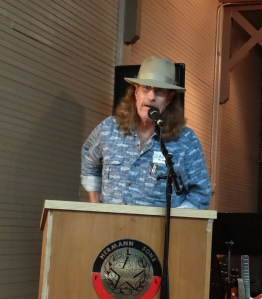
Roy Elkins stepped back up and introduced Bobby Montgomery, DSA Executive Vice President, and 2014 Songwriter of the year. Bobby gave a short bio of Larry Beaird, owner of Beaird Music Group, and judge of the country category. After reading the semifinalists and announcing the country winners, Montgomery introduced M’Lynn Musgrove. M’Lynn played her two semifinalist songs, Healed, and Preaching to the Choir, both in the singer-songwriter category.

M'Lynn Musgrove

M’Lynn Musgrove

Elkins then introduced Michael Brandenberger, DSA President. Michael gave a bio of the Instrumental judge, Tony Hakim, owner of jazz venue, Kitchen Café, and a positive force in the Dallas-Ft. Worth jazz scene for over 25 years. After reading the semifinalists and announcing the winners, Brandenberger introduced Dori Weavers, who played her winning critique song, Waiting to Breathe. He then read the Love Songs/Easy Listening semi-finalists and announced the winners.

Barbe McMillen came back to the podium to give a bio of the Children’s/Novelty judge, Monty Harper, who has been on the Oklahoma Arts Council Touring Roster since 1995. Barbe read the semifinalists and announced the winners. She then introduced, Jon Storm. Jon played his semifinalist song in the Pop/Rock category, Love Me Now.

Roy Elkins returned to the podium and introduced Harry Hewlett, co-director of the song

Warren Hanson

Warren Hanson

contest this year and director next year. Harry gave a short bio of Pop/Rock judge Kathy Forste, who has worked in television and radio for the past 30 years in various capacities. He read the semifinalists and announced the winners. Then he introduced Warren Hanson, who performed his semifinalist song in the singer-songwriter category, Just Lucky I Guess.

Roy Elkins returned to introduce Michael Waid. Michael performed his singer-songwriter semifinal song, Lost and Found. Roy then introduced Jennifer Marler, who, joined with her husband, Justin, played her semifinalist song, Memories Don’t Burn. Then Elkins called Barbe McMillen back to the podium.
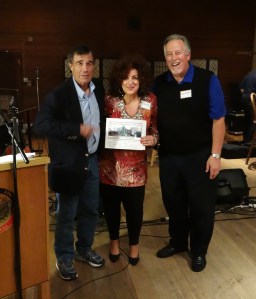
Harry Hewlett, Dori Weaver, and Michael Brandenberger

Harry Hewlett, Dori Weaver, and Michael Brandenberger

Barbe gave a brief bio of singer-songwriter judge, David Card, owner of Poor David’s Pub, one of Dallas’ best listening rooms. David also founded the BW Stevenson Memorial Singer-Songwriter Competition. Then Barbe read the semifinalists and announced the winners. She then announced the winner of the iPod for which each contest entrant received an entry. The winner was Samuel Miller from Chico, California. Miller’s song, Can’t Get Enough, was a semifinalist song in the singer-songwriter category.

McMillen explained the judging process – which can be found on the DSA website – and introduced grand prize judge, Roy Elkins. Roy talked about the song entries and announced the Grand Prize winner. He then introduced Buck Morgan, who played his winning critique song, Jimmy Loves Jesus. Elkins then introduced Bobby Montgomery, who played his winning critique song, Give ‘Em Time, Lord.

Harry Hewlett, Rio King,Barbe McMillen

Harry Hewlett, Rio King,Barbe McMillen

Roy brought Harry Hewlett back to the podium. Harry explained the process for song of the year. Then he gave a short bio of the song of the year judge, Ian Dickson, a singer-songwriter having performed for a number of years. Then Harry announced the Song of the Year winner. Harry made some closing remarks and then Michael Brandenberger started the open mic. A list of semifinalists can be found here and the a list of winners can be found here.

Although time and space did not allow me to elaborate more, all the performances were wonderful and the evening was a huge success.

Keep writing the songs that are in your heart.

Chasing After Wind Cover 2 I hope the new year is starting off well for everyone. Ours started off well and will do better when routines settle in again. My cd went on sale in the Play Store, iTunes store, Cd Baby, etc., today. There is a store on my Facebook fan page and a new store on my website.

Cyndy and I are headed to Austin this week for the Austin Songwriter Group’s Songwriter Symposium. Cyndy will work in the hotel room while I’m at the symposium during the day. She’ll attend the showcases with me at night. I’ll be playing at the open mic Wednesday night if all goes well. With the oldest son moving back home it will be nice to get away by ourselves.

Have a good week and I will be posting about songwriting while I am at the symposium. Thank you for your support.

Peace be with you.

Dan '13 I hope everyone had a merry Christmas and is looking forward to a new year. With recording, producing, and releasing a new cd, Chasing After Wind, and the busy Christmas season with church and family, little time remained to tend to other affairs such as posting on this blog. But today I am able to say that my new cd is available for order and download on my website. You can hear different versions of two of the songs on my Facebook fan page and Reverbnation page, as well as download my app, which will be updated as regularly as possible. The cd will also be available soon on iTunes, Amazon, etc. Thank you for your support.

Peace be with you.

Time of Calamity

A couple of days ago, about 10 a.m., the bottom dropped out, weather-wise. The “sky was crying,” as Stevie Ray Vaughan would sing. It also sounded as if Mother Nature might have some serious issues. Being in the middle of a storm is a little scary, no matter who you are. You may not admit it, but even the strongest among us have their moments.

When it is storming so tremendously outside that the thunder, lightning, and rain on the house is all you hear – even over the tv, radio, or heater. The sun seems to be on sick leave and the sky just gets increasingly darker. If you are having any major life problems at all – and who is not – a serious funk can be one thunder crash away. The all-consuming gloominess that appears to surround you suddenly feels tangible – shrinking around the house like plastic wrap – closing off all exits. That’s how I imagine Qohelet felt when I read certain parts of Ecclesiastes.

“Again I saw that under the sun the race is not to the swift, nor the battle to the strong, nor bread to the wise, nor riches to the intelligent, nor favor to the skillful; but time and chance happen to them all. For no one can anticipate the time of disaster. Like fish taken in a cruel net, and like birds caught in a snare, so mortals are snared at a time of calamity, when it suddenly falls upon them.” Eccl. 9:11, 12.

Everyone has experienced times similar to those mentioned here. But, as I discuss in the book, Qohelet did not have grace and forgiveness of sins as we have. Not to say that God did not give grace to the Israelites or grace their endeavors – the Israelites simply did not see it as grace, per se. The Israelites and people of the Old Testament viewed life in more concrete terms. If life took a bad turn – family, crops, or livestock dying, for example – they must have done something to cause it.

Unfortunately for them, Jesus Christ had not been born yet. Fortunately for us, he has. Through Christ’s life and sacrifice, we not only have God’s grace, but the Holy Spirit and forgiveness of sins. Looking at Ecclesiastes in that light, we can take Qohelet’s view – which is valid even today – mix in grace, the Holy Spirit, and redemption, and ascertain our actions as Christians when we have a tendency to “hate all the toil in which we have toiled under the sun.”

Join me on the journey.

Peace be with you.

Words and phrases that may have begun as an original thought with an apparent obvious meaning and intent, after constant use, misuse, and abuse, over time become catchphrases and buzzwords with thoroughly ambiguous meanings. Thinking “outside the box” was the hot business concept in the late 1990’s. Through the years, the expression has been bandied about and used in advertisements and press releases to represent ideas and supposed innovations that, in the end, were not so out of the box after all. All anyone succeeded in doing was expanding the box.

“Whatever” was originally used having to do with making a decision. As in “get a Coke or a Dr. Pepper or whatever you want.” Or ” it has to do with Kleenex, napkins, paper towels, or whatever.” Currently the word is most often used to mean “I don’t want to talk about it anymore.” Or a sign of being noncommittal. Our teenagers and their friends use it when they have gotten themselves in a conversational hole and do not want to admit it. “Whatever!”

The phrase “don’t guilt-trip me” gained prominence in the 1960’s with accusations that the “establishment” was trying to lay a guilt-trip on the middle and lower classes. While I sympathized with some of their positions, I disliked the phrase even then. It is more distasteful to me now when my children use it toward me. What the phrase actually means is “I know I’ve screwed up a lot (or owe you a lot), but I don’t want to be told that, I want to get what I want.”

Other variations could be applied, but that is the gist. More often than not, what they refer to as guilt-tripping is actually telling them the truth. For example, one of the boys asks us for something that requires financing from us. When we go down the list of things they have already received no return effort – even though that was the arrangement- we are now required to add “and I’m not trying to guilt-trip you, just telling you the truth.” Beat them to the punch, as it were.

I grew up under the impression that it was easier to keep problems and debts to a minimum rather than endure the bothersome situation of feeling bad. It is our conscience that causes us to feel remorseful. Other people cannot make you feel bad – or guilty – if you have no reason to feel bad in the first place. But most of us feel shame over past indiscretions of one sort or another. In addition to a natural inclination to get defensive when being told we are being selfish. Because, on some level, we are all being selfish. But we would prefer not to admit it or have it made public.

Which led me to wonder if sometimes we do not try to guilt-trip God. As if making a list of our Christian “accomplishments” will persuade God to lend a special hand and eliminate our particular situation. A situation which seems important to us, but in God’s grand scheme of things is quite minuscule. Yet we have the audacity to think that we could have possibly done enough good in our lives to not only outweigh our myriad of failures, but move us higher up on God’s to do list.

“Where are you, God? I go to church every Sunday, well, most every Sunday. I attend Sunday school. I am at the Wednesday dinner s. I read the Bible every day. I pray every night for everyone on my prayer list. I try to be kind to everyone. So why am I stuck in this situation? Why will you not help me?”

God did not put us in the situation we are in – we did. We may not have been the direct cause of our current malady or tragedy, but in some way we had a hand in it. Regardless of whether we were a part of the cause or had little or nothing to do with it, God most certainly was not the cause. Why are we blaming him and ridiculously trying to make God feel sorry for us and give us the outcome we want. We do not want the outcome that God wants or the outcome we may deserve. We want the outcome we think is best.

Just like our teenagers. They do not want to hear the truth. They want to be told they can have things their way. Telling them the truth is guilt-tripping them. We are alongside our children when we ask God for help. We do not want to be guilt-tripped by being told the truth or what is best for us. But we know in our hearts and souls that God wants the best for us. So why are we trying to blame and guilt-trip God?

In trying to guilt-trip God, and when our teenagers try to guilt-trip us, one thing is overlooked. It is, in fact, what is wrong with the term guilt-trip in the first place. It also renders the term irrelevant. And it is quite simply this: you cannot guilt-trip a truly innocent person – or being – as the case may be.

Peace be with you.