Tag Archive: grace


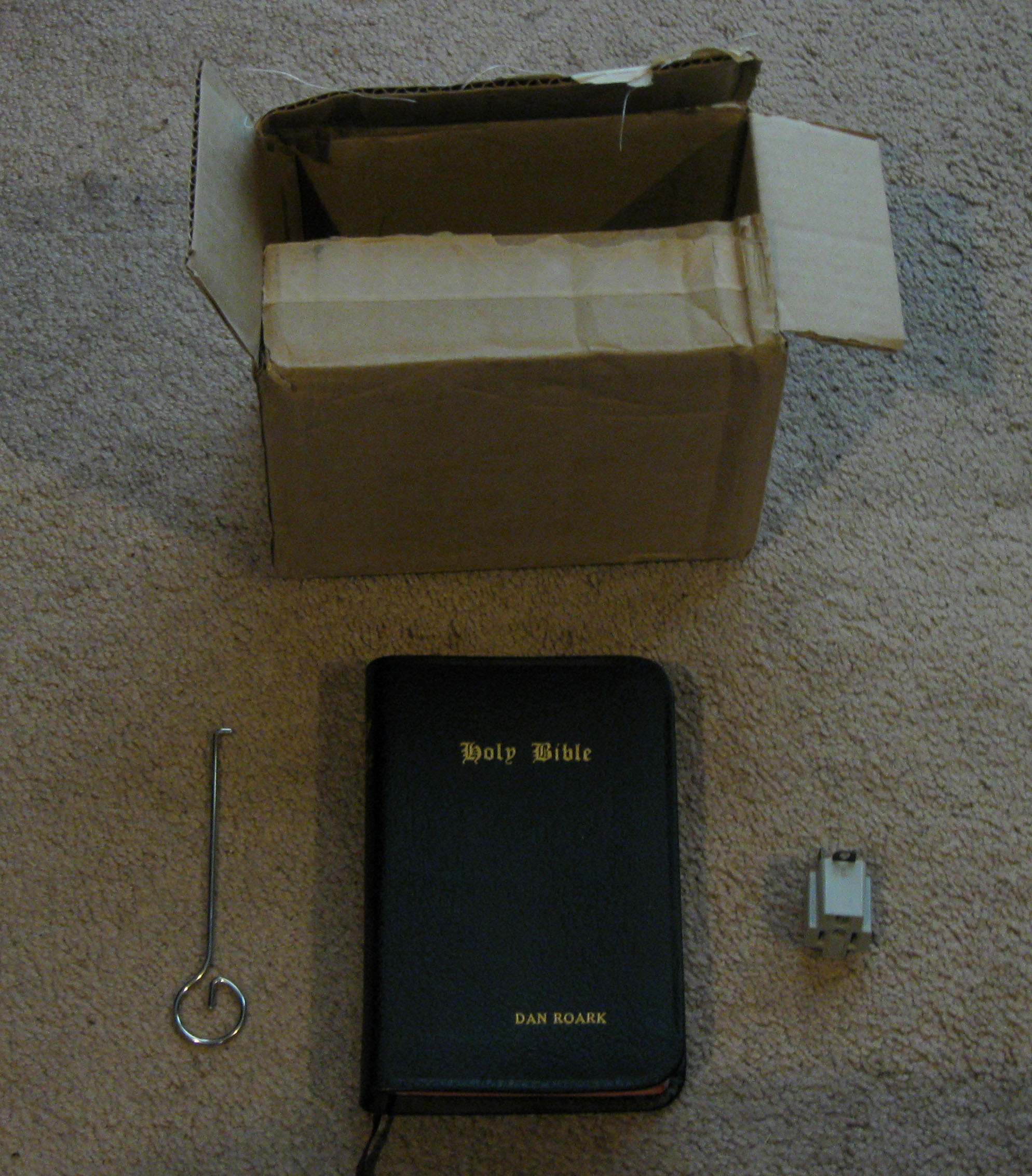
There are a number of boxes, gadgets, and doohickies in our shed, closets, and drawers that we have kept because they “might be useful some day.” They just sit there waiting – hoping that someday they fulfill their purpose – useless until useful. I walked out into the backyard this morning and discovered that Cyndy found a use for a box I decided to hang on to a few days ago. The box had acquired a secondary purpose. Like the doohickey – or thing-of-a-jig – that becomes the perfect “tool” to complete an odd job around the house.

Once a “might be useful someday” object serves a purpose it is no longer possibly useful. It is indispensable. It can collect dust for years, but it will not be thrown away. On the premise that because it has been useful once – or twice as the case may be – it will inevitably be useful again. Even though that might not be the case.

I have found that for some people, and some Christians, the Bible is simply one of those things to have around because it might be useful some day. They take it to church on Sunday if they remember it. “After all, they have one in the pew.” Then they never actual open it. Why bother when the lay reader is reading it to them. And the preacher will remind them if their thoughts happen to drift.

But – sure enough – a time comes when their Bible becomes useful. Tragedy strikes family or friends. A job is lost, a relationship ends, or any one of any number of life-changing events occur. Then their Bible again has purpose. It eases their mind, softens their heart, soothes their soul, or simply provides comfort. Their Bible has become indispensable.

Unfortunately, there are too many Christians to whom the Bible is something waiting to be useful. They have not discovered the life-changing story of the Israelite’s history, the life and death on the cross of Jesus, or the forgiving grace of God. They have not felt their “heart strangely warmed” as John Wesley did. They have not had their souls cleansed with God’s grace.

With persecuted Christians around the world clamoring for Bibles and materials to continue their spiritual journey with Christ, it is sad that many Christians in our part of the world have a Bible that they never use. I have had a Bible – and have been a Christian – for as long as I can remember. Beginning with the pocket-size New Testament I received when I began attending Sunday school. I have always had a Bible at hand. Unfortunately though, there were times when I felt I was keeping it around “in case it was useful.”

When I finally felt the Lord’s nudging and again opened my Bible for study and prayer, I ceased to think of the Bible as being “potential useful.” It is a part of my day, my life, my profession, and our family life. I feel uncomfortable when too much time has passed since our last visit. The Bible, once thought of as potentially useful, has become indispensable.

“In the beginning was the Word, and the Word was with God, and the Word was God.” John 1:1 NRSV.

Peace be with you.

Alyce McKensie, Professor of Homiletics at Perkins Theological Seminary at SMU, published a post before Easter entitled “Have You Got Your Ticket” on Patheos.com. With three teenagers and end of the year school and church activities, I was distracted and only recently re-read the post. The lectionary text that week was the Walk to Emmaus in Luke 24:13-35. “… Easter season is a journey that begins with the empty tomb and the Risen Lord. But for some reason I’ve been thinking about journeys and ways we can remember where were headed and why.”

McKensie recalled the well-known story about Albert Einstein’s train trip when he was on the floor looking for his lost ticket. The conductor told him it was okay, he knew who he was, and trusted him. “It’s not a matter of trust,” said Einstein. “If I don’t find that ticket, I have no idea where I’m going!”

Alyce then wrote about receiving an original ticket to the Wesleyan Class Meeting of the Wesleyan-Methodist Society from 1829. How holding the ticket in her hand led her on a mental spiritual journey back to when James Hart (the name on the ticket) was in fellowship and worship with the society and back to the beginning of the Christian church with the Last Supper and the empty tomb. Read the full post here.

While I was reading her post, my mind went in a slightly different direction (as my mind is wont to do) with the example of the ticket. I do not know what the conductor would have done with the ticket when Einstein found it. But I remember having to get my ticket punched when riding on a train – ostensibly to prove the conductor had validated my ticket. Which led me to consider another kind of ticket.

Part of the problem with the decline of churches today is that many Christians live as though they are mentally getting their ticket punched. Not exactly a good example with which to persuade people to come to, or come back to, church. It’s more about having their eternal ticket punched than faithfulness or discipleship.

Went to Communion Sunday – punch. Went to Wednesday night dinner – punch. Church music programs – punch. Holiday worship services – punch. Christmas services and Easter services – double punches at least. As if the totality of one’s good works can bring entrance to heaven.

If St. Peter at the golden gate were the conductor to eternity, when handed the attendance punch card, he might ask: “Where is your mission punch card, your evangelical punch card, your kindness to strangers punch card?” And so on. If the applicant is using the punch card approach, they are going to fall short of the mark of a good and faithful Christian.

Approached with a true and right spirit, attending church services and events are joyful times of worship and fellowship. Worship and fellowship create an impetus for doing good works, not the other way around. The good works come as acts of faith to, in some small way, return the favor for the Lord’s magnanimous gift of grace. We should want to do good works to further our spiritual journey, not to collect points.

“For by grace you have been saved through faith, and this is not your own doing; it is the gift of God – not the result of works, so that no one may boast. For we are what he has made us, created in Christ Jesus for good works, which God prepared beforehand to be our way of life.” Ephesians 2:9,10

Peace be with you.

The Mercedes commercial, in which the driver does not see objects coming, but the car does, is disturbing to me. You know the commercial. “I didn’t notice I was swerving, but my car did.” “I didn’t realize I was nodding off, but my car did.”

On the surface, it is simply a commercial to illustrate some advanced features of Mercedes’ new car. The ability of the car to sense coming obstructions and automatically avoid them. Which is obviously a good thing when it comes to accidental circumstances.

But a viewer could interpret the commercial to mean that it is not necessary to bother paying attention. And many drivers cannot afford to pay any less attention. “I was sending a text to a friend and didn’t see the car in front of me, but my car did.” “I was talking to a friend in the back seat and didn’t know I was swerving into oncoming traffic, but my car did.”

Odd, is it not, that an improvement in an automobile that can potentially prevent accidents and save lives is also a potential excuse for continuing the same activities while driving that cause more accidents and deaths. Sad as it may be, people will use the advanced feature much like they use cruise control – a feature to enable them to do unnecessary things while driving.

Which is much the same with many things. Such as the Bible, the Koran, and other sacred texts. Texts which were written (by whatever means or guidance) to guide people along a path toward spiritual fulfillment. Yet some readers insist on using these texts – in and out of context – to justify their own actions that most assuredly are not spiritual or fulfilling. The very scriptures intended to bring hope, peace, inner tranquility, and spiritual assuredness are distorted to excuse acts of violence, terrorism, and war.

The examples in the Mercedes commercial were appropriate examples to demonstrate the self-correcting feature. The implication of the dialogue was objectionable, but the intent was honorable. The misinterpretation as a result illustrates one of the problems with the human condition. As humans, we have the uncanny ability to take things given to us to with the intention of improving our chance of living through the world we have abused, and use them to further our selfish, lazy endeavors to do what we want, without consideration of others.

Fortunately, by the grace of God, as humans we have the moral capacity to know when we are doing wrong. But as a result of free will, we also have the capacity to make wrong choices and screw up. The key is to succumb to God’s extended arms of grace before falling prey to the temptations constantly before us. To follow the Scriptures as God intended and not as an excuse to satisfy our selfish desires.

“Do nothing from selfish ambition or conceit, but in humility regard others as better than yourselves. Let each of you look not to your own interests, but to the interests of others. Let the same mind be in you that was in Christ Jesus.” Phil. 2:3 (NRSV)

Peace be with you.

My family moved to Wichita Falls just before I started fourth grade. After we settled in, I became friends with the three boys that lived next door. The oldest of the three boys was a few years older than I, the second oldest was a year or two older, and Jeffrey, the youngest, was a year or two younger than I was. Jeffrey’s is the only name I can remember and I am not one hundred percent sure that was his name.

Be that as it may, Jeffrey and I became friends. Particularly when friends my own age were out of town or unavailable. We had several notable adventures, but one in particular comes to mind that involved matchbooks. Matchbooks were still commonplace items, more so than lighters. Disposable lighters were not yet readily available.

The two of us were in the alley behind our houses. The alley was dirt, full of ruts most of the time from the garbage truck and city vehicles. But grass grew in the four or five feet between the alley and the backyard fences. It was late fall without a lot of rain and the grass by the alley was dry, brittle, and brown in spots . And we were bored.

We thought we would experiment with the matches and fire. Holding the matchbook with the striking strip on the bottom, we held the head of a match on the strip with our index finger. Then we would light the match while flipping it toward the ground. If the grass caught fire, we would let it burn, watching the circle of fire grow for a bit, then stomp it out with our foot.

As one would imagine, we kept letting the fire get a little bigger each time. After all, it would not be a challenge otherwise. As fate would have it, and you would guess, one of the fires got out of hand. When we stomped on the fire, ashes jumped, starting another little fire that soon became part of the larger one. It was not too terribly long before we began to panic.

The faster and harder we stomped, the faster the fire spread. When the fire was about three feet across, Jeffrey took off his jacket – which as I remember was brand-new – and began trying to put the fire out with it. At first, he only succeeded in spreading the fire more. I seem to remember coughing and screaming a lot. But he could not hear me, because he was screaming and coughing, too.

We finally put the fire out. Leaving a five foot circle of burned and smoldering grass as a monument to our stupidity. That and the rather large hole of burned fabric on the inside of Jeffrey’s new jacket. He asked me to take it home so he could tell his parents he loaned it to me and buy him some time to confess.

He did not get that chance. The jacket smelled distinctly of smoke and my parents asked me why I had it. I told them he had forgotten it and I would give it back to him. I went out in the backyard and threw the jacket over the fence to Jeffrey, who was in his backyard. His parents had asked him where the jacket was and told him to go get it. Following the rendering of his punishment, his parents talked to my parents. I did not escape unpunished. It was impossible to explain the five foot circle of burnt grass without telling the truth – which was ridiculous enough.

“Rejoice, young man, while you are young, and let your heart cheer you in the days of your youth. Follow the inclination of your heart and the desire of your eyes, but know that for all these things God will bring you into judgment.” Ecclesiastes 11:9

Qohelet’s God was a vengeful God. Making a list and checking it twice, as it were. But, with the New Testament and the life of Christ, we know God as forgiving and as a God of grace. While I certainly received my comeuppance for my part in the temporary fascination with fire – giving me a lasting respect for its power – I do not think that any further punishment is forthcoming. It is not a layer in the pile of bad or stupid things I have done in my life for which I will be punished for its totality.

Free will is offset somewhat by our conscience. We may still decide to sin, but we will feel remorseful about it. Each time I have recalled our venture into stupidity, I have received sharp pangs of regret brought on by my conscience. The recurring memories along with regret and feelings of stupidity are sufficient punishment, thank you very much. I do not think I need a final hammer coming down at the end of my life to punish me further for my collective sins.

God may indeed bring us into judgement, but it will be with grace and a forgiving hand of redemption. All will be taken into account, not just our sins. Which is a wonderful thing because no one is without sin. It is easy to understand David singing praises to the Lord. We should sing our praises and thank God with our prayers for his grace, forgiveness, and redemption. Because, in my case, if I was to be held accountable for my sins, the grass fire would be the least of my worries.

Peace be with you.

Time of Calamity

A couple of days ago, about 10 a.m., the bottom dropped out, weather-wise. The “sky was crying,” as Stevie Ray Vaughan would sing. It also sounded as if Mother Nature might have some serious issues. Being in the middle of a storm is a little scary, no matter who you are. You may not admit it, but even the strongest among us have their moments.

When it is storming so tremendously outside that the thunder, lightning, and rain on the house is all you hear – even over the tv, radio, or heater. The sun seems to be on sick leave and the sky just gets increasingly darker. If you are having any major life problems at all – and who is not – a serious funk can be one thunder crash away. The all-consuming gloominess that appears to surround you suddenly feels tangible – shrinking around the house like plastic wrap – closing off all exits. That’s how I imagine Qohelet felt when I read certain parts of Ecclesiastes.

“Again I saw that under the sun the race is not to the swift, nor the battle to the strong, nor bread to the wise, nor riches to the intelligent, nor favor to the skillful; but time and chance happen to them all. For no one can anticipate the time of disaster. Like fish taken in a cruel net, and like birds caught in a snare, so mortals are snared at a time of calamity, when it suddenly falls upon them.” Eccl. 9:11, 12.

Everyone has experienced times similar to those mentioned here. But, as I discuss in the book, Qohelet did not have grace and forgiveness of sins as we have. Not to say that God did not give grace to the Israelites or grace their endeavors – the Israelites simply did not see it as grace, per se. The Israelites and people of the Old Testament viewed life in more concrete terms. If life took a bad turn – family, crops, or livestock dying, for example – they must have done something to cause it.

Unfortunately for them, Jesus Christ had not been born yet. Fortunately for us, he has. Through Christ’s life and sacrifice, we not only have God’s grace, but the Holy Spirit and forgiveness of sins. Looking at Ecclesiastes in that light, we can take Qohelet’s view – which is valid even today – mix in grace, the Holy Spirit, and redemption, and ascertain our actions as Christians when we have a tendency to “hate all the toil in which we have toiled under the sun.”

Join me on the journey.

Peace be with you.