Tag Archive: Jesus


The full title of Rubel Shelly’s book published by Leafwood Publishers (ACU Press) is “I Knew Jesus Before He Was A Christian…and I Liked Him Better Then.” When I was asked to review the book, I was intrigued by the title. As I began to read, it became apparent that the title was not merely cute to boost sales, but was entirely appropriate for the material. Our small group was deciding what book to study next and I suggested this one. Rather than read through it before the group studied it, I waited to review the book in order to include it’s effectiveness for a small group study.

The conclusion is that I Knew Jesus… works well for small groups. Precisely because it compares the original churches to churches now and the Jesus of the Bible to the Jesus nonbelievers perceive to be preached in churches today. The subject is – and should be – on the minds of all church and small group members.

Shelly begins by asserting that we can be both pro-Jesus and pro-church simultaneously. But not as long as a perception exists of disconnect between the two. Changing the perception necessarily requires elimination of the disconnect. The author quotes Stephen King when he wrote, “And while I believe in God, I have no use for organized religion..”

That is what many Christians have heard, unfortunately, far too often. Then there is the oft-quoted “I’m spiritual, but not religious.” In chapter four, Shelly tells the story of author Anne Rice. Rice renounced the Catholic religion at age eighteen. After a series of tragedies, including  the near loss of her life, she renewed her commitment to the Catholic faith. Rice wrote a book about the experience, dedicated herself to “glorifying God,” and launched a series of Christ the Lord books.

On July 28, 2010, Anne Rice posted a statement on her Facebook page that she was giving up Christianity and doing it “in the name of Christ.” She said that she remained committed to Christ as always, but not to being ‘Christian’ or part of Christianity. Rice followed the next day with “my conversion from a pessimistic atheist lost in a world I don’t understand, to an optimistic believer in a universe created and sustained by a loving God is crucial to me. But following Christ does not mean following his followers.”

Which is precisely the point Shelly is making. The Jesus of the Bible – and by extension, of the original churches – is not the Jesus the people of the world see proclaimed by many of today’s churches. We should strive to be more like the Jesus of the Bible than the Jesus we portray through the filter of our organizational structure and polity. Rubel Shelly, in I Knew Jesus…, looks at different aspects of the disconnect and barriers between Jesus and the church. The author challenges and encourages the reader to work toward solutions in their own lives and churches, with questions found in the discussion guide.

Too many people have decided they are done with the church. They do not want to have anything to do with the church. “But you just might get attention with this radical, engaging, challenging, life-transforming, healing, rescuing person named Jesus of Nazareth. In fact, I think it is the only hope we have for communicating with a postmodern world. The best argument is…a living demonstration of kindness and acceptance, grace made incarnate, or love emptying itself for the sake of others.”

In I Knew Jesus Before He was a Christian, Shelly uses real-life and biblical examples to illustrate that while church membership may be declining, there are still souls searching for the life-affirming love of Christ. For a church to be a model of the first Christian churches and the life Christ displayed, they must first exhibit Jesus in the community and participate in ministering to those in need.

Peace be with you.

[I received this book free from Leafwood Publishers for a review. I was not required to write a favorable review.]

Since attending my uncle Jack’s funeral this past week, I’ve been thinking of times I remember being with him on family occasions. My daughter, Jennifer, took her first steps at Jack and Juanita’s house. Eventually my thoughts traveled to other experiences of my younger days. Such as our family trip to Pennsylvania.  Cyndy, the three boys, and myself replicated part of that trip in August of 2010. The trips were also on my mind because I am flying to Philadelphia this week for the Religion Communicators Council’s national convention.

Be that as it may, the story from the Pennsylvania trip when I was a teenager that came to mind was when we were driving through the farms in Amish country. The view was gorgeous and breath-taking. I think I even put down the book I was reading – I always read when we drove long distances. We drove through miles and miles of farms and fields.

We passed several produce stands – which were larger, as a general rule, than the stands I was used to seeing in Texas. The stands in Texas were mostly single farm stands whereas the Pennsylvania stands were co-op. After the third stand, my mother said “we need something sweet.” We pulled into the next stand, mom went looking and came back with several pounds of cherries.

We left the produce stand and continued our journey. The four of us ate cherries until we were nearly sick. Then mom spotted a nut stand.

“Now I need something salty,” mom said, after which dad pulled into the stand. This time she came back with a pound or two of a nut mixture.

We continued down the road, stuffing ourselves with nuts. Fortunately, we had some cherries leftover. With the sandwiches and lemonade mom had made, we were able to stretch the sweet and salty cycle for most of the day. However, during the unfolding of the sweet and salty saga, another story unfolded.

As we ate lunch and switched between salty and sweet, we put our reading material down, turned down the radio, looked out at the scenery, and shared observations and stories.

After a while we quit eating and were just talking and sharing. The salty and sweet episode was, at the outset, giving in to selfish urges. But, rather than simply giving in to the urges, we used it  as a time to have a conversation and draw closer to each other.

Which is a lesson I have kept with me since our family vacations all those years ago. For one thing, a family vacation is not about having a perfect time, leaving all the problems behind. A vacation is about having an experience together out of the ordinary (facing different problems) as a family. When the vacation is over, you remember the good times the most, not the difficulties.

The other part of the lesson pertains to the sweet and salty episode in particular. In different forms it occurs in every vacation, and life itself. Satisfying urges is not, in itself, a bad thing. But if we let the urges control the circumstances, the urges become more important than the fellowship and our faith. God made food to feed us, but Jesus also said “is not life more than food, and the body more than clothing?”

Peace be with you.

He walked through the streets in darkness,

Homeless but not alone,

A man on a mission of reverence

beyond the mundane chore of survival,

in a spirit of grace and mercy.

___

He stopped at Johnson’s Laundry

With it’s Closed for Christmas sign,

He knelt on the sidewalk outside the door,

Quietly saying the Lord’s Prayer,

the only prayer he knew.

___

Thanking “Papa” Johnson

For the clothes left unclaimed,

He left a small package – a crude, homemade cross

With a card on which was scrawled,

“Merry Christmas, from Jesus.”

___

Next was Garcia’s Grocery

For the leftovers not yet spoiled

He knelt and prayed –

Another crude cross,

And the card, “Merry Christmas, from Jesus.”

___

Ten blocks later, Miller’s Hardware,

For his sturdy, cardboard box dwelling,

and timber for his bed,

A kneel, a prayer, a larger crude cross,

And the card, “Merry Christmas, from Jesus.”

___

Too far from home, the mission closed,

He found a bench in the park,

after a passerby bought coffee

and he walked – recalling forgotten memories –

without knowing what they meant.

___

Early the next morning on Christmas Day,

he fought the wind and rain,

through the cold streets to the mission,

where Christmas dinner was served, the soul sustained,

and life again had purpose.

___

The rain stopped, the wind died down,

as he trekked on home,

home – an alley behind the church

white and made of stone,

with a view of the cross on the wall.

___

He turned into the alley

and stopped in his tracks.

Where his cardboard box had stood,

was a sturdy lumber shack,

with a roof, a window, and a door.

___

He opened the door to a sturdy wooden cot,

An orange crate table, his few possessions inside,

with something new on top.

A suit of clothes hung on a hook,

with the laundry marker still on it.

___

He closed the door because he could,

he’d forgotten what it felt like.

Walking to the table he turned on the lamp,

it had been years since he had his own light,

but then his breath went away.

___

Also on the table sat a Bible, brand new,

inscribed with a name he hadn’t used in years,

next to a picture of a family he’d forgotten he had.

He stood staring at them, his mind racing,

memories bombarding his thoughts.

___

He sat on the cot and picked up the Bible,

after staring at the picture a while.

He ran his fingers over the only thing he owned

that wasn’t worn by wear or weather,

with emotions he couldn’t control.

___

Through tears, with shaking hands,

he opened the Bible and read

“Merry Christmas, from Jesus.”

___________________________

© 2009  Daniel L. Roark

Merry Christmas!

Peace be with you.

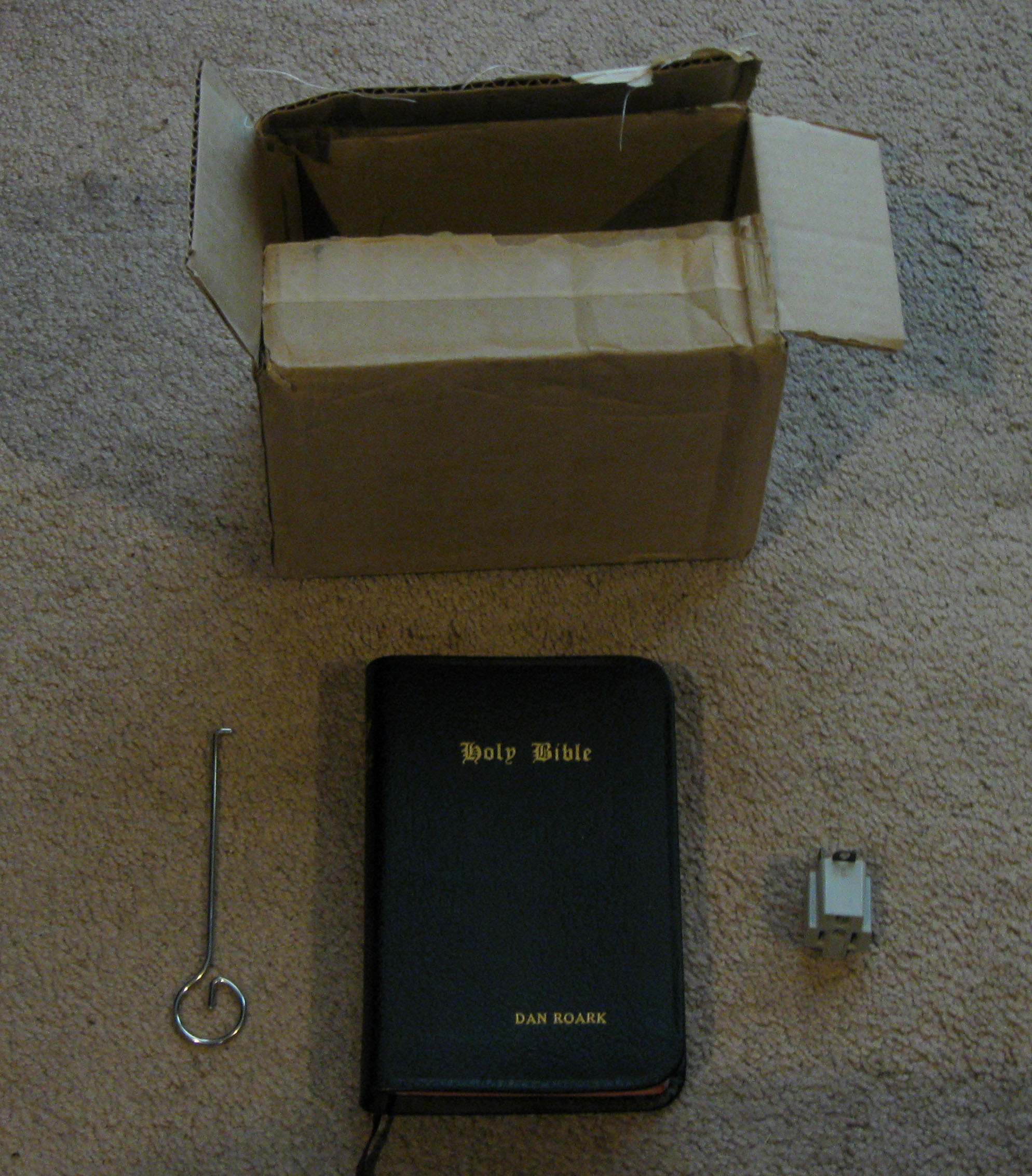
There are a number of boxes, gadgets, and doohickies in our shed, closets, and drawers that we have kept because they “might be useful some day.” They just sit there waiting – hoping that someday they fulfill their purpose – useless until useful. I walked out into the backyard this morning and discovered that Cyndy found a use for a box I decided to hang on to a few days ago. The box had acquired a secondary purpose. Like the doohickey – or thing-of-a-jig – that becomes the perfect “tool” to complete an odd job around the house.

Once a “might be useful someday” object serves a purpose it is no longer possibly useful. It is indispensable. It can collect dust for years, but it will not be thrown away. On the premise that because it has been useful once – or twice as the case may be – it will inevitably be useful again. Even though that might not be the case.

I have found that for some people, and some Christians, the Bible is simply one of those things to have around because it might be useful some day. They take it to church on Sunday if they remember it. “After all, they have one in the pew.” Then they never actual open it. Why bother when the lay reader is reading it to them. And the preacher will remind them if their thoughts happen to drift.

But – sure enough – a time comes when their Bible becomes useful. Tragedy strikes family or friends. A job is lost, a relationship ends, or any one of any number of life-changing events occur. Then their Bible again has purpose. It eases their mind, softens their heart, soothes their soul, or simply provides comfort. Their Bible has become indispensable.

Unfortunately, there are too many Christians to whom the Bible is something waiting to be useful. They have not discovered the life-changing story of the Israelite’s history, the life and death on the cross of Jesus, or the forgiving grace of God. They have not felt their “heart strangely warmed” as John Wesley did. They have not had their souls cleansed with God’s grace.

With persecuted Christians around the world clamoring for Bibles and materials to continue their spiritual journey with Christ, it is sad that many Christians in our part of the world have a Bible that they never use. I have had a Bible – and have been a Christian – for as long as I can remember. Beginning with the pocket-size New Testament I received when I began attending Sunday school. I have always had a Bible at hand. Unfortunately though, there were times when I felt I was keeping it around “in case it was useful.”

When I finally felt the Lord’s nudging and again opened my Bible for study and prayer, I ceased to think of the Bible as being “potential useful.” It is a part of my day, my life, my profession, and our family life. I feel uncomfortable when too much time has passed since our last visit. The Bible, once thought of as potentially useful, has become indispensable.

“In the beginning was the Word, and the Word was with God, and the Word was God.” John 1:1 NRSV.

Peace be with you.

Alyce McKensie, Professor of Homiletics at Perkins Theological Seminary at SMU, published a post before Easter entitled “Have You Got Your Ticket” on Patheos.com. With three teenagers and end of the year school and church activities, I was distracted and only recently re-read the post. The lectionary text that week was the Walk to Emmaus in Luke 24:13-35. “… Easter season is a journey that begins with the empty tomb and the Risen Lord. But for some reason I’ve been thinking about journeys and ways we can remember where were headed and why.”

McKensie recalled the well-known story about Albert Einstein’s train trip when he was on the floor looking for his lost ticket. The conductor told him it was okay, he knew who he was, and trusted him. “It’s not a matter of trust,” said Einstein. “If I don’t find that ticket, I have no idea where I’m going!”

Alyce then wrote about receiving an original ticket to the Wesleyan Class Meeting of the Wesleyan-Methodist Society from 1829. How holding the ticket in her hand led her on a mental spiritual journey back to when James Hart (the name on the ticket) was in fellowship and worship with the society and back to the beginning of the Christian church with the Last Supper and the empty tomb. Read the full post here.

While I was reading her post, my mind went in a slightly different direction (as my mind is wont to do) with the example of the ticket. I do not know what the conductor would have done with the ticket when Einstein found it. But I remember having to get my ticket punched when riding on a train – ostensibly to prove the conductor had validated my ticket. Which led me to consider another kind of ticket.

Part of the problem with the decline of churches today is that many Christians live as though they are mentally getting their ticket punched. Not exactly a good example with which to persuade people to come to, or come back to, church. It’s more about having their eternal ticket punched than faithfulness or discipleship.

Went to Communion Sunday – punch. Went to Wednesday night dinner – punch. Church music programs – punch. Holiday worship services – punch. Christmas services and Easter services – double punches at least. As if the totality of one’s good works can bring entrance to heaven.

If St. Peter at the golden gate were the conductor to eternity, when handed the attendance punch card, he might ask: “Where is your mission punch card, your evangelical punch card, your kindness to strangers punch card?” And so on. If the applicant is using the punch card approach, they are going to fall short of the mark of a good and faithful Christian.

Approached with a true and right spirit, attending church services and events are joyful times of worship and fellowship. Worship and fellowship create an impetus for doing good works, not the other way around. The good works come as acts of faith to, in some small way, return the favor for the Lord’s magnanimous gift of grace. We should want to do good works to further our spiritual journey, not to collect points.

“For by grace you have been saved through faith, and this is not your own doing; it is the gift of God – not the result of works, so that no one may boast. For we are what he has made us, created in Christ Jesus for good works, which God prepared beforehand to be our way of life.” Ephesians 2:9,10

Peace be with you.

The Mercedes commercial, in which the driver does not see objects coming, but the car does, is disturbing to me. You know the commercial. “I didn’t notice I was swerving, but my car did.” “I didn’t realize I was nodding off, but my car did.”

On the surface, it is simply a commercial to illustrate some advanced features of Mercedes’ new car. The ability of the car to sense coming obstructions and automatically avoid them. Which is obviously a good thing when it comes to accidental circumstances.

But a viewer could interpret the commercial to mean that it is not necessary to bother paying attention. And many drivers cannot afford to pay any less attention. “I was sending a text to a friend and didn’t see the car in front of me, but my car did.” “I was talking to a friend in the back seat and didn’t know I was swerving into oncoming traffic, but my car did.”

Odd, is it not, that an improvement in an automobile that can potentially prevent accidents and save lives is also a potential excuse for continuing the same activities while driving that cause more accidents and deaths. Sad as it may be, people will use the advanced feature much like they use cruise control – a feature to enable them to do unnecessary things while driving.

Which is much the same with many things. Such as the Bible, the Koran, and other sacred texts. Texts which were written (by whatever means or guidance) to guide people along a path toward spiritual fulfillment. Yet some readers insist on using these texts – in and out of context – to justify their own actions that most assuredly are not spiritual or fulfilling. The very scriptures intended to bring hope, peace, inner tranquility, and spiritual assuredness are distorted to excuse acts of violence, terrorism, and war.

The examples in the Mercedes commercial were appropriate examples to demonstrate the self-correcting feature. The implication of the dialogue was objectionable, but the intent was honorable. The misinterpretation as a result illustrates one of the problems with the human condition. As humans, we have the uncanny ability to take things given to us to with the intention of improving our chance of living through the world we have abused, and use them to further our selfish, lazy endeavors to do what we want, without consideration of others.

Fortunately, by the grace of God, as humans we have the moral capacity to know when we are doing wrong. But as a result of free will, we also have the capacity to make wrong choices and screw up. The key is to succumb to God’s extended arms of grace before falling prey to the temptations constantly before us. To follow the Scriptures as God intended and not as an excuse to satisfy our selfish desires.

“Do nothing from selfish ambition or conceit, but in humility regard others as better than yourselves. Let each of you look not to your own interests, but to the interests of others. Let the same mind be in you that was in Christ Jesus.” Phil. 2:3 (NRSV)

Peace be with you.

[Re-posted from former blog]

Faith and Pop Culture is the eighth installment of the Christianity Today Current Issues Bible Study Series, published by Thomas Nelson. As stated in the introduction, “[t]his Current Issues Bible Study is designed to facilitate lively and engaging discussion on various facets of entertainment and how it connects to our lives as Jesus’ followers.” The Faith and Pop Culture study examines the compatibility of our faith with the current culture as it pertains to the various parts of the entertainment industry. The book includes observations on movies, books, sports, television, and violence in entertainment media.

The study also takes a look at how entertainment affects Christians and vice versa. Must all entertainment Christians enjoy be “family friendly?” Can Christians influence the entertainment industry? With “entertain me” as the cry of our culture, is it compatible with a life of faith? These are questions to be discussed during the eight weeks of this study.

The Current Issues Bibles Studies are designed to be small group studies. Each session of the Faith and Pop Culture study begins with a Scripture Focus which provides the passages pertaining the lesson. After a brief introduction, a relevant article from Christianity Today magazine and ChristianityToday.com follows. The study guide of each session following the article are Open Up – discussion activities, The Issue – focusing on the main issues with which the session is concerned, Reflect – sharing thoughts and observations on the Scripture Focus passages, Let’s Explore – discussion questions, and Going Forward – taking what is learned and discussed and putting thought into action within our culture.

Each study guide includes ample questions and activities. Which allows for flexibility within the small groups using the study. If the group meets for two hours, they have plenty of questions, scripture reading, and activities. A group that meets for a shorter time has many options to choose from. Some sessions have “bonus” ideas or extra activities which could also be done outside of the regular group time.

In a time when many books and articles are written about modernism, post-modernism, and, indeed, faith and culture, Faith and Pop Culture is an intriguing Bible study that allows Christians as a group to actively apply their faith to the culture in which we live. The studies are also relevant for any small group in any situation. After reading the study, you might find yourself mentioning the book and series to group leaders whom you know.

Peace be with you.

I was given this book by Thomas Nelson Publishers for the purpose of  review. I was not required to write a positive review, nor did I receive any compensation other than the book itself.

Max on Life,” the new book by Max Lucado and published by Thomas Nelson consists of the author’s answers to questions he has received over the years in letters, emails, and phone calls. Questions he has been asked as both a pastor and a writer. The letters Lucado received as a pastor are separated by categories (and chapters) entitled Hope, Hurt, Help, Him/Her, Home, Haves/Have-nots, and Hereafter. The questions asked of Lucado range from basic theological questions to marital questions related to God to why go to church. The pastor writes about the role of prayer, the purpose of pain, and the reason for our ultimate hope.

The writing questions are answered in an essay in the addendum, The Write Stuff. The well-written essay deals almost exclusively with writing for the church and as a calling, using the prophets and other authors of the Bible as examples. Lucado deals with basic matters of writing in the last couple of pages. He does not tell an aspiring writer how to be published. But he does tell anyone who feels called to write in the service of the Lord how to proceed from the call, the desire and an idea.

Some readers will read the book cover to cover. Others will use it as a devotional reference or as a topical reference when they are facing hard questions in their own lives. Lucado directly answers most questions with personal experiences and/or Biblical references combined with insights gained from his study, reflection, and prayer. Even answers to questions I will probably (and hopefully) never have still evoked deep feelings, causing me to reflect on my own spiritual journey.

“Max on Life” is an interesting read. Regular readers of Max Lucado will enjoy this book as well as those who are not familiar with his earlier books.

Peace be with you.

Grief and the Presence of God is a Bible study using the book of Job with observations from C.S. Lewis and my own experiences. Originally written for use in a Sunday school, I recently revised it. The study is in three parts, with study questions in the back for each lesson.

Lesson one, Grief and It’s Symptoms, delves into the symptoms and resulting effects of the grieving process. The Book of Job certainly has a lot to say about grief and it’s effects. As I mention in the study, Job is probably the only person in the history of the world – with the exception of Jesus (and he knew what his mission was) – who can truthfully tell someone that they do not know how he feels.

Lesson two, Meanwhile, Where is God?, discusses what is arguably the most destructive symptom of grief – when you think God is not around when you need him. When one is grieving, being told that the departed loved one is in God’s hands is little comfort when one considers that they were in God’s hands even as they were on the road to death. It is even more disconcerting if the death was slow and painful.

Lesson three, Alone into the Alone, is concerned with Lewis’ Cosmic Sadist theory and what I consider to be the myth of closure. Whether you agree or disagree with Lewis’ theory or my own theory of closure, you will come to your own conclusion and perhaps progress further in your spiritual journey. After which you will hopefully be better equipped to face times of grief in the future.

Grief and the Presence of God is available in the bookstore at www.danroark.com.

Peace be with you.

Before the spectacle we refer to as the Super Bowl (with its own display of vanity) – before the freezing temperatures, the ice, and the snow – Cowboys Stadium (speaking of vanity and excess) was the site of another vanity focused event. The Great Plate auction at Cowboys Stadium a couple of weeks ago was more than a little over the top. They are called vanity plates after all, but the term originally applied to simply having your name – or some form thereof – on your license plates, announcing to the world that the car belongs to you. In many cases, the car was a rather expensive one, adding to the sense of sheer vanity.

Thirty-three speciality (read “vanity”) license plates were up for grabs at the auction. A woman bought T BIG TEX for her husband and DIAMOND for herself for a total of $4,500. She reportedly said that it was “for a good cause.” Not quite true – the majority of proceeds from the auction goes toward the general revenue fund. The rest of the proceeds is to go to charities, the Department of Motor Vehicles, and MyPlates – the company designing and marketing the plates.

Not surprisingly, sports teams brought a few of the largest bids. DRAGONS (Southlake Dragons) went for $7,750. Which is quite a sum to show off around town for a high school team. Rangers sold for $10,000, GO HORNS for $10,500, and COWBOYS for $11,500. The largest bid was for FERRARI, which brought in $15,000.

Granted, the “winners” are allowed to keep the plates for 25 years and can sell them for a profit at any time. But who can imagine spending enough for them to make a profit? Unfortunately, I think there are some people who could. People to whom vanity is priceless.

Qohelet would have been appalled. In all of his searching, with times of serious excess, I believe this example would take the proverbial cake. What Qohelet did he did with the goal of knowledge and wisdom in mind. True, it was excess, but it was practical excess – to coin a term. Qohelet considered efforts to improve oneself and serve a purpose in this lifetime, vanity (or meaningless, or vapor). He did give into pleasure, but only to find out if it led to knowledge or wisdom on some level. To actually give into vanity for its own sake would have given Qohelet a heart attack. It would have made Jesus, himself, pass out.

People are free to spend their money on whatever they choose. But – and you saw that coming, did you not? – would not giving $15,000 to a charity be more beneficial to the recipients than what is left over after everyone gets their piece of the auction price. Of course, they would not have the supposed popularity (or notoriety, as it were) of driving around with a $15,000 license plate (which is hard to even say or write). And how much will their insurance payments increase to include damage or loss of the plate?

If I was them, I would install the plates in such a way as to seriously discourage theft. On the other hand, if they were me, they would never have bid on the plates in the first place. I have enough problem curbing my own impulses towards vanity without announcing to the world that I am insecure enough to pay $15,000 for license plates so that I will be noticed.

Peace be with you.

[The picture and information were taken from a WFAA.com article by Chris Hawes]