

Will journalism survive the digital age? If it does, what will it look like? Will it be profitable or subsidized? These were the questions discussed by the panel that included David Sedeno, editor of The Texas Catholic/El Catolico de Texas, Sam Hodges, managing editor of the United Methodist Reporter (UMR), and Jeff Weiss, reporter (and past religion writer) for the Dallas Morning News (DMN). The journalists were speaking to members of the Dallas-Ft. Worth Chapter of the Religion Communicators Council (RCC) at their October meeting, held at Christ United Methodist Church, Farmers Branch.
Moderating the informal discussion was Cherrie Graham, Chapter President and advertising manager at UMR. “Looking at the first question, Will journalism survive? Well, it has to, it doesn’t have any other choice.” The question is not will it survive, but how will it survive?”
During his response to the question, David Sedeno discussed the elements for successful publications in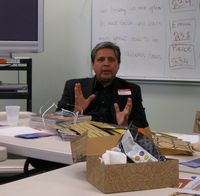 today’s media environment. “Let’s not give up on printed product yet, in terms of niche [religion] publications. The four things I look at [for success of print publications] are content – not content as content, it has to be relevant. So the second thing is relevance. The third, obviously, is technology. You have to take a look at the capabilities you have to extend your reach. The third, and probably the most important one, is partnerships.” Sedeno went on to explore the avenues of partnership.
Media applications on tablets are partnerships, using advertising from both sources to affect the financial outcome. In 2001, DMN entered into a partnership with a website in Mexico that wanted their content to translate into Spanish. Which illustrates not only a partnership, but content that is relevant to readership. Sedeno added that while he does not think that paper products will come to an end, “tablets are certainly taking a big bite out of everything.” Tablets are portable and you can take them places you couldn’t take a laptop. In addition, the applications open up new avenues of revenue. But it all goes back to content that is relevant, and partnerships.
Jeff Weiss, “the only one [of the three panelists] still employed by the Dallas Morning News,” began by saying that when he woke up that morning, “it was cold and wet.” “I picked up my iPad…and opened the e-edition of DMN and it looks exactly like the print version. And that’s how I have increasingly read the newspaper. I’ve been comfortable with the title ‘content producer’ long before some of my colleagues were. Because that’s what I do – I generate content.” Addressing the religion communicators directly, Weiss stated that with fewer and fewer people and less and less money, mainstream media has a smaller and smaller stream of what they can cover. “Which makes what religion publications do so much more important to their target audiences and people who want to get the word out for them.”
 In response to the question – how will journalism be paid for – Weiss stated that he does not know “where we (Dallas Morning News) will be in five years time.” The newspaper continually has less people and less content while asking people to pay more for it. “At a certain point, we can no longer be producing enough content that people will be willing to pay to read it.”
“Are we there yet?” Weiss asked. “I don’t think we are. Even in its diminished form the Dallas Morning News is still producing way more general content than anybody else in the area. And there is still an audience for that. And as a business proposition, we have more advertising dollars than anyone else in the area. So advertisers are going to be willing to pay for that as long as they see results.” While he is fairly certain that he could make a decent living writing for online publications and websites, he would not receive the benefits that he does with DMN.
“I think the larger truth, that David was speaking to, and Jeff, too, is the decline of mass media and an era of fragmentation,” said Sam Hodges. “It’s a wild frontier out there. And I think journalistically there are advantages to having fewer gate-keepers, and some real disadvantages. I think the question mark is the economic model. What underwrites professional journalism, the gathering of news, analysis, etc.?
The world is becoming flat and also fragmented at the same time. You can communicate instantly with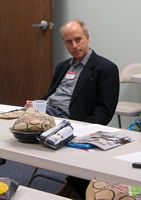 anybody in the world and yet we all seem to be in our little villages at the same time. If you are passionately interested about [a particular subject] there is something on the web that will satisfy you. Journalism might be part of a bigger shift in American life that disadvantages the middle class.
Because, it seems to me, that we had an era where what went away were pension plans. What you got next were 401K plans, and then, suddenly, employers weren’t contributing to 401K plans anymore. And now I think phase three is that salaried, benefitted jobs, especially in journalism, are going to continue to decline. You’ll have people working as freelance writers or maybe on contract and they’re responsible for their own benefits and vacation pay.”
While the discussion was lively and informative, there were few clear answers. Religion and niche publications have a more secure future than mainstream media, but what form that future may take is still an unknown factor. The emphasis, however, will be on adjusting focus to attract succeeding generations in a changing world, such as The Texas Catholic’s Texas Catholic Football publication to engage the younger generation. As well as broadening the options available, like UMR, with advertising partners and printing services. But the future of journalism will still depend on what has kept it alive and vibrant for years. Content, relevance of that content, technology, and partnerships.
Peace be with you.



 Chasing After Wind