Tag Archive: religion


Have you ever bought a bag of potato chips – or other munchie (although, oddly enough, it is always potato chips with me) – and open it to find nothing but air? As if some ticked off employee who is having a bad day fiendishly plotted – complete with crooked grin and sneer – to put a hitch in my day. I always took it as a personal affront because usually it was the only cash I had at the time and I was away from the store when I opened it and would not have been able to prove it was actually empty.

The fact that it contained no salt could simply mean that I wiped it clean. Although why anyone would do that, I could not tell you. Suffice it to say, the empty bag pops up at the most inopportune time. We had one of the large variety boxes of chips. The empty bag is never discovered right away. That would be rather convenient and that is not allowed.

The empty bag, of course, was the last bag of one of our sons’ favorite chip. Which, also quite naturally, he had been saving for just that particular occasion. If you have been one of the chosen few who have never received an empty bag of chips, you can liken it to the time in college when you were settling back one evening. You get a cup of coffee or your favorite beverage, find a book you actually want to read, then go to the cabinet and your roommate has eaten your last Ding Dong (insert favorite dessert treat). Going to the store to get a replacement, while within the realm of possibility, just would not be the same thing. The moment is ruined.

As to the empty bag of chips, there is no real person to blame. I used to imagine the assembly line worker who fills the bag with chips turning to another worker. With a fiendish look on his face, he says, “I’m going to fix somebody,” as he passes the empty bag down the line. Ostensibly getting back at who knows who about who knows what. He feels bad so making someone else feel bad apparently evens things out.

It is harder to get upset at a machine having a sudden glitch and not pushing the chips into the bag which would be sealed by another machine that did not know the difference. And if you are one of the lucky people who have never bought an empty bag of chips, your time may still come. I have happened upon several myself, and each member of my family has had it happen to them at least once. I would think we have reached our quota.

“I said in my heart with regard to human beings that God is testing them to show that they are but animals.” Ecclesiastes 3:18

Am I suggesting that empty chip packages or roommates eating the last dessert treat are tests from God? Certainly not. God has considerably more important matters to attend to than a glitch in the machinery at the chip factory, the act of a disgruntled employee, or a hungry roommate. God created the world and set it in motion. Humans are the unpredictable factor in the equation – thanks to free will.

With all of our gadgets and internet connections, giving us the illusion of being in control of our lives, we still need to be reminded that we are not in control. To think that we are is surely a vanity and chasing after wind.

Peace be with you.

Time of Calamity

A couple of days ago, about 10 a.m., the bottom dropped out, weather-wise. The “sky was crying,” as Stevie Ray Vaughan would sing. It also sounded as if Mother Nature might have some serious issues. Being in the middle of a storm is a little scary, no matter who you are. You may not admit it, but even the strongest among us have their moments.

When it is storming so tremendously outside that the thunder, lightning, and rain on the house is all you hear – even over the tv, radio, or heater. The sun seems to be on sick leave and the sky just gets increasingly darker. If you are having any major life problems at all – and who is not – a serious funk can be one thunder crash away. The all-consuming gloominess that appears to surround you suddenly feels tangible – shrinking around the house like plastic wrap – closing off all exits. That’s how I imagine Qohelet felt when I read certain parts of Ecclesiastes.

“Again I saw that under the sun the race is not to the swift, nor the battle to the strong, nor bread to the wise, nor riches to the intelligent, nor favor to the skillful; but time and chance happen to them all. For no one can anticipate the time of disaster. Like fish taken in a cruel net, and like birds caught in a snare, so mortals are snared at a time of calamity, when it suddenly falls upon them.” Eccl. 9:11, 12.

Everyone has experienced times similar to those mentioned here. But, as I discuss in the book, Qohelet did not have grace and forgiveness of sins as we have. Not to say that God did not give grace to the Israelites or grace their endeavors – the Israelites simply did not see it as grace, per se. The Israelites and people of the Old Testament viewed life in more concrete terms. If life took a bad turn – family, crops, or livestock dying, for example – they must have done something to cause it.

Unfortunately for them, Jesus Christ had not been born yet. Fortunately for us, he has. Through Christ’s life and sacrifice, we not only have God’s grace, but the Holy Spirit and forgiveness of sins. Looking at Ecclesiastes in that light, we can take Qohelet’s view – which is valid even today – mix in grace, the Holy Spirit, and redemption, and ascertain our actions as Christians when we have a tendency to “hate all the toil in which we have toiled under the sun.”

Join me on the journey.

Peace be with you.

Words and phrases that may have begun as an original thought with an apparent obvious meaning and intent, after constant use, misuse, and abuse, over time become catchphrases and buzzwords with thoroughly ambiguous meanings. Thinking “outside the box” was the hot business concept in the late 1990’s. Through the years, the expression has been bandied about and used in advertisements and press releases to represent ideas and supposed innovations that, in the end, were not so out of the box after all. All anyone succeeded in doing was expanding the box.

“Whatever” was originally used having to do with making a decision. As in “get a Coke or a Dr. Pepper or whatever you want.” Or ” it has to do with Kleenex, napkins, paper towels, or whatever.” Currently the word is most often used to mean “I don’t want to talk about it anymore.” Or a sign of being noncommittal. Our teenagers and their friends use it when they have gotten themselves in a conversational hole and do not want to admit it. “Whatever!”

The phrase “don’t guilt-trip me” gained prominence in the 1960’s with accusations that the “establishment” was trying to lay a guilt-trip on the middle and lower classes. While I sympathized with some of their positions, I disliked the phrase even then. It is more distasteful to me now when my children use it toward me. What the phrase actually means is “I know I’ve screwed up a lot (or owe you a lot), but I don’t want to be told that, I want to get what I want.”

Other variations could be applied, but that is the gist. More often than not, what they refer to as guilt-tripping is actually telling them the truth. For example, one of the boys asks us for something that requires financing from us. When we go down the list of things they have already received no return effort – even though that was the arrangement- we are now required to add “and I’m not trying to guilt-trip you, just telling you the truth.” Beat them to the punch, as it were.

I grew up under the impression that it was easier to keep problems and debts to a minimum rather than endure the bothersome situation of feeling bad. It is our conscience that causes us to feel remorseful. Other people cannot make you feel bad – or guilty – if you have no reason to feel bad in the first place. But most of us feel shame over past indiscretions of one sort or another. In addition to a natural inclination to get defensive when being told we are being selfish. Because, on some level, we are all being selfish. But we would prefer not to admit it or have it made public.

Which led me to wonder if sometimes we do not try to guilt-trip God. As if making a list of our Christian “accomplishments” will persuade God to lend a special hand and eliminate our particular situation. A situation which seems important to us, but in God’s grand scheme of things is quite minuscule. Yet we have the audacity to think that we could have possibly done enough good in our lives to not only outweigh our myriad of failures, but move us higher up on God’s to do list.

“Where are you, God? I go to church every Sunday, well, most every Sunday. I attend Sunday school. I am at the Wednesday dinner s. I read the Bible every day. I pray every night for everyone on my prayer list. I try to be kind to everyone. So why am I stuck in this situation? Why will you not help me?”

God did not put us in the situation we are in – we did. We may not have been the direct cause of our current malady or tragedy, but in some way we had a hand in it. Regardless of whether we were a part of the cause or had little or nothing to do with it, God most certainly was not the cause. Why are we blaming him and ridiculously trying to make God feel sorry for us and give us the outcome we want. We do not want the outcome that God wants or the outcome we may deserve. We want the outcome we think is best.

Just like our teenagers. They do not want to hear the truth. They want to be told they can have things their way. Telling them the truth is guilt-tripping them. We are alongside our children when we ask God for help. We do not want to be guilt-tripped by being told the truth or what is best for us. But we know in our hearts and souls that God wants the best for us. So why are we trying to blame and guilt-trip God?

In trying to guilt-trip God, and when our teenagers try to guilt-trip us, one thing is overlooked. It is, in fact, what is wrong with the term guilt-trip in the first place. It also renders the term irrelevant. And it is quite simply this: you cannot guilt-trip a truly innocent person – or being – as the case may be.

Peace be with you.

Vanity of vanities, says the Teacher,

vanity of vanities! All is vanity.

What do people gain from all the toil

at which they toil under the sun?

A generation goes, and a generation comes,

but the earth remains forever. Eccl. 1:2-4

During a Disciple Bible Study several years ago, when we got to Ecclesiastes, the text suggested that we read the entire book in one sitting. Always up for a challenge, I dutifully read it all the way through – and I was fascinated. Of all the books in the Bible, I have read or heard passages from Ecclesiastes the least in my lifetime as a Christian. Granted, I did not go to church all the time when I was younger.

If you take a passage of Ecclesiastes out of context, it can be downright depressing. Which is the general opinion of Ecclesiastes from what I have ascertained after hearing sermons, speakers, and talking with people. But when I read it in one sitting, not only did I see the relevance to my life, but was left with a feeling of hope. Quite the opposite of what I expected after what I had heard.

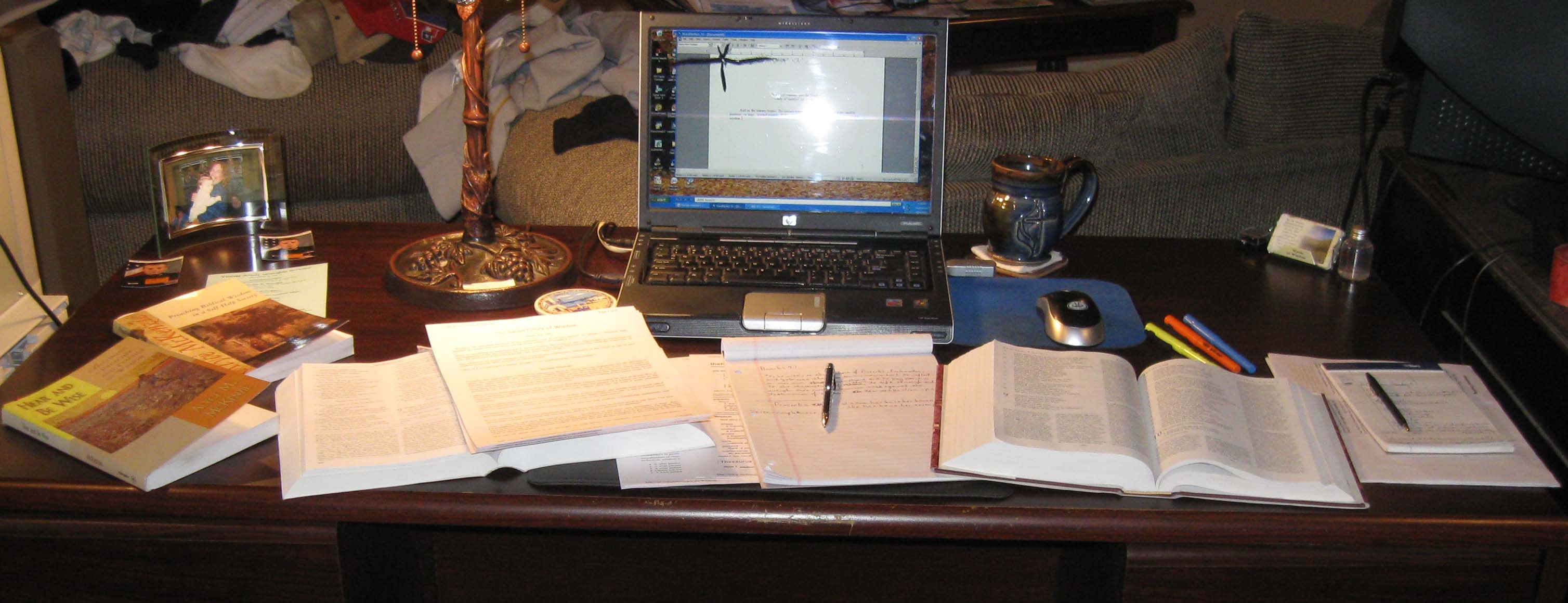
I knew then that my next Bible study would be Ecclesiastes. This is not the first full length Bible study I have written, but it will be the first one published. The previous studies are still waiting for reprint permission for passages I included. So I began my journey with Qohelet, the teacher.

Scholars generally agree that Solomon did not write Ecclesiastes. But it is not known for certain who did write the book. I prefer to look at it from the view that Qohelet, the “teacher,” or “preacher,” was the author. It seems to be more relevant to our lives today from that view.

I am currently editing the book for the last time. Feel free to join me on my dual journey – through Ecclesiastes and the editing process – which will continue as a journey through theology and our lives today.

Peace be with you.