Tag Archive: song


jbl-harman-truckI’m on the home stretch – catching up-wise. On September 28, I had the good fortune to play one of my songs for a video in the EON ONE Take – One Song One Take contest from JBL Professional and Harman. I had been picked from a large number of people to receive a slot. I arrived at the Harman truck in the Guitar Center parking lot in Farmers Branch before my required time. I signed the required form and waited my turn.

J.T. – I’m pretty sure that was his name – had me tune and set up, then do a sound check. When the red line came on, I played my newest song at the time – Peace Be With You, which I wrote about the strange year we’re having and the shooting during the protest in downtown Dallas. [A live version will be available soon.] J.T. seemed to like the song. I’m sure he has to be careful lest someone misunderstand. He explained how the contest would go from there.

The tour around the country concludes about the end of October. Voting will take place the first couple of weeks in November and the top ten finalists will be picked and notified. I’m not sure how the grand prize winner will be picked from the finalists, but the grand prize is a trip to LA to record the song at a noted studio.                                                                                                                                                              akg-d5

As I thanked J.T. and left, he handed me an AKG D5 microphone for recording the video and entering the contest. I used the microphone when I hosted the Monday open mic at Angela’s at the Crosswalk a week ago Monday and the mic performed beautifully. A very clear sounding mic without any of the annoying whine or scream on the high end. At $99, it’s a great deal.

Hopefully, I’ll be asking for your help to do whatever I have to do should I be chosen as a finalist. But I’m not holding my breath.

Peace be with you.

Okay, so it’s not really a tour. But since I wrote a song for Sack Summer Hunger, I have played it at every show and talked about SSH to increase awareness and support – both volunteers and donations – before the program begins on June 11. So it is, in a way, a tour. Several of the “shows” consisted of playing “What the Lord Intends” for congregations of churches. Which included the congregation of The Norkirk Presbyterian Church Sunday morning. The tour ends this coming Sunday, June 5th, with the Sack Summer Hunger Concert.
[The video is of my show at Angela’s during the DSA Showcase. The SSH song is third.]

The Norkirk is a very friendly church. I felt welcome right away. I was looking forward to seeing Nancy Pratt, who is the Christian Education Director. Nancy and I went to high school together. I wrote for the school paper and Nancy was my first in a long line of editors throughout the years.

I wrote a music review column for the paper. I reviewed albums, books, concerts, and so forth. Since it was for school, my parents paid for most of the concerts. I saw a lot of concerts. I would write my column in the style of Hunter S. Thompson or Tom Wolfe – as a participant rather than an observer.

I never knew how much space was available in the next issue. So I would write until the column was finished. Usually on deadline day, or rather deadline hour. The newspaper office had a manual typewriter. After an hour or more of frantic typing, my fingers were sore, but I had a finished column. She would tell me she had room for 250 words. I would hand her the final copy.

“Here’s 400. You choose the 250.”

I actually think I said that to her once. I hope it was only once, but I doubt it. I wasn’t really trying to be pompous. I had written it as a complete piece and would have a hard time cutting it down. Mainly because I was covering a lot of events, depending on the month. I don’t know that she even remembers, but I will apologize when I get a chance.

I walked into the church to smiles and hellos. I set my guitar down when I spotted the restroom. On my way, Rev. Bill Parr approached me.

“You must be here for our minute for mission.”

“I am.”

“Bill Parr,” he said as he shook my hand. “ We’re glad you’re here.”

After I did what was necessary, I picked my guitar up and went into the sanctuary. I didn’t know what to do, so I set my guitar down at the rear of the sanctuary. I looked up and there was Charlotte and Bruce Gibson. I went over and hugged Charlotte and shook Bruce’s hand.

I was in a band with Bruce’s dad and Charlotte’s ex, Bruce, and Joel Nichols, named Southern Plains. Joel and I were a duo for twenty-five years, with Bruce joining in when we played in Dallas and he was able. Joel and I had a band when we made enough money to pay them. Joel died in 1999. Bruce and I played at his funeral.

I went up in the front of the sanctuary and set my guitar case down out of the way. I pulled out my guitar and quickly tuned it. Several people greeted me and thanked me for being there. Then Nancy came up and gave me a hug. She introduced other members that had gone to W.T. White.

The service was an experience in fellowship. John Reas gave me a very nice introduction. I played What the Lord Intends (Sack Summer Hunger) and the congregation appreciated it, judging from the applause.

I appreciate all of the old friends I meet, and I hope I continue to run into old friends. As well as meet new friends who will become old friends. Far too many old friends are no longer with us.

Peace be with you.


Since it is Autism Awareness Month, here is a video of my song about those on the autism spectrum – Hello Out There.

Dan Roark and Roy Elkins

Dan Roark and Roy Elkins

People began to arrive at Sons of Hermann Hall at 6:30 on Tuesday, December 8 for the Dallas Songwriters Association (DSA) Song Contest Award Ceremony and Christmas party. Board members Barbe McMillen, Bobby Montgomery, Ken Duren, and Dan Roark, with member and SOHH employee, Lisa Byrn, David Lewis (SOHH), and the sound man, Logan Hughes, had arrived early to set up the hall. Master of Ceremonies for the evening, Roy Elkins, CEO of Broadjam.com, pitched in to help Bobby set up the food tables. Board member, James Pappas, owner of Dallas Ice Sculptures, supplied the Christmas tree sculpture for the table.

Christmas Tree Ice Sculpture
The ceremony began promptly at 7 p.m. with a welcome from Barbe McMillen, DSA Founding President Emeritus and an explanation of the song contest process and breakdown of prizes. She then introduced MC Roy Elkins. As mentioned earlier, Roy is founder and ceo of Broadjam.com. He came down from Wisconsin a day early to present a free workshop the night before at Tone Shop Guitars in Addison. The workshop was called Your Music and Your Business. Elkins shared from his experiences in the music business and Broadjam, as well as information from music contacts. More information about the workshop can be found here.

AudienceAfter a few opening comments, Roy introduced Dickey Johnson. Dickey, along with Mary Guthrie and Mary Hestand (Sugar Daddy and the M&Ms), played his winning critique song, Alone with Alone. Then Elkins introduced Dan Roark, Showcase, Workshop, and Lyric Contest Director. Dan gave a short bio of the Americana judge, Kendra Terry, booking manager at Uncle Calvin’s Coffee House. He read the list of semifinalists and announced the winners.

Roark then introduced Katie Riley, with her mother and sister. They played both of Katie’s Dan Roarksemfinal songs, I Believe (Christian), and Dry Bones (Pop/rock). After which, Dan gave a short bio of the Christian/Inspirational judge, Scott Dicken, currently music director at Christ United Methodist Church in Farmers Branch. He then read the semifinalists and announced the winners, before introducing Rio King. Rio played his four winning critique songs, Sweet Rolls and Cream, Boogie Woogie Rhythm, Boomer Boogie, and The Old Wrecked Vet.
Roy Elkins stepped back up and introduced Bobby Montgomery, DSA Executive Vice President, and 2014 Songwriter of the year. Bobby gave a short bio of Larry Beaird, owner of Beaird Music Group, and judge of the country category. After reading the semifinalists and announcing the country winners, Montgomery introduced M’Lynn Musgrove. M’Lynn played her two semifinalist songs, Healed, and Preaching to the Choir, both in the singer-songwriter category.

M'Lynn Musgrove

M’Lynn Musgrove

Elkins then introduced Michael Brandenberger, DSA President. Michael gave a bio of the Instrumental judge, Tony Hakim, owner of jazz venue, Kitchen Café, and a positive force in the Dallas-Ft. Worth jazz scene for over 25 years. After reading the semifinalists and announcing the winners, Brandenberger introduced Dori Weavers, who played her winning critique song, Waiting to Breathe. He then read the Love Songs/Easy Listening semi-finalists and announced the winners.

Barbe McMillen came back to the podium to give a bio of the Children’s/Novelty judge, Monty Harper, who has been on the Oklahoma Arts Council Touring Roster since 1995. Barbe read the semifinalists and announced the winners. She then introduced, Jon Storm. Jon played his semifinalist song in the Pop/Rock category, Love Me Now.

Roy Elkins returned to the podium and introduced Harry Hewlett, co-director of the song

Warren Hanson

Warren Hanson

contest this year and director next year. Harry gave a short bio of Pop/Rock judge Kathy Forste, who has worked in television and radio for the past 30 years in various capacities. He read the semifinalists and announced the winners. Then he introduced Warren Hanson, who performed his semifinalist song in the singer-songwriter category, Just Lucky I Guess.

Roy Elkins returned to introduce Michael Waid. Michael performed his singer-songwriter semifinal song, Lost and Found. Roy then introduced Jennifer Marler, who, joined with her husband, Justin, played her semifinalist song, Memories Don’t Burn. Then Elkins called Barbe McMillen back to the podium.
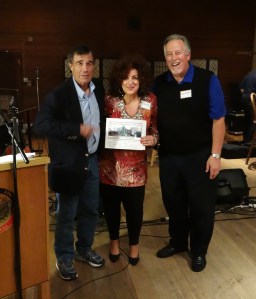
Harry Hewlett, Dori Weaver, and Michael Brandenberger

Harry Hewlett, Dori Weaver, and Michael Brandenberger

Barbe gave a brief bio of singer-songwriter judge, David Card, owner of Poor David’s Pub, one of Dallas’ best listening rooms. David also founded the BW Stevenson Memorial Singer-Songwriter Competition. Then Barbe read the semifinalists and announced the winners. She then announced the winner of the iPod for which each contest entrant received an entry. The winner was Samuel Miller from Chico, California. Miller’s song, Can’t Get Enough, was a semifinalist song in the singer-songwriter category.

McMillen explained the judging process – which can be found on the DSA website – and introduced grand prize judge, Roy Elkins. Roy talked about the song entries and announced the Grand Prize winner. He then introduced Buck Morgan, who played his winning critique song, Jimmy Loves Jesus. Elkins then introduced Bobby Montgomery, who played his winning critique song, Give ‘Em Time, Lord.

Harry Hewlett, Rio King,Barbe McMillen

Harry Hewlett, Rio King,Barbe McMillen

Roy brought Harry Hewlett back to the podium. Harry explained the process for song of the year. Then he gave a short bio of the song of the year judge, Ian Dickson, a singer-songwriter having performed for a number of years. Then Harry announced the Song of the Year winner. Harry made some closing remarks and then Michael Brandenberger started the open mic. A list of semifinalists can be found here and the a list of winners can be found here.

Although time and space did not allow me to elaborate more, all the performances were wonderful and the evening was a huge success.

Keep writing the songs that are in your heart.

Roy Elkins 1Roy Elkins, CEO of Broadjam.com, has been Master of Ceremonies for the Dallas Songwriters Association Song Contest Award Ceremony for several years now. This year, he offered to come a day early and give a Your Music and Your Business workshop – at no cost. With the awards ceremony/Christmas party always on the second Tuesday of December, which would be our regular meeting night, we decided on Monday for the workshp.

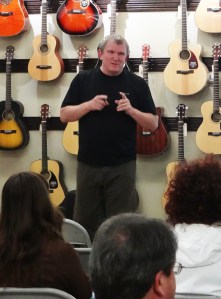
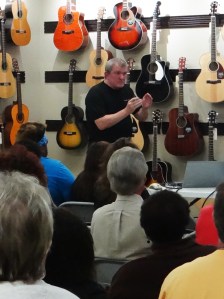
DSA President Michael Brandenberger has known Tommy Roberts for many years. Tommy Roberts is co-owner of Tone Shop Guitars, north of Beltline on Midway, in Addison. Michael asked Tommy if we could have the workshop in their very large showroom. It is a very nice store. Tommy said they would be happy to have us. I met with him and we went over details.

The day of the workshop, we had 26 rsvps. We were shooting for 30 people. I brought 32 chairs. The Attendees workshop was to begin at 6 p.m. I arrived at 5 p.m. and one person was already there. Since it was a guitar shop, the early arrivals had something to do – which was one of the reasons Tommy was eager to have us.

Since a few people had not arrived by 6, we started a little late. Several people arrived during the presentation. The final tally was 28, with two no-shows of the original rsvps. At such a busy time of year, with traffic like it was, we had a great turnout.

Roy gave a very entertaining and informative presentation. He talked about starting Broadjam because he wanted to help songwriters. The used Broadjam, as well as his experience in the music business to illustrate his points. Roy discussed what, and how, to prepare for a pitch. He described good and bad music or song pitches.

Roy Elkins 2Elkins showed the crowd a written pitch that he had actually been given by a member of a band. The writer was apparently inviting Roy to see them at a show. He went on to basically say that the drummer sucked, but they were still going to use him just for the night. He made some more excuses – with bad punctuation and grammar. He ended by saying “you can find our music on soundcloud, sonicbidz, and revernation.”

Roy talked about how ridiculous the mistakes were. The punctuation and grammar mistakes were obvious. Have good material for them to hear. If it’s good, there’s no need to make excuses. Stand behind your work. And if you want someone to listen to your music, you don’t tell them they can find your music on their competitors website.

“It happens more than you think. I talk to those guys all the time (representatives from the three companies mentioned above) when we’re on panels together,” Elkins said, “and we always laugh about it.”

It was a great workshop. Stay tuned for posts with advice culled from the recent meetings and workshops and experience. You will also read a bit more about Roy in a post about the song contest award ceremony. In the meantime, however, if you are a songwriter, join Broadjam, fill out your profile, and check it out. As with most online music sites, there is a free level. But there is quite a bit you can do, with extras at a la carte expense (which is reasonable). You can have your song reviewed by professional songwriters. And much more.

Peace be with you.

11064659_10152721017857172_5984720308632017596_n [Re-posted from DSA blog] October has been a busy month for Dallas Songwriters Association (DSA). There were several special events in addition to the regular weekly events (all of which went well). The first was a visit by Skype with Tirk Wilder at the 2nd Tuesday meeting at the Center for Community Cooperation. Board member, Ken Duren, invited Wilder to speak at the meeting and Tirk graciously accepted.

Once the technical difficulties – such as they were – were worked out and we could see him and he could see us, the presentation began. Ken introduced him by saying that they had been friends since the 70s. The two of them reminisced a bit before Wilder told the story about writing the theme song to Walker: Texas Ranger. During the meeting, he told several stories about songwriting and Nashville – some hilarious and some horrifying.

After answering questions from the attending group, Tirk critiqued three members’ songs. He had offered to do song critiques and they were the songs he was sent. He had each songwriter move to a chair in front of the computer so the two of them could talk face to face. Wilder had some very helpful suggestions for the songwriters. According to the three songwriters, Tirk was right on with his critique.

Wilder also recommended Broadjam for songwriters wanting to get an honest critique of their songs. Tirk himself is one of the pro reviewers listed on the site. Then it was time to wrap things up. After those in attendance expressed our thanks to him for visiting with us, the Skype connection was broken.

As the meeting wound down, Harry Hewlett said that Wilder was right about Broadjam. Harry had paid to have Tirk review his song. While it had taken some time – he’s a busy man – his review of Harry’s song was right on the mark as well. Not only is Tirk Wilder a good songwriter, but he is a very likeable person and tells a good verbal story as well. He even took time to go into another room and come back with one of the BMI awards for the “Eyes of the Ranger” to show us.

Stay tuned for the other special events….

Keep writing the songs that are in your heart.

[Peace be with you.]

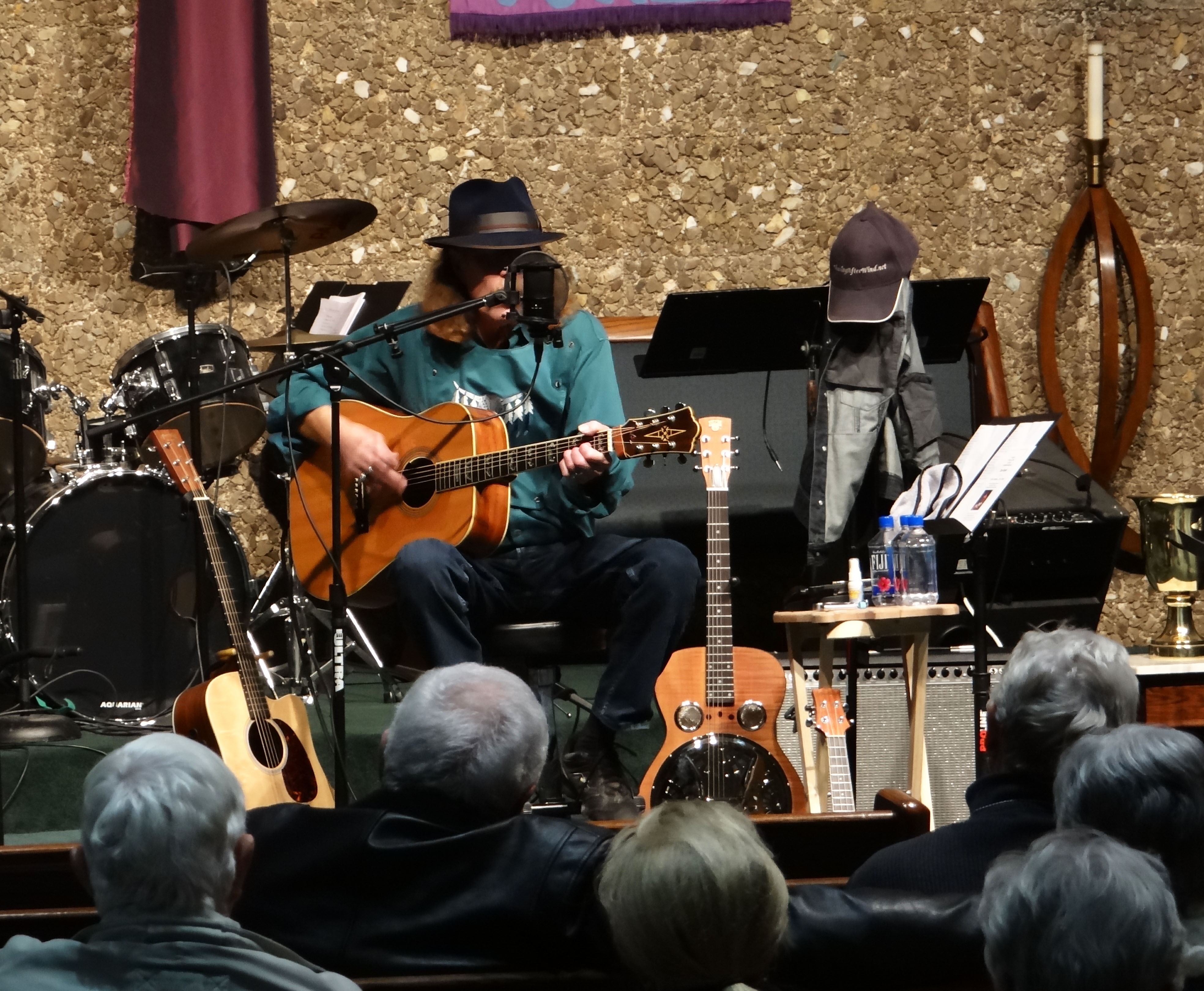
Dan at CUMC 3At my one man show at Christ UMC a couple of weeks ago, I played my newest song, Hello Out There, for the first time in public. Introducing the song, I explained that there were various members of church families that were on the autistic spectrum. I was not personally familiar with autism untill a few years ago. I noticed the symptoms in a few of the children, but did not know it was autism.

A college student at church was helping with the Autism center at UNT in Denton and facilitated a program at church with a director of an autism program who had autistic children. After that I began to realize how varied the autism spectrum is. If you do not know, the autistic spectrum stretches from those who are highly functioning to those who are low functioning. Those who are highly functioning need steady, but only slight, intervention by others. Those who are low functioning, on the other hand, need almost constant attention.

I have witnessed incidents at church over the years with some of the children. A few days after one particularly violent episode, I had a conversation with the child’s father. I asked him how the child was and he told me that he wished he could get inside the child’s head to know what the child was thinking. I kept thinking about that because, as a songwriter and author, that’s what I do – think about things.

I do not have any insight into an autistic person’s state of mind. But, having stuttered all my life, I know what it’s like to live in one’s own head. And that’s what led me to write the song, Hello Out There. It can be found here.

Peace be with you.


20131103_132007I recently joined the Board of the Dallas Songwriters Association (DSA) after having been a member for several years. I am now the Lyric Contest Director, as well as helping out in other areas. I was given the entries to the recently completed contest (it is run quarterly). My job is to read all the lyrics and pass along to another member of the board the songs I think are worthy to be considered in the final judging. After reading the lyric contest entries, I have a few thoughts to pass along to those planning to enter a lyric/songwriting contest.

If you are just writing lyrics, find someone to write or play the melody. Make sure that it is a song, not just a poem. Granted, sometimes the line between the two is blurred. But even in those instances, one can tell the difference between a poem and song. Read it out loud.

If it sounds good to you, then have a few other people read your song. It is your choice to accept or reject suggestions or criticism. But if more than one person says the same thing, it would be prudent to follow their advice. If you read your song out loud and it sounds “sing-song-y,” you might want to work on it a little more.

At the very least – and I mean the very least – read your song several times before you submit your entry. Use spell checker and check the grammar. When I’m reading the song entries, I can forgive a misspelled word or single grammatical error. But if you misspell the same word in the chorus each time you type out the chorus, the song instantly goes in the rejection pile. It’s the same with the gramatical errors. If you are using slang purposely, or  are misspelling words to imitate an accent, use quotation marks. But make sure  it fits the song.

If you are going to take the time, make the effort, and spend the money, you might as well make it worth it. Present yourself and your song in as professional a manner as possible. A song should fit on one page, maybe one and a half. Certainly not more than two pages. You do not need to type out the chorus each time it occurs, if it is the same each time. Using 12 pt. type is quite sufficient – anything larger is unnecessary.

The first thing you should consider before submitting an entry is whether or not you have written an actual song. I do not have time to tell you how to write a song. There is so much already written on the subject, I do not need to. If you’re in the Dallas area, you could join the DSA and attend meetings. Every major city should have a songwriting association. Keep writing and learning as you go along.

Along the journey, when you decide to submit to a lyric or songwriting contest, you need to do four things. Make sure it is actually a decent song. Present yourself and your song professionally. Read it over carefully a couple of times before sending it. And follow the entry rules  to the letter.

Peace be with you.

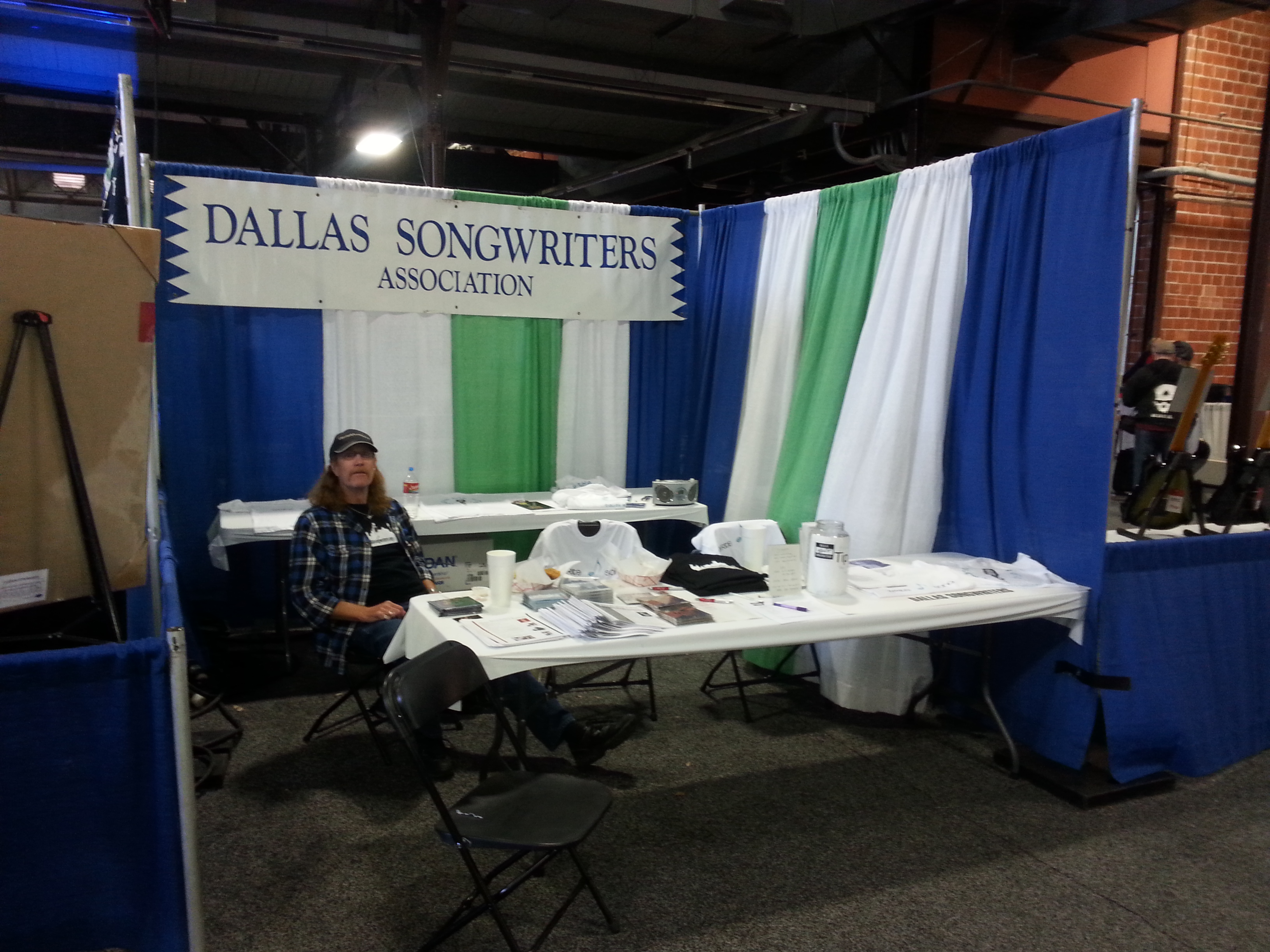
20140503_171118 One thing I noticed while working the Dallas Songwriters Association booth at the Dallas Guitar Show is something I notice most of the time when I visit a music store. Naturally, there are talented guitarists at the guitar show or store. The majority, I would think. But then there are the new guitarists who do not want anyone else in the store to know that they have not been playing very long or cannot play very well.

So they play the one riff they can play well from their favorite band. Unfortunately, that is the only cover tune riff they can do well enough to be heard in Guitar Center, Sam Ash, or any music store that sells guitars, as well as guitar shows. So, rather than risk embarrassment, they play that riff over and over. They change the settings each time so it sounds a little different and gives the impression that they are actually serious about buying a guitar. Which would work if they were not there three times a week and had never bought anything more than strings.

At guitar shows, these guitarists are the same, but incredibly louder. Particularly at booths selling amps that purport to be louder than all other amps. Then it is just painful. And it is made worse by their insistence in hearing themselves over all the other guitarists who are doing the same thing. That and the fact that, for some reason, the sound men for the various stages seem to feel that good sound is not as important as being heard in the next universe.

In the ‘70s and ‘80s, there was a dual lick. By that I mean that the lick I refer to was useful to guitarists and also those who wanted to “prove” they could play bass. That lick was from the song, Smoke On the Water, by Deep Purple. Whether you liked Deep Purple or not, you got tired of it quick – just because someone could play the riff did not mean they could do it well. These days, these irritating guitarists’ riffs span the scale of genres.

I was in a Guitar Center in the past week or so to pick up a couple of things. A guy was playing his favorite heavy metal riff. As the clerk was ringing up my purchase, the guy played it a couple more times, pausing for a few minutes between to change settings.

“I think you’ve got it down now,” I said outloud to the guy (who couldn’t hear me).

The clerk made a face that said he agreed with me.

“At least it wasn’t Smoke On the Water!” I said, and he laughed.

“Oh, he was in yesterday,” he replied.

It was my turn to laugh, but I was surprised that people still play that riff in public. I shouldn’t have been surprised, really. The song is still played on classic rock stations. And the riff is relatively simple to play. The funny thing, though, is that most people play it wrong. Which makes the pretense of displaying their talent all the more sad.

Peace be with you.