Tag Archive: theology


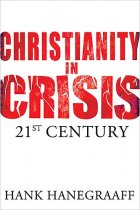
[Re-posted from former blog.] Christianity in Crisis 21st Century, written by Hank Hanegraaff, published by Thomas Nelson, is a book every Christian should have on his or her bookshelf. I wished I had read Hanegraaff’s first book, Christianity in Crisis when it was published in 1993. It would not have changed my views, but would have given me a source to which to turn for proof in my discussions on the subject. I commend Hanegraaff for having the faith and mission to read and listen to these preachers of fallacies and their obvious distortion of God’s word in order to alert the general populace of Christians – many who have themselves been deceived by prosperity and faith healing preachers.

In the 1970’s, after a night of sitting with my jaw on the floor while watching the 700 Club, Pastor Gene Scott, and the like, I wrote a song called Buy One God (Get One Free) portraying the ridiculousness of the prosperity gospel. At the time, I felt alone in my convictions, not even being able to bring the subject up in church. Now I find that I am not alone – thanks to Hanagraaff and others – but the problem has grown much larger and more ingrained in our society and economy.

It is not necessary that I repeat some of his arguments here – he does an excellent job and you must read it for yourself. Although you will be completely repelled and incensed at the audacity of these false preachers – which under other circumstances would leave you feeling lost and praying that it was not so – Hanegraaff points out the fallacies, which offsets the discomfort brought on by their demented interpretation of scripture.

In chapter seven, Back to Basics – as well as the appendixes – Hanegraaff leaves the Christian readers with positive thoughts and theology on their journey through the teachings and theology of these false “prophets.” The reader finishes the book with the comfort of knowing that there are those such as Hank Hanegraaff to point out the false preachers and their fallacies.

Peace be with you.

I was given this book by Thomas Nelson for reviewing purposes. I was not required to write a positive review, nor did I receive any compensation other than the book itself.

Max on Life,” the new book by Max Lucado and published by Thomas Nelson consists of the author’s answers to questions he has received over the years in letters, emails, and phone calls. Questions he has been asked as both a pastor and a writer. The letters Lucado received as a pastor are separated by categories (and chapters) entitled Hope, Hurt, Help, Him/Her, Home, Haves/Have-nots, and Hereafter. The questions asked of Lucado range from basic theological questions to marital questions related to God to why go to church. The pastor writes about the role of prayer, the purpose of pain, and the reason for our ultimate hope.

The writing questions are answered in an essay in the addendum, The Write Stuff. The well-written essay deals almost exclusively with writing for the church and as a calling, using the prophets and other authors of the Bible as examples. Lucado deals with basic matters of writing in the last couple of pages. He does not tell an aspiring writer how to be published. But he does tell anyone who feels called to write in the service of the Lord how to proceed from the call, the desire and an idea.

Some readers will read the book cover to cover. Others will use it as a devotional reference or as a topical reference when they are facing hard questions in their own lives. Lucado directly answers most questions with personal experiences and/or Biblical references combined with insights gained from his study, reflection, and prayer. Even answers to questions I will probably (and hopefully) never have still evoked deep feelings, causing me to reflect on my own spiritual journey.

“Max on Life” is an interesting read. Regular readers of Max Lucado will enjoy this book as well as those who are not familiar with his earlier books.

Peace be with you.

The King of Glory Lutheran Church’s Dr. Debbie Jacob Life Enrichment Series presents Living a Real Life in a Real World with Dr. Walter Brueggemann on Sunday and Monday, March 6-7. Dr. Brueggemann will preach at all three worship services on Sunday morning. A program on Sunday evening at 7 p.m. and a luncheon at 11:30 a.m. on Monday will round out the event.

A Rest from the Rat Race will be the topic on Sunday evening. Brueggemann will discuss the answer to questions such as: Does our acquisitive culture keep us too anxious to rest? What alternatives do we have to our frantic lives? How can Sabbath keeping help us withdraw from the rat race and refresh our souls? The suggested donation is $5, but due to limited seating, registration is required.

The topic for the luncheon on Monday is Giving In Without Giving Up. Is U.S culture hostile to our living the Gospel? Can faith survive in our militant and materialistic environment? How can we learn to respond intentionally? Registration is $20 and includes luncheon.

Dr. Brueggemann is professor emeritus of Old Testament at Columbia Theological Seminary in Decatur, Georgia, where he taught from 1986 until his retirement in 2003. A respected author and one of the world’s leading theologians, Dr. Brueggemann bridges the Old Testament and contemporary Christian worlds with imagination, scholarship, and a passion for justice and redemption. He is a contributing editor for “Sojourners” and “Christian Century,” he has received honorary degrees and awards from numerous institutions, and is a past president of the Society of Biblical Literature.

Before her death in 2005, Debbie Jacob and her husband, Will, created a program to fund speakers in adult education on topics such as sociology, economics, art, music, and theology. Dr. Brueggemann’s visit is the second in the series. King Of Glory began as a mission church more than 50 years ago and moved to its current site in 1968 so that it might be more visible within the community. King of Glory is a “place where people can grow together in faith and make a difference in the world for Christ.” Its mission is to be and to make growing disciples.

See the King of Glory website for registration, directions, and other information.

Peace be with you.

Who’s Your Neighbor

“Who’s Your Neighbor” was the topic of the January meeting of the Religion Communicators CouncilDallas-Ft. Worth Chapter – held at University Park UMC. I am a member of RCC as a representative of Christ UMC, Farmers Branch, and the Communications Committee. Giving the presentation was Anne Marie Weiss-Armush, president of the DFW International Community Alliance.

The DFW International Community Alliance is a network of over 1600 internationally-focused organizations in the Dallas/Ft. Worth metroplex that embodies the cultural and economic vibrancy of the global community. Their mission is to “build mutual understanding and respect by linking diverse international cultural communities.” The organization not only aligns the diverse groups with one another and the society as a whole, but the members of the groups with themselves. Yahoo groups were formed, such as an African group, to promote community among those living in different areas of the metroplex.

A newsletter is sent out by email each week listing the cultural activities of the many varied ethnic groups. As a new subscriber, I look forward to receiving notice of events in our community and the surrounding area. The subject was quite timely, considering our pastor, Dr. Vic Casad’s recent sermon on the demographics of our community and congregation. While Weiss-Armush praised churches who are reaching out with ESL classes – of which Christ Church is one – there are more opportunities for advancing communication among various ethnic groups with the goal of unifying the community with open exchange of cultural influences.

The Christ Church congregation is a diverse group of individuals and families, as are other faith communities. However, there are other people(s) in our community who are seeking faith, or simply help, on some level, but are unsure where to turn for guidance and assistance. We see them every day at the store, the library, the rec center, and other places.

As part of our mission to share the love of Christ, we need to reach out to other faiths and cultures to move toward a unified community – understanding, appreciating, and celebrating our differences. Sometimes we reject what we do not understand instead of realizing that the ways in which we are actually different are relatively insignificant. As part of our mission as stewards of God’s earth, we must work alongside – and in community with – our multi-faceted neighbors. Which, as the alliance illustrates, is true of any and all faith communities whose end result of mission is to help and serve others.

Do I see opportunities in our community to share the word and be of physical and spiritual assistance? All the time. Do I have opportunities to ask questions and listen to someone about their faith community and how we are alike? Again, all the time. Do I avail myself of every opportunity to be a witness to the love of Christ? Unfortunately, no. But I am praying about it and working on it. How about you?

Peace be with you.

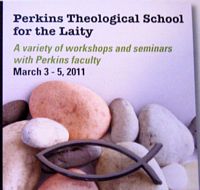
All Laity are invited to attend Perkins Theological School for the Laity (PTSL) at Perkins School of Theology March 3-5. The school consists of a variety of workshops and seminars with Perkins faculty and noted scholars. It is a chance for any and all Laity to explore theology on a college level as well as potential students. The only problem is trying to decide which course(s) to take among the excellent variety of choices. There are Thursday/Friday classes and Saturday classes.

The weekend begins with registration and check-in at 12:30 p.m. on Thursday. After a welcome and opening worship at 1 p.m., there will be two sessions of the Thursday/Friday classes before the opening banquet at 5:30 at which Elaine Heath will give the lecture, “Vampire Love: Is Twilight Bad News for Girls?” The classes resume on Friday at 9:45 a.m. and continue until 4 p.m., interrupted only by lunch at 11:45 and the plenary lecture at 1 p.m. Miroslav Volf will lecture on “Empire, Church, and Missio Dei.” Evening worship will begin at 4:30 p.m.

This year’s PTSL program is being held in conjunction with the annual meeting of the Wesleyan Theological Society (WTS). Participants will be able to attend certain events of the WTS meeting. Those taking the Thursday/Friday class, “Wesleyan Movement in America,” will attend Friday WTS sessions.

Registration and check-in will begin at 8 a.m. Saturday morning as will Morning Prayer. The WTS panels on war and mission begin at 8:30. Saturday one-day classes begin at 10 a.m. with a service of Holy Communion at noon and the Woodrow B. Seals Laity Award Luncheon at 1 p.m. The final session(s) of the one-day classes begin at 2:30 with the School for the Laity adjourning around 4:30 p.m.

There is not an all-inclusive price this year so the banquets and luncheons are optional. Participants can also choose between two-day classes, one-day classes or both. Course descriptions and registration can be found on the Perkins website. This will be my seventh year to attend the School for the Laity. It is a wonderful time for spiritual renewal, fellowship, and delving deeper into theology. I hope to see you there.

Peace be with you.

Cyndy and I decided to bake a few gifts this year. Among other things, she wanted to bake mini fruitcakes using her mother’s recipe. I looked for candied fruit in the neighborhood grocery store. I asked for the candied fruit for fruitcakes and was told they did not have it. The last time I looked for candied fruit – albeit several years ago – it was in every grocery store. I persisted in my search by asking other employees, only to discover that they did, in fact, not have the candied fruit.

I tried again the next day at a different grocery store when I was picking up Christmas stocking items. The looks I received from the clerks in the bakery – who should have had some idea – led me to believe that the employees had little clue as to what a fruitcake really is. After checking where they suggested proved fruitless – pun intended – I went to the baking aisle since that was a logical guess. The candied fruit was there under the cake decorations, but not in the variety or at the price I remembered.

Which is due to the fact that fruitcakes are not the quick gift choices they once were and are certainly not as prevalent. In recent years I have gone through the holiday season without hearing the word “fruitcake.” In earlier years I would not have seen the holiday season pass by without receiving a fruitcake. Fruitcakes kept one from having to hone in on a personally relevant gift.

At one time, a fruitcake was what you gave someone when you did not know what to give them, or when giving one gift to a family. I remember the colorful tin containers that unmistakably held a fruitcake wrapped in plastic. I never understood why I never saw anyone actually eat a fruitcake. It was rare that I even saw anyone break the seal on the plastic. But when someone went to the trouble of baking their own fruitcake, the recipient was more inclined to open and eat at least part of it.

When we had the White Elephant gift exchange with my father’s family on Christmas, there was usually a fruitcake involved that someone had received for Christmas. It was not uncommon for a fruitcake to be passed around three or four times before the new year began. And then, quite possibly, the fruitcake would make the rounds again the next Christmas. With the same bow affixed to the top of the can. Often, the same was true of other White Elephant gifts.

These days -fortunately – the only people who go to the trouble of baking fruitcakes are those who have a tried and true recipe – such as Cyndy’s mom’s recipe. They can still be ordered, but few people I know buy fruitcakes. It doesn’t help that the shelf life of candied fruits after being opened, baked, and then taken out of the plastic is about twenty-seven minutes.

Be that as it may, giving someone a gift received from someone else goes against the grain of the Christmas spirit. Regardless of the gift, it was given with a good spirit. It cannot be re-given with the same true spirit. There is only one gift that can be given repeatedly in the same spirit with which it was originally given – the love of Christ. No matter how many times the love of Christ is given and shown, it is still fresh, new, and untainted. A gift you can give to anyone and everyone. A gift that can be joyously re-given and joyfully received. So this Christmas, spread the love of Christ – the true spirit of Christmas.

Peace be with you.

Time of Calamity

A couple of days ago, about 10 a.m., the bottom dropped out, weather-wise. The “sky was crying,” as Stevie Ray Vaughan would sing. It also sounded as if Mother Nature might have some serious issues. Being in the middle of a storm is a little scary, no matter who you are. You may not admit it, but even the strongest among us have their moments.

When it is storming so tremendously outside that the thunder, lightning, and rain on the house is all you hear – even over the tv, radio, or heater. The sun seems to be on sick leave and the sky just gets increasingly darker. If you are having any major life problems at all – and who is not – a serious funk can be one thunder crash away. The all-consuming gloominess that appears to surround you suddenly feels tangible – shrinking around the house like plastic wrap – closing off all exits. That’s how I imagine Qohelet felt when I read certain parts of Ecclesiastes.

“Again I saw that under the sun the race is not to the swift, nor the battle to the strong, nor bread to the wise, nor riches to the intelligent, nor favor to the skillful; but time and chance happen to them all. For no one can anticipate the time of disaster. Like fish taken in a cruel net, and like birds caught in a snare, so mortals are snared at a time of calamity, when it suddenly falls upon them.” Eccl. 9:11, 12.

Everyone has experienced times similar to those mentioned here. But, as I discuss in the book, Qohelet did not have grace and forgiveness of sins as we have. Not to say that God did not give grace to the Israelites or grace their endeavors – the Israelites simply did not see it as grace, per se. The Israelites and people of the Old Testament viewed life in more concrete terms. If life took a bad turn – family, crops, or livestock dying, for example – they must have done something to cause it.

Unfortunately for them, Jesus Christ had not been born yet. Fortunately for us, he has. Through Christ’s life and sacrifice, we not only have God’s grace, but the Holy Spirit and forgiveness of sins. Looking at Ecclesiastes in that light, we can take Qohelet’s view – which is valid even today – mix in grace, the Holy Spirit, and redemption, and ascertain our actions as Christians when we have a tendency to “hate all the toil in which we have toiled under the sun.”

Join me on the journey.

Peace be with you.

Words and phrases that may have begun as an original thought with an apparent obvious meaning and intent, after constant use, misuse, and abuse, over time become catchphrases and buzzwords with thoroughly ambiguous meanings. Thinking “outside the box” was the hot business concept in the late 1990’s. Through the years, the expression has been bandied about and used in advertisements and press releases to represent ideas and supposed innovations that, in the end, were not so out of the box after all. All anyone succeeded in doing was expanding the box.

“Whatever” was originally used having to do with making a decision. As in “get a Coke or a Dr. Pepper or whatever you want.” Or ” it has to do with Kleenex, napkins, paper towels, or whatever.” Currently the word is most often used to mean “I don’t want to talk about it anymore.” Or a sign of being noncommittal. Our teenagers and their friends use it when they have gotten themselves in a conversational hole and do not want to admit it. “Whatever!”

The phrase “don’t guilt-trip me” gained prominence in the 1960’s with accusations that the “establishment” was trying to lay a guilt-trip on the middle and lower classes. While I sympathized with some of their positions, I disliked the phrase even then. It is more distasteful to me now when my children use it toward me. What the phrase actually means is “I know I’ve screwed up a lot (or owe you a lot), but I don’t want to be told that, I want to get what I want.”

Other variations could be applied, but that is the gist. More often than not, what they refer to as guilt-tripping is actually telling them the truth. For example, one of the boys asks us for something that requires financing from us. When we go down the list of things they have already received no return effort – even though that was the arrangement- we are now required to add “and I’m not trying to guilt-trip you, just telling you the truth.” Beat them to the punch, as it were.

I grew up under the impression that it was easier to keep problems and debts to a minimum rather than endure the bothersome situation of feeling bad. It is our conscience that causes us to feel remorseful. Other people cannot make you feel bad – or guilty – if you have no reason to feel bad in the first place. But most of us feel shame over past indiscretions of one sort or another. In addition to a natural inclination to get defensive when being told we are being selfish. Because, on some level, we are all being selfish. But we would prefer not to admit it or have it made public.

Which led me to wonder if sometimes we do not try to guilt-trip God. As if making a list of our Christian “accomplishments” will persuade God to lend a special hand and eliminate our particular situation. A situation which seems important to us, but in God’s grand scheme of things is quite minuscule. Yet we have the audacity to think that we could have possibly done enough good in our lives to not only outweigh our myriad of failures, but move us higher up on God’s to do list.

“Where are you, God? I go to church every Sunday, well, most every Sunday. I attend Sunday school. I am at the Wednesday dinner s. I read the Bible every day. I pray every night for everyone on my prayer list. I try to be kind to everyone. So why am I stuck in this situation? Why will you not help me?”

God did not put us in the situation we are in – we did. We may not have been the direct cause of our current malady or tragedy, but in some way we had a hand in it. Regardless of whether we were a part of the cause or had little or nothing to do with it, God most certainly was not the cause. Why are we blaming him and ridiculously trying to make God feel sorry for us and give us the outcome we want. We do not want the outcome that God wants or the outcome we may deserve. We want the outcome we think is best.

Just like our teenagers. They do not want to hear the truth. They want to be told they can have things their way. Telling them the truth is guilt-tripping them. We are alongside our children when we ask God for help. We do not want to be guilt-tripped by being told the truth or what is best for us. But we know in our hearts and souls that God wants the best for us. So why are we trying to blame and guilt-trip God?

In trying to guilt-trip God, and when our teenagers try to guilt-trip us, one thing is overlooked. It is, in fact, what is wrong with the term guilt-trip in the first place. It also renders the term irrelevant. And it is quite simply this: you cannot guilt-trip a truly innocent person – or being – as the case may be.

Peace be with you.

Vanity of vanities, says the Teacher,

vanity of vanities! All is vanity.

What do people gain from all the toil

at which they toil under the sun?

A generation goes, and a generation comes,

but the earth remains forever. Eccl. 1:2-4

During a Disciple Bible Study several years ago, when we got to Ecclesiastes, the text suggested that we read the entire book in one sitting. Always up for a challenge, I dutifully read it all the way through – and I was fascinated. Of all the books in the Bible, I have read or heard passages from Ecclesiastes the least in my lifetime as a Christian. Granted, I did not go to church all the time when I was younger.

If you take a passage of Ecclesiastes out of context, it can be downright depressing. Which is the general opinion of Ecclesiastes from what I have ascertained after hearing sermons, speakers, and talking with people. But when I read it in one sitting, not only did I see the relevance to my life, but was left with a feeling of hope. Quite the opposite of what I expected after what I had heard.

I knew then that my next Bible study would be Ecclesiastes. This is not the first full length Bible study I have written, but it will be the first one published. The previous studies are still waiting for reprint permission for passages I included. So I began my journey with Qohelet, the teacher.

Scholars generally agree that Solomon did not write Ecclesiastes. But it is not known for certain who did write the book. I prefer to look at it from the view that Qohelet, the “teacher,” or “preacher,” was the author. It seems to be more relevant to our lives today from that view.

I am currently editing the book for the last time. Feel free to join me on my dual journey – through Ecclesiastes and the editing process – which will continue as a journey through theology and our lives today.

Peace be with you.