Category: Communications


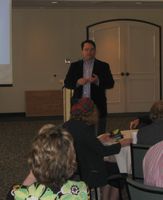
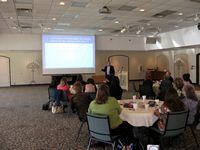
Jake Batsell, Assistant Professor in the Journalism department at SMU, discussed media convergence and the importance of maintaining a presence in, or on, various media, including social media, at the January meeting of the Dallas-Ft. Worth Chapter of the RCC on January 26. He is also faculty adviser for the student media websites, combined at smudailycampus.com, including the SMU Daily Mustang, a multi-platform news site produced by journalism students, and SMU-TV. Entitled “Media Outreach During Turbulent Times for the News Business,” Batsell’s presentation included results of the longitudinal study of media convergence that he, his colleagues, and students have been conducting.

They began the  study by asking a central research question: To what extent has convergence journalism taken hold in U.S. newsrooms over the past decade, and to what extent have these cross-platform partnerships endured? Newspaper and TV managers in the top 200 U.S. media markets were surveyed in 2002-‘03 (Phase 1), 2004-‘05 (Phase 2), and again in 2011 (Phase 3). Batsell and his colleagues are currently studying the results of phase 3. The results indicate challenges and opportunities for media outreach.

“The bad news is that traditional newsrooms are short-staffed, making cultivating relationships with reporters difficult. When you do interact with reporters, they’ll have less time to absorb your story than they used to.”

The good news, particularly for religion communicators, is that there are more non-traditional ways to get the message out. “Press releases that used to be ignored now might spark a blog post, which can be amplified through social media.” Suggested links to background information during an interview are likely to be included in the story. Alternate media outlets are plentiful, such as NeighborsGo and DallasSouthNews, as well as Pegasus News and Advocate Magazine, in the Dallas area.

Current results of the study show that news managers are focusing on developing interactive relationships with readers and viewers, primarily through social media. Which includes multimedia (both staff-generated and user-generated), news as conversation (blogs, comments, live chats, etc.), and engagement via social media platforms. “Today, news is a two way conversation” between newsrooms of all media and their readers. As religion communicators, we need to join the conversation. In an online world of “likes”, links, blogs, comments, and re-sending articles, and posts, good content and internet interaction are key to delivering our message to more people.

Peace be with you.

Knowing the interest in the topic of Social Media, we searched high and low and found an expert to talk about it. Jake Batsell, Assistant Professor in the Journalism department at SMU, will present a program on media convergence at the January meeting of the Dallas-Fort Worth Chapter of the Religion Communicators Council. The meeting will be Thursday, January 26 from 12 noon to 1:30 p.m. at the University Park UMC, 4024 Caruth Blvd, Dallas. Jake is both a knowledgeable and engaging speaker.

Part of his current research is in Phase Three of a study that examines media “convergence” and how both the term and practices it encompasses have evolved in the past 10 years. Results show that news managers are focusing on developing interactive relationships with readers and viewers, primarily through social media. Batsell is also faculty adviser for the student media web sites. SMU Daily Mustang, a multi-platform news site produced by journalism students, and SMU-TV combined operations in fall of 2011. The result is www.smudailycampus.com.

Cost for the meeting is $15 and includes lunch. Please email or call to make reservations, dchristian@umr.org, 214.630.6495 x147, so we’ll be sure to have enough food. Please feel free to invite friends and co-workers who might be interested in this topic.  — from Deb Christian, Secretary.

Peace be with you.

Holocaust survivor Dr. Zsuzsanna Ozsváth will talk about her experience as a schoolgirl in Hungary during World War II at 10 a.m. on Monday, January 9 at King of Glory Lutheran Church. The presentation is part of the Gusto!  event series.

Ozsváth and her immediate family survived the final days of the war with the help of her nanny and dear friend, Erzsi, who found food and safe houses for them. More than half a million Hungarian Jews perished between 1941 and 1945 as part of the Nazis’ Final Solution.

Ozsváth recorded her experience in a memoir titled When the Danube Ran Red, which was released last year. She will discuss the events documented in the book and be available to sign copies.

Ozsváth is the Leah and Paul Lewis Chair of Holocaust Studies and professor of literature and history of ideas at the University of Texas at Dallas. She has written extensively about Holocaust literature and the Holocaust in Hungary. She holds music degrees (piano) from Bartók Béla School of Musical Arts and the State Academy of Music at Hamburg. She completed her Ph.D. in German language and literature at the University of Texas.

Come at 9:45 a.m. for coffee and conversation, and join us for a reception to follow the presentation. Everyone is welcome!

Never Forget: Tour of Dallas Holocaust Museum – Monday also begins sign-up for the trip to the Dallas Holocaust Museum/Center for Education and Tolerance on Monday, January 23. The self-guided audio tour will include permanent displays plus a traveling exhibit of children’s artwork from the Terezin ghetto, Czech Republic. Late KoG member Col. Gil Ackerman’s war crimes trial documents will be displayed especially for our group. Bus transportation and carpooling will be available. Cost is $6 at the door. The museum is located at 211 N. Record St. in downtown Dallas. More information is at www.kingofglory.com/gusto.

——– From the Gusto! media staff.

Peace be with you.

What do an alumni e-newsletter, a Holocaust museum, and gusto have in common? They are past, current, and ongoing projects of RCC D-FW Chapter members. The December DFW Chapter meeting, held this year at Christ UMC in Farmers Branch, is traditionally a time of sharing the year’s accomplishments and trials. The Chapter furnished the lunch and presented each member with a gift (chocolate covered pecans). Members shared samples of their best work, some of which they are considering entering in next year’s DeRose-Hinkhouse Memorial Awards, to be awarded at the RCC Convention in April in Philadelphia.

Alice Dykeman, of Dykeman Associates, Inc., discussed her past year’s work. Her current intern, Emrah Yildiz, is no stranger to the group, having attended meetings for several months. Dykeman also introduced her guest, Reverend Charles Curliss. Rev. Curliss is founder and pastor of The One Church. Debbie Tull, marketing and advertising consultant, brought the group up to date on her work at Patheos.com. Patheos.com is the premier online destination to engage in the global dialogue about religion and spirituality and to explore and experience the world’s beliefs.” Tull explained that, in an effort to be all-inclusive, the website has recently added an atheist channel. They also created Patheos Press to publish e-books. The site has titles already available.

Tim McLemore, Associate Director of Public Affairs at Perkins School of Theology, presented each member with a Perkins marketing eco-sack containing a folder with informational brochures. The Begin Your Journey With Us brochure, a recent addition introducing the school to potential students, illustrates the diversity among faculty and students. McLemore displayed the Perkins website, concentrating on the alumni pages – specifically, the Perkins Precis, an e-newsletter for Perkins alumni/ae. Even before he took the page and e-newsletter live, McLemore was contacted by alumni who had searched on Google, found the page, and asked to be put on the list.

Chris Kelley, principal of The Kelley Group and PR Consultant with the Dallas Holocaust Museum, provided clips from the video of his interview with Frank Risch. Risch was the 2011 Honoree at the museum’s Hope for Humanity dinner. His parents, Herbert and Irma Risch, fled Nazi Germany in 1937 to escape the Holocaust. Risch has been a member of the Board of Directors of the Dallas Holocaust Museum/Center for Education and Tolerance (DHM/CET) for nearly twenty years. “He has been instrumental in transforming the organization from a memorial and resource center located in the Jewish Community Center to a creative museum in the West End Historic District.” The clips were emotionally moving, leaving the room in momentary silence.

Kay Champagne shared the work she and fellow chapter member, Sharon Chapman, have been doing to market the King Of Glory (KOG) Lutheran Church’s Gusto! series. “Gusto! Is a Life Group at KOG for the mature adult community (all are welcome) that creates and promotes enrichment programs that stimulate intellectual growth and expand personal interactions in a supportive and nurturing Christian environment.” Past guest speakers were Martin Marty, Walter Brueggemann, and a series of speakers on Dwight D. Eisenhower. A Holocaust survivor will speak in January, and the group will visit the Dallas Holocaust Museum in February.

During lunch, between small talk and presentations, members of the group discussed the changes in communications methods over the years. From the manual typewriter and mimeograph machines to bulky pcs running on MS-DOS and floppy discs to smartphones that have more power than previous mainframe computers. Several members admitted to still having outdated equipment in a closet or garage. Yet reminiscence is not indicative of a willingness to re-live the times discussed. It is simply a fondness for days that, while they were perhaps simpler, were also the stepping stones to the lives we know and enjoy now.

The meeting was an appropriate ending to the year. It went over the allotted time, due to the continually interesting conversations. Members shared pride and appreciation for past accomplishments as well as excitement for current and future projects. Members left with smiles and exclamations of Merry Christmas or Happy Holidays, looking forward to another year in the world of communication.

Peace be with you.

 Tyndale House Publishers is having an NLT Facebook page giveaway. Here are the details:

Starting on November 29th until December 24th at the New Living Translation Facebook page Tyndale is giving away lots of great prizes and something free for you just for singing up.

By visiting the giveaway entry page (located on the NLT Facebook page, the link is under the profile picture) and entering your name and e-mail address you’ll be entered to win the following prizes:

One random person each day will win a Life Application Study Bible Family Pack (Guys Life Application Study Bible hc, Girls Life Application Study Bible hc, Student’s Life Application Study Bible hc, Life Application Study Bible hc, Life Application Study Bible Large Print hc).

One Random person each week will win an Apple iPad 2!

Everyone that signs up gets a free download copy of the Life Application Bible Study – Book of Luke!

Good luck!

Peace be with you.

Will journalism survive the digital age? If it does, what will it look like? Will it be profitable or subsidized? These were the questions discussed by the panel that included David Sedeno, editor of The Texas Catholic/El Catolico de Texas, Sam Hodges, managing editor of the United Methodist Reporter (UMR), and Jeff Weiss, reporter (and past religion writer) for the Dallas Morning News (DMN). The journalists were speaking to members of the Dallas-Ft. Worth Chapter of the Religion Communicators Council (RCC) at their October meeting, held at Christ United Methodist Church, Farmers Branch.

Moderating the informal discussion was Cherrie Graham, Chapter President and advertising manager at UMR. “Looking at the first question, Will journalism survive? Well, it has to, it doesn’t have any other choice.” The question is not will it survive, but how will it survive?”

During his response to the question, David Sedeno discussed the elements for successful publications in today’s media environment. “Let’s not give up on printed product yet, in terms of niche [religion] publications. The four things I look at [for success of print publications] are content – not content as content, it has to be relevant. So the second thing is relevance. The third, obviously, is technology. You have to take a look at the capabilities you have to extend your reach. The third, and probably the most important one, is partnerships.” Sedeno went on to explore the avenues of partnership.

Media applications on tablets are partnerships, using advertising from both sources to affect the financial outcome. In 2001, DMN entered into a partnership with a website in Mexico that wanted their content to translate into Spanish. Which illustrates not only a partnership, but content that is relevant to readership. Sedeno added that while he does not think that paper products will come to an end, “tablets are certainly taking a big bite out of everything.” Tablets are portable and you can take them places you couldn’t take a laptop. In addition, the applications open up new avenues of revenue. But it all goes back to content that is relevant, and partnerships.

Jeff Weiss, “the only one [of the three panelists] still employed by the Dallas Morning News,” began by saying that when he woke up that morning, “it was cold and wet.” “I picked up my iPad…and opened the e-edition of DMN and it looks exactly like the print version. And that’s how I have increasingly read the newspaper. I’ve been comfortable with the title ‘content producer’ long before some of my colleagues were. Because that’s what I do – I generate content.” Addressing the religion communicators directly, Weiss stated that with fewer and fewer people and less and less money, mainstream media has a smaller and smaller stream of what they can cover. “Which makes what religion publications do so much more important to their target audiences and people who want to get the word out for them.”

In response to the question – how will journalism be paid for – Weiss stated that he does not know “where we (Dallas Morning News) will be in five years time.” The newspaper continually has less people and less content while asking people to pay more for it. “At a certain point, we can no longer be producing enough content that people will be willing to pay to read it.”

“Are we there yet?” Weiss asked. “I don’t think we are. Even in its diminished form the Dallas Morning News is still producing way more general content than anybody else in the area. And there is still an audience for that. And as a business proposition, we have more advertising dollars than anyone else in the area. So advertisers are going to be willing to pay for that as long as they see results.” While he is fairly certain that he could make a decent living writing for online publications and websites, he would not receive the benefits that he does with DMN.

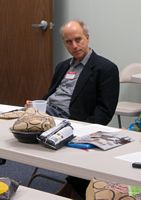
“I think the larger truth, that David was speaking to, and Jeff, too, is the decline of mass media and an era of fragmentation,” said Sam Hodges. “It’s a wild frontier out there. And I think journalistically there are advantages to having fewer gate-keepers, and some real disadvantages. I think the question mark is the economic model. What underwrites professional journalism, the gathering of news, analysis, etc.?

The world is becoming flat and also fragmented at the same time. You can communicate instantly with anybody in the world and yet we all seem to be in our little villages at the same time. If you are passionately interested about [a particular subject] there is something on the web that will satisfy you. Journalism might be part of a bigger shift in American life that disadvantages the middle class.
Because, it seems to me, that we had an era where what went away were pension plans. What you got next were 401K plans, and then, suddenly, employers weren’t contributing to 401K plans anymore. And now I think phase three is that salaried, benefitted jobs, especially in journalism, are going to continue to decline. You’ll have people working as freelance writers or maybe on contract and they’re responsible for their own benefits and vacation pay.”

While the discussion was lively and informative, there were few clear answers. Religion and niche publications have a more secure future than mainstream media, but what form that future may take is still an unknown factor. The emphasis, however, will be on adjusting focus to attract succeeding generations in a changing world, such as The Texas Catholic’s Texas Catholic Football publication to engage the younger generation. As well as broadening the options available, like UMR, with advertising partners and printing services. But the future of journalism will still depend on what has kept it alive and vibrant for years. Content, relevance of that content, technology, and partnerships.

Peace be with you.

September Meeting

The Future of Journalism will be the subject of the October  meeting of the Dallas-Ft. Worth Chapter of the Religion Communicators Council (RCC), an interfaith organization. The presentation will be a panel discussion with panelists including Sam Hodges, managing editor of The United Methodist Reporter, David Sedeño, editor of the Texas Catholic / El Católico de Texas, and Jeff Weiss, long-time reporter and religion writer for the Dallas Morning News. Also invited is Jake Batsell, assistant professor for digital journalism at SMU. Providing additional input (although a schedule conflict precludes his attendance) is Ken Camp, managing editor of The Baptist Standard.

Questions to be considered include:

Will journalism will survive the digital age? If so, what will it look like or in what form?

How will journalism be paid for? Is it possible to make a profit or will it be a non-profit or subsidized “public good”?

Will the news be good? Why?

The meeting will be held at Christ United Methodist Church in Farmers Branch on Thursday, Oct. 27 from 12 – 1:30 p.m. The $15 fee will include lunch. Please email or call Deb Christian, RCC Secretary, at dchristian@umr.org, 214.630.6495 x147 by Monday, Oct. 24 to make reservations. Bring your own thoughts and answers to these timely, pertinent questions.

I will be the host for the meeting. The discussions are always lively and informative with timely, relevant topics. This particular topic is of major concern to communicators, journalists, and writers as we look forward to the future with technological advances, social media, blogs, news feeds, etc.

Peace be with you.

The monthly meeting of the Dallas-Ft. Worth Chapter of the Religion Communicators Council (RCC) will be held on Thursday, September 22, at Christ United Methodist Church in Farmers Branch. Alice Dykeman APR, principal with Dykeman Associates, Public Relations Consultants, (and charter member of the chapter) will talk about how to establish and operate a successful intern training program. She is a seasoned veteran in Public Relations and is accredited by the Public Relations Society of America in Public Relations.

Dykeman has mentored many young people who desired to learn the art, practice, ethics and business of Public Relations. She will share where she finds interns, what and how she teaches them and give some ideas of how others can do the same. Dykeman Associates was established in 1974 and is a full service advertising, public relations and marketing firm. Services include crisis planning, video production, media relations, media and presentation training.

The meeting will be held from 12 – 1:30 p.m. and the $15 fee includes both lunch and presentation. Please RSVP to Deb Christian, dchristian@umr.org (214.630.6495 x147) by close of business on Wednesday, Sept. 21. The Religion Communicators Council is an interfaith association of more than 500 religion communicators working in print and electronic communication, advertising and public relations. Recent meetings have been held at the Biblical Arts Museum and the Holocaust Museum.

Peace be with you.