Category: Family


Being Between Holes

Occasionally, I begin to notice that I keep adjusting my belt. It is not due to a major shift in my weight. I weigh about the same as I did in high school – give or take five pounds at any given time. And I am way past high school. 

When I buy a belt, it fits snugly. Maybe right after my jeans have been washed, the belt might feel a little loose, but when my jeans work back out, it fits fine again. Inevitably, at some point in time, I begin to notice that I need to tighten up the belt a little. But sure enough, when I try to tighten it, I find that I cannot do so without discomfort. I find that I am once again in my personal twilight zone of being “between holes.”

When I bought the belt I had a two hole leeway. Both worked okay, but one a little better. Where did that leeway go? Okay, the belt is leather and leather will flex a bit after time – I get that. And jeans tighten and loosen – I get that, too. But the holes are the same distance apart they always were – within a fraction of an inch. And although I am at the age that my body is beginning to shift, it has not as yet affected my waist.

It is not a recent occurrence. The situation is the same with our son’s belts – when they wear them. Many times I have taken out my pocket knife and fashioned a new hole in a belt. But that is only a temporary solution and does not work for any thing resembling a formal event. And, unlike the original holes, it tends to grow, sometimes splitting the belt in the middle to the next original hole or simply splitting it in half.

Unfortunately, it is not a problem for which I think there will be an easy solution. But it did get me to thinking about the times in our lives when we find ourselves “between holes.” We receive life with all the right holes – with a two hole leeway. We keep going back and forth between one hole and another. Because we do not keep on a steady path, our faith stretches, the human factors flex, and we find we need another hole. Which we try to make ourselves. But the holes we make are inferior to the original holes and do not stand up to wear and tear.

The “between hole” theory can apply to our bodies, the planet, and our faith. We take what we are given, as perfect as it can be, and flex it, stretch it, use it, and abuse it until we suddenly find ourselves between holes. Then we think we can solve it on our own. We make another hole. But our solutions are only temporary and usually do not stand the test of time.

We need to work within the boundaries of what we were originally given. Stay within limits and follow the path we know we ought to and take care of what we have been given. We should listen to the Lord and demonstrate – toward others and our planet – a “love that comes from a pure heart, a good conscience, and sincere faith.” 1st Timothy 1:5.  

Peace be with you.

There is a rooster next door. Which would be insignificant if we lived in the country, but that is not the case. The family thought they were buying a third hen. I am not quite sure how that worked, but I have to assume it is possible. The rooster is apparently not so sure himself that he is, indeed, a rooster. His crowing has not been tremendously loud – though still annoying – but it is also not refined. He almost sounds hoarse.

I do not know whether it is attributed to his lack of experience or his cognitive insufficiency, but this rooster has no idea when he is supposed to crow. While he does crow in the morning, the crowing does not coincide with the rising of the sun. He is also prone to crow at any time of day, particularly if the hens are clucking. He began crowing about 11:30 the other night. Apparently, to this rooster, porch lights, airplane lights, or even lightning bugs resemble the sunrise to our neighboring rooster.

The rooster’s annoying crowing got me to thinking that we all go about our daily lives “crowing” about insensitive drivers, people who will not put their phones on vibrate during meetings or services, those who make us wait for no apparent reason, and the person who looks at us as if it is our fault when we know darn well it certainly is not. At the same time, we pray, and ask for God’s help to get us through some – ultimately at least – minuscule situation. A situation which must appear to God as relatively insignificant as those fleeting incidents that tick us off during the day.

All of us must admit that we know someone who constantly crows. About how good a Christian they are perhaps. About how they do not understand why people do not see things their way. And so on and so forth. Unfortunately, we must also admit that we do some crowing ourselves.

When it occurs to me – often in mid-sentence – that I am crowing on, shall we say, I try to quickly change course. After, that is, finishing the sentence that gave my mouth a bad taste. If I tarried too long over the line, my face goes flush with embarrassment. At least it feels like it does. I can recall times in which it was evident in the look on the listener’s face that I had indeed blushed. Their look also let me know that I had been caught crowing. Which made me want to become part of floor and slide away.

Maybe the rooster’s crowing irritates me because he reminds me how irritating I can be sometimes. Even though I’m not the only one he irritates with his incessant shouting. But when I am walking around the backyard complaining out loud about the people who bothered me throughout the day, I feel my face slowly become flushed. If I could see God’s face, I would see that knowing look. The look that makes me realize the only one I am fooling is myself. I am merely crowing needlessly. It then occurs to me that praying sincerely might be a good idea.

Peace be with you.

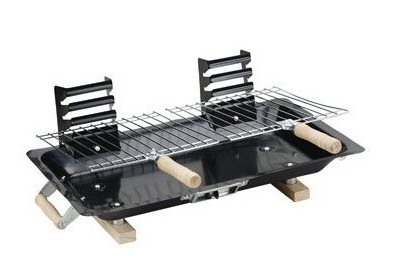
When I was a single father, and my daughter was at her grandparent’s house, I fixed a steak on the small hibachi on the front porch. It was a covered wooden porch but the roof was ten feet high and, like I say, it was a small hibachi. The steak I was cooking covered a majority of its surface area. When the steak was ready, I ate it along with the vegetables I had fixed, then put the dishes in the sink. All the while the front door was wide open.

I laid down on the couch, the left two feet of which faced the front door, and fell asleep watching television. At some point, I was awoken from a deep sleep to the foggy place in between deep sleep and fully awake. I heard a sound, some running steps, and doors slamming. I got on my feet, clawing through the fog, and headed for the open door. I watched the car pull away.

The hibachi was gone. Which was not a tragic loss – I had not paid much for it. But there had been burning coals and ashes in it! I looked around on the porch and over the side where I figured they would dump it. There were, however, no ashes to be found. Not even between the porch and the middle of the street. The two young men had just shoved a grill with a burning fire in their car.

As I stood there looking in the direction in which they had driven and shaking my head, I had a vision of these two guys driving around with steaks, looking for a grill to cook them on. In my mind I saw them driving to a park, pulling out the hibachi and blowing on the coals to cook their steaks. Why else would they take a cheap hibachi costing less than fifteen dollars – with a fire in it no less? It is doubtful they were looking for a grill for their family.

Most likely they were just stealing it for a prank. When they realized it had burning embers in it they did not have time to dump them out before escaping, as it were, in their car. But did they dare each other? Remember, I had the front door open and was laying on the couch facing the door (albeit asleep). What about the hibachi was worth taking the chances they took? Had I thought fast enough, and cared about the hibachi enough, I could have read the number on their license plate.

Thinking back on the occasion, the situation calls to mind those times when we commit sins and think that no one knows or we “got away with it.” Getting too much money in change from an inexperienced or overworked employee at the store, for example. Or being charged less than the actual price and keeping silent. Parking in a handicapped parking space when not at all disabled would be another example. There are many other examples.

We inwardly dare ourselves to not say anything, while at the same time we know it is morally wrong. We think no one notices. We tell ourselves that makes it “okay.” But God is standing on the front porch, shaking his head, watching as we walk or drive away – wondering why we think we have “gotten away” with anything.

Peace be with you.

Micaela Danielle White

Sadly, Micaela Danielle White, 18,  passed away Wednesday, the 17th.  The funeral Mass will be at 11 a.m. on Saturday, August 20th at Prince of Peace Catholic Church in Plano, TX.  A vigil service will be at 7:00 p.m. this evening at the church.  The family will receive friends during the visitation beginning at 6:00 p.m.

I’ve been getting a lot of hits on my posts about Micaela and wanted to pass this along when I received the news. My prayers are with her family. This has been an especially tough year for them for several reasons.  As for Micaela, after her long battle with leukemia, she is in a place without pain in the arms of the Lord.

Peace be with you.

The Mercedes commercial, in which the driver does not see objects coming, but the car does, is disturbing to me. You know the commercial. “I didn’t notice I was swerving, but my car did.” “I didn’t realize I was nodding off, but my car did.”

On the surface, it is simply a commercial to illustrate some advanced features of Mercedes’ new car. The ability of the car to sense coming obstructions and automatically avoid them. Which is obviously a good thing when it comes to accidental circumstances.

But a viewer could interpret the commercial to mean that it is not necessary to bother paying attention. And many drivers cannot afford to pay any less attention. “I was sending a text to a friend and didn’t see the car in front of me, but my car did.” “I was talking to a friend in the back seat and didn’t know I was swerving into oncoming traffic, but my car did.”

Odd, is it not, that an improvement in an automobile that can potentially prevent accidents and save lives is also a potential excuse for continuing the same activities while driving that cause more accidents and deaths. Sad as it may be, people will use the advanced feature much like they use cruise control – a feature to enable them to do unnecessary things while driving.

Which is much the same with many things. Such as the Bible, the Koran, and other sacred texts. Texts which were written (by whatever means or guidance) to guide people along a path toward spiritual fulfillment. Yet some readers insist on using these texts – in and out of context – to justify their own actions that most assuredly are not spiritual or fulfilling. The very scriptures intended to bring hope, peace, inner tranquility, and spiritual assuredness are distorted to excuse acts of violence, terrorism, and war.

The examples in the Mercedes commercial were appropriate examples to demonstrate the self-correcting feature. The implication of the dialogue was objectionable, but the intent was honorable. The misinterpretation as a result illustrates one of the problems with the human condition. As humans, we have the uncanny ability to take things given to us to with the intention of improving our chance of living through the world we have abused, and use them to further our selfish, lazy endeavors to do what we want, without consideration of others.

Fortunately, by the grace of God, as humans we have the moral capacity to know when we are doing wrong. But as a result of free will, we also have the capacity to make wrong choices and screw up. The key is to succumb to God’s extended arms of grace before falling prey to the temptations constantly before us. To follow the Scriptures as God intended and not as an excuse to satisfy our selfish desires.

“Do nothing from selfish ambition or conceit, but in humility regard others as better than yourselves. Let each of you look not to your own interests, but to the interests of others. Let the same mind be in you that was in Christ Jesus.” Phil. 2:3 (NRSV)

Peace be with you.

[Re-posted from former blog]

Faith and Pop Culture is the eighth installment of the Christianity Today Current Issues Bible Study Series, published by Thomas Nelson. As stated in the introduction, “[t]his Current Issues Bible Study is designed to facilitate lively and engaging discussion on various facets of entertainment and how it connects to our lives as Jesus’ followers.” The Faith and Pop Culture study examines the compatibility of our faith with the current culture as it pertains to the various parts of the entertainment industry. The book includes observations on movies, books, sports, television, and violence in entertainment media.

The study also takes a look at how entertainment affects Christians and vice versa. Must all entertainment Christians enjoy be “family friendly?” Can Christians influence the entertainment industry? With “entertain me” as the cry of our culture, is it compatible with a life of faith? These are questions to be discussed during the eight weeks of this study.

The Current Issues Bibles Studies are designed to be small group studies. Each session of the Faith and Pop Culture study begins with a Scripture Focus which provides the passages pertaining the lesson. After a brief introduction, a relevant article from Christianity Today magazine and ChristianityToday.com follows. The study guide of each session following the article are Open Up – discussion activities, The Issue – focusing on the main issues with which the session is concerned, Reflect – sharing thoughts and observations on the Scripture Focus passages, Let’s Explore – discussion questions, and Going Forward – taking what is learned and discussed and putting thought into action within our culture.

Each study guide includes ample questions and activities. Which allows for flexibility within the small groups using the study. If the group meets for two hours, they have plenty of questions, scripture reading, and activities. A group that meets for a shorter time has many options to choose from. Some sessions have “bonus” ideas or extra activities which could also be done outside of the regular group time.

In a time when many books and articles are written about modernism, post-modernism, and, indeed, faith and culture, Faith and Pop Culture is an intriguing Bible study that allows Christians as a group to actively apply their faith to the culture in which we live. The studies are also relevant for any small group in any situation. After reading the study, you might find yourself mentioning the book and series to group leaders whom you know.

Peace be with you.

I was given this book by Thomas Nelson Publishers for the purpose of  review. I was not required to write a positive review, nor did I receive any compensation other than the book itself.

 [Re-posted from former blog] The Noticer, by Andy Andrews, published by Thomas Nelson, is an interestingly quick read. The plot was rather predictable. Jones (no Mr., just Jones) is the noticer, a seemingly ageless old man who appears in the life of people who are at a major crossroads in their life. Jones appears without warning and talks them through their situation and helps them to get a new perspective, after which they are forever changed.

The old man appears to be a charismatic person who not only quietly demands the listener’s attention through his steady voice and calm demeanor, but also renders the person incapable of hearing anything but his voice. His listeners pay rapt attention to what he is saying without knowing why. After talking to him the listener not only has a new perspective on his/her life, but actually feels refreshed.

Despite the predictability, I kept reading, hoping there would be a change in the plot or a surprise. The way in which Jones adjusted his vocabulary and conversational style to each listener was interesting and well done. The Christian overtones were subtle yet solidly present. Some of the dialogue though, seemed as if Jones was approaching Christ-like status, and was rather tame and too obvious.

The ending, while also rather predictable, and drawn out more than necessary, was still successful enough to leave the reader with a warm feeling. It was not, however, the desired effect that Jones had on his listeners throughout the book. All in all, The Noticer is a pleasant and heartwarming story despite occasional straying and the predictability aspect. While I wouldn’t recommend The Noticer to everyone, there are many people to whom I would certainly recommend it. The book would make an appropriate gift for someone going through any type of crisis in their life.

Peace be with you.

 I was given this book by Thomas Nelson for reviewing purposes. I was not required to write a positive review, nor did I receive any compensation other than the book itself.

[Re-posted from former blog.] Christianity in Crisis 21st Century, written by Hank Hanegraaff, published by Thomas Nelson, is a book every Christian should have on his or her bookshelf. I wished I had read Hanegraaff’s first book, Christianity in Crisis when it was published in 1993. It would not have changed my views, but would have given me a source to which to turn for proof in my discussions on the subject. I commend Hanegraaff for having the faith and mission to read and listen to these preachers of fallacies and their obvious distortion of God’s word in order to alert the general populace of Christians – many who have themselves been deceived by prosperity and faith healing preachers.

In the 1970’s, after a night of sitting with my jaw on the floor while watching the 700 Club, Pastor Gene Scott, and the like, I wrote a song called Buy One God (Get One Free) portraying the ridiculousness of the prosperity gospel. At the time, I felt alone in my convictions, not even being able to bring the subject up in church. Now I find that I am not alone – thanks to Hanagraaff and others – but the problem has grown much larger and more ingrained in our society and economy.

It is not necessary that I repeat some of his arguments here – he does an excellent job and you must read it for yourself. Although you will be completely repelled and incensed at the audacity of these false preachers – which under other circumstances would leave you feeling lost and praying that it was not so – Hanegraaff points out the fallacies, which offsets the discomfort brought on by their demented interpretation of scripture.

In chapter seven, Back to Basics – as well as the appendixes – Hanegraaff leaves the Christian readers with positive thoughts and theology on their journey through the teachings and theology of these false “prophets.” The reader finishes the book with the comfort of knowing that there are those such as Hank Hanegraaff to point out the false preachers and their fallacies.

Peace be with you.

I was given this book by Thomas Nelson for reviewing purposes. I was not required to write a positive review, nor did I receive any compensation other than the book itself.

[Re-posted from former blog.] I received the Word Of Promise The Gift of Psalms from Thomas Nelson Publishers yesterday. Since I am in the midst of several projects, I skimmed through the book, then popped the first cd into the computer – planning to read/hear one psalm and devotional and put the book aside for the moment. I found I could neither put the book down nor turn the cd(s) off. I previously thought having celebrities read the Bible would cause the listener to be distracted from the biblical message. Pleasantly, I was mistaken. Although it did distract me a little, the voices of the well-chosen celebrities enhanced the reading of the Psalms – as did the use of the King James version.

The devotionals by Lori Jones are a mixture of exegesis and devotional – as opposed to the common types of devotional. However, readers and listeners who prefer the more common devotional styles will not be disappointed with the mixture. The exegesis adds a contextual view of the scriptures and their application in the world today.

The Gift of Psalms provides an inspirational way to start the day or to take a spiritual break from a hectic schedule. The WOP New Testament Audio Bible is also available.

Peace be with you.

I was given this book by Thomas Nelson for reviewing purposes. I was not required to write a positive review, nor did I receive any compensation other than the book itself.

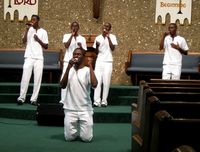
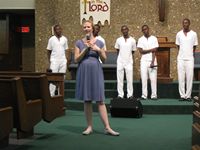
The Innovators, a Christian Acappella band, presented a harmonious and spiritual performance in the sanctuary at Christ United Methodist Church, Farmers Branch, on Wednesday, June 1st at 7 p.m. The six young men were visiting Texas from Innercity UMC in Harare, Zimbabwe. Tatenda Sithole, Michael Sithole, Knowledge Radyo, Dzago Chatsama, Marvellas Nhubu, and Leopold Chipatiso filled the sanctuary with their glorious harmonies, illustrating the presence of the Holy Spirit.

In between songs from their CD, such as The Lord’s Prayer and Never Give Up, the men took turns introducing songs and providing background stories. When they decided to bring their musical ministry to the United States, they faced several obstacles. The first obstacle was obtaining visas to leave Zimbabwe, which are difficult to come by. Each attempt required a non-refundable fee of $240 dollars (US). They were denied initially, despite letters of recommendation.

Each time they were denied, they refused to give up. They did not have money, but they had their faith that God is good and their musical talent with which to raise money. In addition to trying to get visas, the Innovators also raise money for their charity which helps to support orphans in Zimbabwe. After several attempts, the Innovators did, indeed, receive one year visas. Then they faced the task of paying for airplane travel to the states. Following many prayers and conversations with Stefany Simmons and others of the Connectional Table, the prayers were answered and the musical group was on their way to Texas.

A few of the songs were sung in the African dialect of Zimbabwe. The audience was told that “you may not understand the words, but you understand the love of God. I don’t know exactly what it means, but I was told the ‘love of God.’” Other songs included a version of Blessed Assurance in both African and English, Thank You, Lord, and Holy Spirit Fill me, Fill Me. Before the conclusion of the concert, the Innovators had the audience dancing in the aisles, singing, sharing praise and welcoming the Holy Spirit.

The tour, which began at Hamilton Prison in Bryan, with shows in College Station, Houston, Dallas, and San Antonio will end with shows in the Corpus Christi area before the group returns to Zimbabwe on June 13th. The congregation of CUMC, along with the love offering taken during the performance, sends their prayers with the Innovators as they continue to use their musical talents to praise the Lord. Thanks be to God for faith as strong as that of the Innovators.

Peace be with you.


Stefany Simmons introduces Innovators