Latest Entries »

I wrote an earlier post about the hens next door (the rooster, thankfully, has found a new home elsewhere). Our neighbors now have four different colored hens which are white, tan, black, and grey-striped. The black hen recently discovered she could fly over the fence into the front yard. Her choice of direction for her escape was quite intentional. Dogs could be heard barking on the other side of the fence of the other three sides of the backyard.

The hen has taken to wandering from her yard through our yard to the yard on the other side and back again, pausing at length under the bush at the far corner of our house. She also likes the bush next to the front door. She struts so close to the house that we can hear her clucking from inside. When I walked out the front door the other day, the dust flew as she scampered away from behind the bush. Unfortunately, she gives our dog, Misty, added incentive to try to escape when someone opens the door.

In the past few days, the black hen has become more curious and adventurous. She was wandering across the street, exploring the entrance to the driveway across from ours. But she mostly hangs around our front yard and her own. However, when I walked out into the backyard this morning, my assumption that her direction of escape was intentional was torn completely asunder.

The hen was strutting away from me about ten feet ahead. I was glad I had not brought Misty out with me. She strutted around the yard and seemed to be trying very hard to ignore the fact that I was there. As if she just ignored me, I would not notice she was there. She did not cluck at all, presumably so I would not hear her and become aware of her presence. She had acted the same way in the front yard. Yet, even though the hen tried to ignore me, she had to face the fact that I was still there and was not going away.

Which I tend to think is how we are with God at times. “I am just one person out of billions on the planet. Maybe if I try to be insignificant, God will not notice my presence or recent transgressions.” Then, at other times, we wonder why the Lord does not respond when we pray. We cannot have it both ways.

Try as we might, it is beyond our ability to fly underneath God’s “radar.” No matter where we go, God’s presence is always with us. He knows our smallest transgression – and forgives us with his grace. He is present when life is most difficult – supporting us with his grace. We just need to have faith, ask for God’s forgiveness, and accept his grace.

Peace be with you.

While my son was taking his driving test (he passed, thank God), I watched this man sweeping water. Yes, that is correct, and fortunately I have the picture to prove it. Most of the time he was smart enough to stand on the sidewalk at least, instead of standing in the water as he was before we left – as shown here.

He would stare intently at something in the water for a while. Then he would start sweeping as if he was trying to get the water to the higher part of the parking lot. Quite obviously, each time the ripples ceased, the water returned to its original position. 

Other than trying to sweep the water away (futile though it was), anyone else have a clue or guess as to what he was doing?

Peace be with you.

David Sedeno

Dallas-Fort Worth RCC members, in lieu of the March meeting, are invited to attend one of three keynote sessions at “Communicating Through the Clutter”, a conference sponsored by UMR Communications. The presentations are planned to help you cut through the clutter and focus on some best practices for communicators

Choices are:

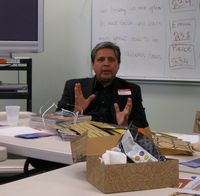
Finding Your Niche Markets Where They Live, led by David Sedeno, Executive Editor of the Texas Catholic at 12 noon on Thursday, March 22 at the Presbyterian Mission Center, 6100 Colwell Blvd, Irving, TX.

Jake Batsell

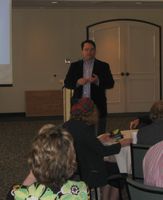
Converging Lanes of Communication, Jake Batsell, Assistant Professor of Journalism at SMU, 6:30 p.m. Thursday, March 22 at the Hyatt Place Hotel, 5455 Green Park Drive, Irving, TX

Is Print Green?, Joe Polanco, President of Printing and Imaging Association of Mid-America, 12:15 p.m. Friday, March 23 at the Presbyterian Mission Center, 6100 Colwell Blvd, Irving, TX.

Joe Polanco

RCC members and others interested can attend any one of the keynotes for $15 (payable at the event, check or cash) which includes the meal. Please email or call for reservations or more information, Deb Christian, dchristian@umr.org, 214.630.6495 x147 by Friday, March 16. More information about the UMR conference is available at www.umportal.org, choose Communicators Conference on the left.

If you want to attend the entire conference or other parts of it, let me know and we’ll work out some arrangement.

Deb Christian, Secretary, Dallas-Fort Worth Chapter RCC

—————-

Peace be with you.

Forty-four percent of residents in Dallas/Fort Worth are New Americans—foreign-born and their children. Over 1 million immigrants moved to the metroplex during the past 10 years. They came from Europe, Asia, South America, Africa and, of course, Mexico and other Latin American countries. They speak 239 languages, and in 32 percent of the region’s homes English is not the language spoken.

Dallas’s strength lies in its diversity, according to Anne Marie Weiss-Armush, who will speak to GUSTO! on Monday, March 12, at 10 a.m. Weiss-Armush is founder and president of DFW International Community Alliance, an umbrella organization for 1,600 internationally themed groups across North Texas. Her presentation will bring the metroplex’s demographics into focus and reveal where these New Americans live and work and how they contribute to the community.

Through its web site, DFW International offers hundreds of links to global organizations and artists plus a calendar of 500 global cultural events each month. The organization also sponsors the annual Dallas International Festival and other special events and produces yearly demographic reports that give insight into the new global face of North Texas.

A Fulbright scholar to Mexico, a Spanish teacher, and an author of four books on Middle Eastern culture, Weiss-Armush lived 11 years in Saudi Arabia, where she lectured on Arabic culture for the national media. Her 20 years of work on behalf of North Texas refugees and immigrant communities have earned her numerous awards, including that of Dallas Peacemaker of the Year for 2003.

For more information or to see what’s going on in Dallas/Fort Worth’s multicultural and ethnic communities, visit the organization’s extensive web site, dfwinternational.org.

Come for coffee and conversation at 9:45 a.m. Everyone is welcome. More information about GUSTO! is at www.kingofglory.com/GUSTO.

NOTE: The follow-on activity, a tour of Dallas’s ethnic communities, has been rescheduled for Monday, April 23. Sign-up for the tour will begin at the April 10 GUSTO! meeting.

Peace be with you.

Our owl returned a few evenings ago. I say it is our owl. It looks the same, sounds the same, and is the same size. And it always returns to the same tree in our backyard, even though trees are numerous in our neighborhood. If it is our owl, then we also have a woodpecker, and several squirrels. Not that they are ours in a pet sense. They do not spend all their time here, with the possible exception of the squirrels. The squirrels are territorial and have our dog, Misty, to hassle.

Although we feed the squirrels inadvertently on occasion, we would not know how to feed the owl and the woodpecker, even if we wanted to or could. The woodpecker could fit in my hand (though I imagine it might be a bit painful), and is usually so high in the tree that we only know he’s there by the sound of his pecking on a branch. For a tiny bird, he, or she, is amazingly loud. She begins a little later in the morning and can be heard periodically through the day.

The owl, on the other hand – as you would expect – only visits at night. I have always wondered what owls do during the daytime. Be that as it may, it is comforting to walk out in the backyard at night to get some air and see him, a shadow against the night sky. Then he begins to expound his bird-ly wisdom, or at least his thoughts at the time.

While the owl and the woodpecker are not our pets in the traditional sense, they do seem to stop by to say “hi” occasionally. Which I think is not only an act of nature, but a subtle sign from God. It has been a particularly difficult time for us. As I have stated before, we have three teenage boys and problems can multiply in an instant. It’s frustrating not being able to post because nothing positive seems to be happening.

So when I went out in the backyard a few nights ago, I was greeted and comforted by the owl hooting overhead. He was on a branch lower than any branches he had perched on previously, not very far overhead. It was as if he was telling me that everything was okay and God was with me. It was the same feeling I get when I am greeted in the morning by the pecking of the woodpecker. And after all, who knows how God speaks to, or contacts, each one of us. So why not through an owl and a woodpecker?

Peace be with you.

In today’s tough economic climate where we all try to do more with less, it is sometimes difficult to know when, or if, to add more staff. We ask ourselves: Do I get more work first, then bring in extra workers to handle it or do I go ahead and bring in the workers so I can handle more work as I get it?

The Dallas-Fort Worth Chapter of the Religion Communicators Council has a program planned to provide some answers and insight, especially for our communication and faith-based needs. Abigail Allen, a senior account executive with Creative Circle will share ideas, suggestions and background for staffing. We’ll meet on Thursday, Feb. 23, 12 noon to 1:30 p.m. at Christ United Methodist Church.

Creative Circle is a specialized staffing agency representing advertising, creative, marketing, visual communication and interactive professionals. Ms. Allen has more than 12 years of experience in the advertising, creative and marketing industry. She works closely with companies, agencies and nonprofits in Dallas-Fort Worth to help identify top talent on both a freelance and full time basis. She has extensive experience in marketing communications, project management and business development.

Allen will introduce her company, explain how the process works, and give us examples, so we’ll be better prepared to work within our own organizations.

Cost is $15 and includes lunch. Please email or call Deb Christian, dchristian@umr.org, 214.630.6495 x147 to make a reservation.

——- From Deb Christian, Secretary, D-FW Chapter, RCC

Peace be with you.

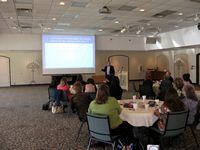
Jake Batsell, Assistant Professor in the Journalism department at SMU, discussed media convergence and the importance of maintaining a presence in, or on, various media, including social media, at the January meeting of the Dallas-Ft. Worth Chapter of the RCC on January 26. He is also faculty adviser for the student media websites, combined at smudailycampus.com, including the SMU Daily Mustang, a multi-platform news site produced by journalism students, and SMU-TV. Entitled “Media Outreach During Turbulent Times for the News Business,” Batsell’s presentation included results of the longitudinal study of media convergence that he, his colleagues, and students have been conducting.

They began the  study by asking a central research question: To what extent has convergence journalism taken hold in U.S. newsrooms over the past decade, and to what extent have these cross-platform partnerships endured? Newspaper and TV managers in the top 200 U.S. media markets were surveyed in 2002-‘03 (Phase 1), 2004-‘05 (Phase 2), and again in 2011 (Phase 3). Batsell and his colleagues are currently studying the results of phase 3. The results indicate challenges and opportunities for media outreach.

“The bad news is that traditional newsrooms are short-staffed, making cultivating relationships with reporters difficult. When you do interact with reporters, they’ll have less time to absorb your story than they used to.”

The good news, particularly for religion communicators, is that there are more non-traditional ways to get the message out. “Press releases that used to be ignored now might spark a blog post, which can be amplified through social media.” Suggested links to background information during an interview are likely to be included in the story. Alternate media outlets are plentiful, such as NeighborsGo and DallasSouthNews, as well as Pegasus News and Advocate Magazine, in the Dallas area.

Current results of the study show that news managers are focusing on developing interactive relationships with readers and viewers, primarily through social media. Which includes multimedia (both staff-generated and user-generated), news as conversation (blogs, comments, live chats, etc.), and engagement via social media platforms. “Today, news is a two way conversation” between newsrooms of all media and their readers. As religion communicators, we need to join the conversation. In an online world of “likes”, links, blogs, comments, and re-sending articles, and posts, good content and internet interaction are key to delivering our message to more people.

Peace be with you.

Knowing the interest in the topic of Social Media, we searched high and low and found an expert to talk about it. Jake Batsell, Assistant Professor in the Journalism department at SMU, will present a program on media convergence at the January meeting of the Dallas-Fort Worth Chapter of the Religion Communicators Council. The meeting will be Thursday, January 26 from 12 noon to 1:30 p.m. at the University Park UMC, 4024 Caruth Blvd, Dallas. Jake is both a knowledgeable and engaging speaker.

Part of his current research is in Phase Three of a study that examines media “convergence” and how both the term and practices it encompasses have evolved in the past 10 years. Results show that news managers are focusing on developing interactive relationships with readers and viewers, primarily through social media. Batsell is also faculty adviser for the student media web sites. SMU Daily Mustang, a multi-platform news site produced by journalism students, and SMU-TV combined operations in fall of 2011. The result is www.smudailycampus.com.

Cost for the meeting is $15 and includes lunch. Please email or call to make reservations, dchristian@umr.org, 214.630.6495 x147, so we’ll be sure to have enough food. Please feel free to invite friends and co-workers who might be interested in this topic.  — from Deb Christian, Secretary.

Peace be with you.

I attended the funeral of an old family friend yesterday morning. She lived across the street from my parents. I went to school with her two sons and daughter. She and my mom have been close for years. Carolyn was cremated, so it was a memorial service – a very nice and appropriate service.

At some point during the service, as the pastor was talking, the sound of children talking and laughing came through the wall as they went out the door from the hallway into the playground. My first thought was how interruptive it was. But then I began to think that it was rather fitting. A festive counterpoint to the somber proceedings on the other side of the wall.

Carolyn’s grandchildren were beginning to fidget from having to sit still so long. Hearing the children in the hallway did not help. It was as if God was illustrating that as one life ends, another begins. Reassuring those assembled that Carolyn is still with us in a spiritual sense.

It is odd to me that funerals can seem like reunions. But then, funerals are, after all, more for the living than the departed. Which makes the interruption of the children more poignant. The cycle continues. Love comes into the world, even as the loved depart from it. And all will meet again.

God speaks in many ways. We just need to listen.

Peace be with you.

It is not uncommon for people to ponder the question of whether there can be good without bad or evil. Considering the fact that both good and bad obviously exist, it is almost begging the question. Theoretically though, if bad and difficult times did not exist, there would be no perception of good because good would have no qualification. There would simply be existence.

With that said, I do not think “would there be good without bad?” is the correct question. It certainly has no discernible answer. I think the proper question would be: without bad, would we have any appreciation for what we received or the life we lived? If there were no pain, would we know when we felt good?

The plumbing backed up in our home a few weeks ago. We have a home warranty, but the plumber could not come out until the next day. We soaked up water with towels, ringing them out as best we could. We were not sure we could run the washing machine without acerbating the situation. We lit scented candles and sprayed air freshener in an attempt to override the stench of sewage. The attempt was only partially successfully.

A couple of weeks ago the heater went out and we were without heat from sometime in the early morning on Monday until Tuesday evening. We had two space heaters, but in a two- story home they were not all that effective. Naturally, the temperature dropped to freezing overnight. Cyndy and I both work at home so there was no choice for us but to bear the uncomfortable situation. However, while we were forced to bear the situation, there was no grinning to speak of.

When the plumber left weeks ago, with everything flushing or draining, we felt relief, even though the stench took a little longer to get rid of. We relaxed as the tenseness of waiting for the plumber to arrive dissipated and the problem was rectified. The feeling returned when the heater technician left a week or so later. With the addition of the anticipation of warmth.

As Joni Mitchell said, “you don’t know what you’ve got ‘till it’s gone.” But what about when it comes back? When the power goes out, the plumbing backs up, or the heater or air conditioner stops working, one begins to appreciate things working when the switch is flipped, the toilet flushes, and the A/C cycles on. Knowing that at any given moment, something may stop working – causing inconvenience and added expense. The principle does not only apply to utilities, of course.

Whether I had a toothache, fractured jaw, gash in my knee, broken heel, or even an end of a relationship (of any kind), I embraced – in a manner of speaking – the pain or inconvenience. Not the misery, but the situation as it is presented. With a toothache, if the tooth is not abscessed, I put off going to the dentist. Not only because I am not fond of dentist’s offices, but also because by living with the pain for a time helps me to appreciate the times I do not hurt – and I know how much better I will feel when the situation is remedied. It did not help when the injuries coincided with times of financial deficit and conflicting schedules.

To put it another way, I am an optimistic realist. I hope for the best, but am prepared for the worst. Difficult or painful times are part of life. There is no reason to get worked up about it – it is no one person’s fault and getting upset will not change the outcome. I did not enjoy the toothache. But I had the comfort of knowing the dentist was there to ease the pain at some point.

Then there are painful times when relief cannot be seen on the horizon. A family member or close friend dies or is diagnosed with a terminal illness. Or one any of a number of calamities occurs. In those moments it is hard not to get worked up about the situation or be upset. The answers are not as clear. The problem cannot be fixed with a single visit when you are tired of the pain. The pain – physical or emotional – seems endless.

Whether or not good could exist without bad, the fact remains that both do exist. Evil can be seen rearing its head in daily life. It affects us in many ways. Fortunately, God also exists and is stronger than the worst evil. We are human, with free will. There will still be illness, death, and other forms of serious pain. But God, with his grace, will help us get through any circumstance and quiet the fear within us. When God helps us through a time of pain, we have a greater appreciation for his grace and the times when life is good.

Peace be with you.