Tag Archive: Bible


“(JSB* – “And lo, the Lord passed by.”) “Now there was a great wind, so strong that it was splitting mountains and breaking rocks in pieces before the Lord, but the Lord was not in the wind; and after the wind an earthquake, but the Lord was not in the earthquake; and after the earthquake a fire, but the Lord was not in the fire; and after the fire a sound of sheer silence.”NRSV – (“a soft murmuring sound.”*)

A week ago last Sunday, our pastor, Kenny Dickson, gave a sermon on 1 Kings 19:1-18. He relayed the story of Ahab, Jezebel, and Elijah. Concerning the above passage, he concluded that God was in the silence and it is in times of silence that we can hear the Lord the loudest. I thoroughly enjoyed his sermon, but while the lay reader was reading the scripture, verses 11 and 12 brought a thought to my mind that deserved returning to at a later time. Which would be now.

With all the disasters that have occurred in the past couple of years, the question – does God bring or cause disasters? – has come up on considerably more than one occasion. I think the two verses above not only play a significant role in Elijah’s story, but also answer the question of “where is God” when natural disasters occur. The term natural is deceptive, not duly taking into account the effect of the human race on the planet. Either way, it refers to the actions of nature over the course of time. But when disasters occur, God is not sitting on a golden throne causing the destruction of his creation to unfold.

I find it interesting that the Jewish Study Bible (JSB) begins the second half of verse 11 – after God tells Elijah to come out of the cave and “stand on the mountain before the Lord” – with “And lo, the Lord passed by.” Without this sentence, the NRSV translation seems to imply that God is not present until the “sound of sheer silence.” Conversely, the JSB translation says “There was a great and mighty wind, splitting mountains and shattering rocks by the power of the Lord…” implying that the Lord was the ultimate cause. The NRSV indicates that the great wind came “before the Lord,” intimating that the Lord was not the cause, just an observer.

On the surface, as far as the plot is concerned, the mighty wind, the earthquake, and the fire – even the sheer silence – are unnecessary. Elijah gave God the same answer to his question “Why are you here?” both before and after the four examples of nature’s force. The sheer silence immediately following the violence of the earth was a sudden, terrifying silence – not knowing what might come next. But in verse 13 we learn that Elijah did not emerge from the cave until “hearing” the sheer silence or upon hearing the soft murmuring sound.

The passage does not give any indication as to whether Elijah was coming out of the cave before the mighty display of nature or not. Certainly he would have stayed in the cave when the “storms” began, regardless. Then, as is stated, he “wrapped his face in his mantle” and walked to the cave entrance. And God asks him the same question. To which, as we have said, Elijah gives the same answer. Then the Lord tells Elijah how to proceed.

So why include verses 11-14 if not to emphasize that the mighty wind, the earthquake, and the fire were not of the Lord. But after the acts of nature – as Pastor Dickson surmised – God could be found in the sheer silence (or the soft murmuring sounds). Which is why “when Elijah heard it,” he came out of the cave – where the Lord was waiting. Quite possibly the Holy Spirit, but the Old Testament did not include the concept.

As a result of free will and “having dominion” over the earth (Gen. 1:26 & 28), the world is to a large extent – and for better or worse – in our hands. And although God created nature, it too has “mind of its own” as it were. How else could God be disappointed in us? Because we let our faith and trust in God falter, not to mention ignoring his gift of grace.

When a natural disaster occurs, it happens “before the Lord,” but the Lord is not in the disaster (he did not cause it). But after the disaster, depending on the circumstances, the Lord appears in the sheer silence or soft murmur. Which is when we come out of the cave and listen to the Lord. He helps us get over the trauma, gather together as children of God, and move on. The effect of our existence on the earth is, literally, our “cross to bear.” But the Lord is there in the resulting silence, waiting to comfort us and help us persevere.

Peace be with you.

* Jewish Study Bible

The Mercedes commercial, in which the driver does not see objects coming, but the car does, is disturbing to me. You know the commercial. “I didn’t notice I was swerving, but my car did.” “I didn’t realize I was nodding off, but my car did.”

On the surface, it is simply a commercial to illustrate some advanced features of Mercedes’ new car. The ability of the car to sense coming obstructions and automatically avoid them. Which is obviously a good thing when it comes to accidental circumstances.

But a viewer could interpret the commercial to mean that it is not necessary to bother paying attention. And many drivers cannot afford to pay any less attention. “I was sending a text to a friend and didn’t see the car in front of me, but my car did.” “I was talking to a friend in the back seat and didn’t know I was swerving into oncoming traffic, but my car did.”

Odd, is it not, that an improvement in an automobile that can potentially prevent accidents and save lives is also a potential excuse for continuing the same activities while driving that cause more accidents and deaths. Sad as it may be, people will use the advanced feature much like they use cruise control – a feature to enable them to do unnecessary things while driving.

Which is much the same with many things. Such as the Bible, the Koran, and other sacred texts. Texts which were written (by whatever means or guidance) to guide people along a path toward spiritual fulfillment. Yet some readers insist on using these texts – in and out of context – to justify their own actions that most assuredly are not spiritual or fulfilling. The very scriptures intended to bring hope, peace, inner tranquility, and spiritual assuredness are distorted to excuse acts of violence, terrorism, and war.

The examples in the Mercedes commercial were appropriate examples to demonstrate the self-correcting feature. The implication of the dialogue was objectionable, but the intent was honorable. The misinterpretation as a result illustrates one of the problems with the human condition. As humans, we have the uncanny ability to take things given to us to with the intention of improving our chance of living through the world we have abused, and use them to further our selfish, lazy endeavors to do what we want, without consideration of others.

Fortunately, by the grace of God, as humans we have the moral capacity to know when we are doing wrong. But as a result of free will, we also have the capacity to make wrong choices and screw up. The key is to succumb to God’s extended arms of grace before falling prey to the temptations constantly before us. To follow the Scriptures as God intended and not as an excuse to satisfy our selfish desires.

“Do nothing from selfish ambition or conceit, but in humility regard others as better than yourselves. Let each of you look not to your own interests, but to the interests of others. Let the same mind be in you that was in Christ Jesus.” Phil. 2:3 (NRSV)

Peace be with you.

[Re-posted from former blog]

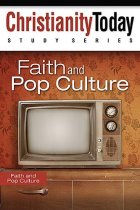
Faith and Pop Culture is the eighth installment of the Christianity Today Current Issues Bible Study Series, published by Thomas Nelson. As stated in the introduction, “[t]his Current Issues Bible Study is designed to facilitate lively and engaging discussion on various facets of entertainment and how it connects to our lives as Jesus’ followers.” The Faith and Pop Culture study examines the compatibility of our faith with the current culture as it pertains to the various parts of the entertainment industry. The book includes observations on movies, books, sports, television, and violence in entertainment media.

The study also takes a look at how entertainment affects Christians and vice versa. Must all entertainment Christians enjoy be “family friendly?” Can Christians influence the entertainment industry? With “entertain me” as the cry of our culture, is it compatible with a life of faith? These are questions to be discussed during the eight weeks of this study.

The Current Issues Bibles Studies are designed to be small group studies. Each session of the Faith and Pop Culture study begins with a Scripture Focus which provides the passages pertaining the lesson. After a brief introduction, a relevant article from Christianity Today magazine and ChristianityToday.com follows. The study guide of each session following the article are Open Up – discussion activities, The Issue – focusing on the main issues with which the session is concerned, Reflect – sharing thoughts and observations on the Scripture Focus passages, Let’s Explore – discussion questions, and Going Forward – taking what is learned and discussed and putting thought into action within our culture.

Each study guide includes ample questions and activities. Which allows for flexibility within the small groups using the study. If the group meets for two hours, they have plenty of questions, scripture reading, and activities. A group that meets for a shorter time has many options to choose from. Some sessions have “bonus” ideas or extra activities which could also be done outside of the regular group time.

In a time when many books and articles are written about modernism, post-modernism, and, indeed, faith and culture, Faith and Pop Culture is an intriguing Bible study that allows Christians as a group to actively apply their faith to the culture in which we live. The studies are also relevant for any small group in any situation. After reading the study, you might find yourself mentioning the book and series to group leaders whom you know.

Peace be with you.

I was given this book by Thomas Nelson Publishers for the purpose of  review. I was not required to write a positive review, nor did I receive any compensation other than the book itself.

[Re-posted from former blog.] I received the Word Of Promise The Gift of Psalms from Thomas Nelson Publishers yesterday. Since I am in the midst of several projects, I skimmed through the book, then popped the first cd into the computer – planning to read/hear one psalm and devotional and put the book aside for the moment. I found I could neither put the book down nor turn the cd(s) off. I previously thought having celebrities read the Bible would cause the listener to be distracted from the biblical message. Pleasantly, I was mistaken. Although it did distract me a little, the voices of the well-chosen celebrities enhanced the reading of the Psalms – as did the use of the King James version.

The devotionals by Lori Jones are a mixture of exegesis and devotional – as opposed to the common types of devotional. However, readers and listeners who prefer the more common devotional styles will not be disappointed with the mixture. The exegesis adds a contextual view of the scriptures and their application in the world today.

The Gift of Psalms provides an inspirational way to start the day or to take a spiritual break from a hectic schedule. The WOP New Testament Audio Bible is also available.

Peace be with you.

I was given this book by Thomas Nelson for reviewing purposes. I was not required to write a positive review, nor did I receive any compensation other than the book itself.

Beyond Opinion,” edited by Ravi Zacharias and published by Thomas Nelson, is a book for anyone who writes apologetics, enjoys reading apologetics, wants to know what apologetics are all about, or someone who would like to have answers when asked about their faith in everyday life. It is not a book that will be read in one setting. It took me longer to read than most books I review. Fortunately, I found I was not alone, according to reviews by fellow reviewers, Angie Boy and Christian Salafia.

“Beyond Opinion” is a book to be read, re-read, and savored, mentally devouring each delectable morsel – made up of theology and reason. Each of a number of today’s leading apologists, including Zacharias himself, takes on a different aspect or topic of apologetics. Though each chapter stands on it own, it is also a unique part of the cohesive whole.

As is noted in the marketing copy, “Beyond Opinion” is Zacharias’ response to the question posed to him by a Hindu friend. “If this conversion is truly supernatural, why is it not more evident in the lives of so many Christians that I know?” To achieve his objective – an apologetic to enable Christians to be theologically informed enough to answer the tough questions in such a way as to persuade rather than argue – he asked the leading apologists, working with Ravi Zacharias International Ministries (RZIM), to write on the different challenges to the Christian faith.

“Beyond Opinion” is not only a relevant and useful apologetic compendium, it may also be used as a topical apologetic in particular situations. Beginning with the postmodern challenges to the Bible, part one also addresses the other most common challenges such as atheism, youth, Islam, eastern religions, and science. For those wanting to delve further into apologetics and theology in order to be equipped to ” simultaneously defend the faith and be transformed into a person of compassion,” section two of part one digs deeper by addressing conversational apologetics, broader cultural and philosophical challenges, the existential challenges of evil and suffering, and cross-cultural challenges.

Part two seeks to internalize the questions and answers acquired by venturing into the Trinity as a paradigm for Spiritual Transformation, the role of doubt and persecution in spiritual transformation, and idolatry, denial, and self-deception – hearts on pilgrimage. Zacharias rounds out the tome expounding on the church’s role in apologetics and the development of the mind.

Unfortunately, space does not permit in a short review a discussion of the theological points so eloquently stated in the book. And where would one begin? Or end, for that matter. It is better that you read it for yourself in its entirety (albeit not all at once). Your faith will become stronger and you will become spiritually assured. More importantly, the next time you find yourself in a conversation about your faith in a public setting, you will be able to respond knowledgeably and in a manner aimed more toward “winning people rather than arguments.”

Peace be with you.

Max on Life,” the new book by Max Lucado and published by Thomas Nelson consists of the author’s answers to questions he has received over the years in letters, emails, and phone calls. Questions he has been asked as both a pastor and a writer. The letters Lucado received as a pastor are separated by categories (and chapters) entitled Hope, Hurt, Help, Him/Her, Home, Haves/Have-nots, and Hereafter. The questions asked of Lucado range from basic theological questions to marital questions related to God to why go to church. The pastor writes about the role of prayer, the purpose of pain, and the reason for our ultimate hope.

The writing questions are answered in an essay in the addendum, The Write Stuff. The well-written essay deals almost exclusively with writing for the church and as a calling, using the prophets and other authors of the Bible as examples. Lucado deals with basic matters of writing in the last couple of pages. He does not tell an aspiring writer how to be published. But he does tell anyone who feels called to write in the service of the Lord how to proceed from the call, the desire and an idea.

Some readers will read the book cover to cover. Others will use it as a devotional reference or as a topical reference when they are facing hard questions in their own lives. Lucado directly answers most questions with personal experiences and/or Biblical references combined with insights gained from his study, reflection, and prayer. Even answers to questions I will probably (and hopefully) never have still evoked deep feelings, causing me to reflect on my own spiritual journey.

“Max on Life” is an interesting read. Regular readers of Max Lucado will enjoy this book as well as those who are not familiar with his earlier books.

Peace be with you.

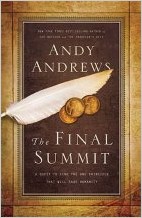
The Final Summit,” by Andy Andrews, published by Thomas Nelson, is the sequel to Andrews’ “The Traveler’s Gift.” It is not necessary to have read the previous book to understand “The Final Summit.” Andrews recounts the story in the first chapter. David Ponder recalls his travels through time after an accident. He meets seven famous figures from history who give him the Seven Decisions for Success.

Using the seven decisions, Ponder makes a fortune and then the business fails in a very public way. After losing everything, Ponder realizes that the seven decisions were right all along. It was his lack of wisdom that caused the disaster. Ponder makes another fortune, building a skyscraper in Dallas without borrowing any money, “paying as he went.” When the building is completed, he and his wife Ellen give it all away through charitable trusts and retire to the penthouse which encompasses the top floor of the skyscraper.

Then his wife, Ellen, dies in her sleep while in Austin with their daughter and grandchildren. Ponder stays in the penthouse and mourns her death. He goes through the navy blue tobacco pouch with the souvenirs of his travels. He breaks down in tears, not understanding why he had been left alone. Then Gabriel appears for the second time – having been one of the figures from his time travels. Gabriel tells him that he is to lead the Final Summit of all the Travelers (every Traveler who ever existed) to decide the fate of the Earth and avoid another disaster as destructive as the flood in Genesis.

In chapter two Gabriel explains about the gathering of the travelers and plans for the summit. Including the fact that Ponder will be leading the meeting. Even though Solomon and Winston Churchill will be there. Gabriel takes Ponder under his wing, literally, and they are off “like a rocket.” The remainder of the book details the meeting place and the summit itself with an array of famous characters and Biblical figures.

I am not the first reviewer to have mixed feelings about the book. It is the next installment in Andrew’s series of lesson filled books as well as the sequel to “The Traveler’s Gift.” Unlike a few of his previous books, however, the dialogue seems stilted and the plot rather contrived and drawn out longer than necessary. Gabriel, for example, does not quite sound as one would imagine from reading the Bible. But if you are looking for a light afternoon feel-good read, you will enjoy “The Final Summit.” Just do not expect to get too involved in the story or receive any unexpected revelation.

Peace be with you.

Disclosure of Material Connection: I received this book free from Thomas Nelson Publishers as part of their Blogger Review Program. I was not required to write a positive review. The opinions I have expressed are my own. I am disclosing this in accordance with the Federal Trade Commission’s 16 CFR, Part 255: “Guides Concerning the Use of Endorsements and Testimonials in Advertising.”

Grief and the Presence of God is a Bible study using the book of Job with observations from C.S. Lewis and my own experiences. Originally written for use in a Sunday school, I recently revised it. The study is in three parts, with study questions in the back for each lesson.

Lesson one, Grief and It’s Symptoms, delves into the symptoms and resulting effects of the grieving process. The Book of Job certainly has a lot to say about grief and it’s effects. As I mention in the study, Job is probably the only person in the history of the world – with the exception of Jesus (and he knew what his mission was) – who can truthfully tell someone that they do not know how he feels.

Lesson two, Meanwhile, Where is God?, discusses what is arguably the most destructive symptom of grief – when you think God is not around when you need him. When one is grieving, being told that the departed loved one is in God’s hands is little comfort when one considers that they were in God’s hands even as they were on the road to death. It is even more disconcerting if the death was slow and painful.

Lesson three, Alone into the Alone, is concerned with Lewis’ Cosmic Sadist theory and what I consider to be the myth of closure. Whether you agree or disagree with Lewis’ theory or my own theory of closure, you will come to your own conclusion and perhaps progress further in your spiritual journey. After which you will hopefully be better equipped to face times of grief in the future.

Grief and the Presence of God is available in the bookstore at www.danroark.com.

Peace be with you.

Have you ever bought a bag of potato chips – or other munchie (although, oddly enough, it is always potato chips with me) – and open it to find nothing but air? As if some ticked off employee who is having a bad day fiendishly plotted – complete with crooked grin and sneer – to put a hitch in my day. I always took it as a personal affront because usually it was the only cash I had at the time and I was away from the store when I opened it and would not have been able to prove it was actually empty.

The fact that it contained no salt could simply mean that I wiped it clean. Although why anyone would do that, I could not tell you. Suffice it to say, the empty bag pops up at the most inopportune time. We had one of the large variety boxes of chips. The empty bag is never discovered right away. That would be rather convenient and that is not allowed.

The empty bag, of course, was the last bag of one of our sons’ favorite chip. Which, also quite naturally, he had been saving for just that particular occasion. If you have been one of the chosen few who have never received an empty bag of chips, you can liken it to the time in college when you were settling back one evening. You get a cup of coffee or your favorite beverage, find a book you actually want to read, then go to the cabinet and your roommate has eaten your last Ding Dong (insert favorite dessert treat). Going to the store to get a replacement, while within the realm of possibility, just would not be the same thing. The moment is ruined.

As to the empty bag of chips, there is no real person to blame. I used to imagine the assembly line worker who fills the bag with chips turning to another worker. With a fiendish look on his face, he says, “I’m going to fix somebody,” as he passes the empty bag down the line. Ostensibly getting back at who knows who about who knows what. He feels bad so making someone else feel bad apparently evens things out.

It is harder to get upset at a machine having a sudden glitch and not pushing the chips into the bag which would be sealed by another machine that did not know the difference. And if you are one of the lucky people who have never bought an empty bag of chips, your time may still come. I have happened upon several myself, and each member of my family has had it happen to them at least once. I would think we have reached our quota.

“I said in my heart with regard to human beings that God is testing them to show that they are but animals.” Ecclesiastes 3:18

Am I suggesting that empty chip packages or roommates eating the last dessert treat are tests from God? Certainly not. God has considerably more important matters to attend to than a glitch in the machinery at the chip factory, the act of a disgruntled employee, or a hungry roommate. God created the world and set it in motion. Humans are the unpredictable factor in the equation – thanks to free will.

With all of our gadgets and internet connections, giving us the illusion of being in control of our lives, we still need to be reminded that we are not in control. To think that we are is surely a vanity and chasing after wind.

Peace be with you.

Time of Calamity

A couple of days ago, about 10 a.m., the bottom dropped out, weather-wise. The “sky was crying,” as Stevie Ray Vaughan would sing. It also sounded as if Mother Nature might have some serious issues. Being in the middle of a storm is a little scary, no matter who you are. You may not admit it, but even the strongest among us have their moments.

When it is storming so tremendously outside that the thunder, lightning, and rain on the house is all you hear – even over the tv, radio, or heater. The sun seems to be on sick leave and the sky just gets increasingly darker. If you are having any major life problems at all – and who is not – a serious funk can be one thunder crash away. The all-consuming gloominess that appears to surround you suddenly feels tangible – shrinking around the house like plastic wrap – closing off all exits. That’s how I imagine Qohelet felt when I read certain parts of Ecclesiastes.

“Again I saw that under the sun the race is not to the swift, nor the battle to the strong, nor bread to the wise, nor riches to the intelligent, nor favor to the skillful; but time and chance happen to them all. For no one can anticipate the time of disaster. Like fish taken in a cruel net, and like birds caught in a snare, so mortals are snared at a time of calamity, when it suddenly falls upon them.” Eccl. 9:11, 12.

Everyone has experienced times similar to those mentioned here. But, as I discuss in the book, Qohelet did not have grace and forgiveness of sins as we have. Not to say that God did not give grace to the Israelites or grace their endeavors – the Israelites simply did not see it as grace, per se. The Israelites and people of the Old Testament viewed life in more concrete terms. If life took a bad turn – family, crops, or livestock dying, for example – they must have done something to cause it.

Unfortunately for them, Jesus Christ had not been born yet. Fortunately for us, he has. Through Christ’s life and sacrifice, we not only have God’s grace, but the Holy Spirit and forgiveness of sins. Looking at Ecclesiastes in that light, we can take Qohelet’s view – which is valid even today – mix in grace, the Holy Spirit, and redemption, and ascertain our actions as Christians when we have a tendency to “hate all the toil in which we have toiled under the sun.”

Join me on the journey.

Peace be with you.