Tag Archive: church


St. Nick's entrance

St. Nick’s entrance

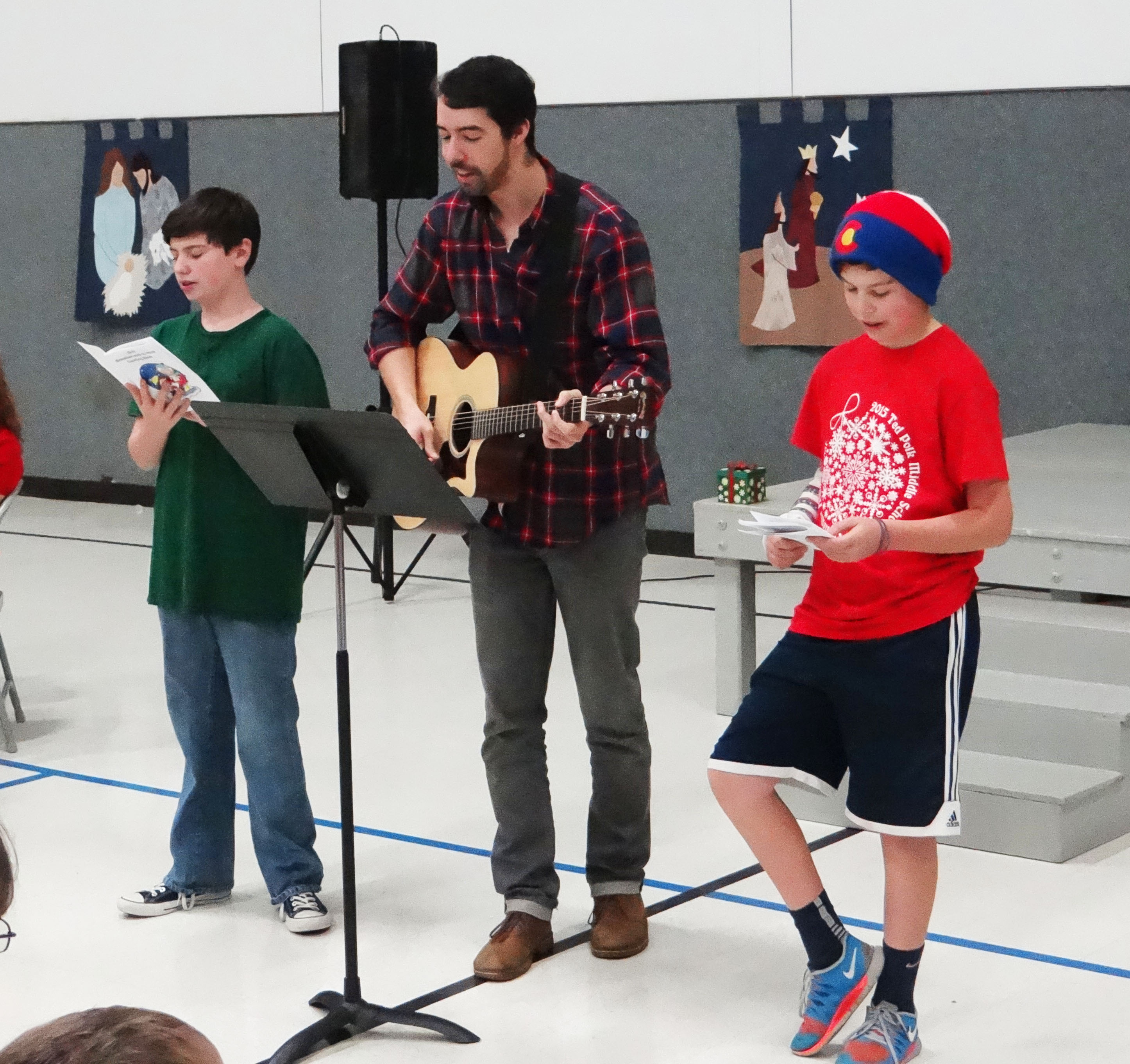
Every year, for a number of years now, due to the efforts of Debbie Darland, her family, and volunteers, St. Nick/Santa has arrived at Christ UMC in Farmers Branch on a Saturday in December. This year it was December 12th. As Santa was still making his way there, the morning began with a sing-a-long led by Youth Director David Magallanes with Jaime Boenig and Jack Texada.

After the sing-a-long, Debbie announced that Mrs. Claus was sick and would not read the Christmas story this year. And since Santa was “still stuck in traffic,” Katheryn Taylor would read to the children. Which she did, quite well. Since she helps with the children on a regular basis, they were very receptive to her.

Then Santa arrived, preceded by a penguin. Why the penguin led him in is still a mystery. Since Mrs. Claus was ill did a penguin fill in? Why wasn’t an elf taking her place? Do people prefer penguins over elves? And why make us choose between elves and penguins anyway?

Regardless of the penguin/elf debate, Santa took his seat and began to call the children to him. Which Jamie Boenig, David Magallanes, Jack Texadasounds like someone else we know who is associated with Christmas. The children wanted to see Santa Claus. But they also spent time at the manger scene to the right of the stage, looking at baby Jesus.

A list was posted of the order in which the children would be called to see Santa. The families who were further down the list went to get breakfast so they could eat before their child/children’s names were called. Those at the first of the list would eat after talking to Santa and having their picture taken. Members of the Pathfinders Sunday school class cheerfully cooked and served the breakfast.

Rachel Meier and Carly ImthurnSanta finally made his way through all the children and headed on to the next stop. The youth helped to clean up the gym and the Pathfinders class cleaned the kitchen. The children headed home with their parents. Some of the children would be asleep before too long. But all left excited and happy. Thanks to Debbie Darland and family, the youth, Pathfinders class, and all other volunteers not named here for another successful Breakfast with St. Nick, with 80 children this year.


Peace be with you.

Rashad and Kaleigh Okay, maybe not babes exactly, but children nonetheless. The girl, Kaleigh, is my friend’s daughter. The boy, Rashad, is Kaleigh’s nephew. I took the picture when Cyndy and I were watching Kaleigh and Rashad for Randy and Kelly. Rashad is now about five or six. Randy came by today and had Rashad with him. He just dropped by to pick up Disc Golf brochures, so he ran in without Rashad.

When he was leaving, Randy asked me to come out to the car so Rashad would know who I was. Randy had asked him on the way over if he remembered me, and Rashad wasn’t exactly sure. He’s been over quite a few times since the picture was taken, by the way. When we reached the car, Randy knocked on the window and Rashad popped his head up and saw me. He squealed, then jumped in the back seat and kept squealing at me and grinning.

“Now he remembers who you are,” Randy said, laughing.

I said goodbye and went back in the house. Not long after the phone rang. I assume Randy was going Dennis to Valwood to Josey, because of the number of churches within the two blocks of Valwood. Either way, I answered the phone.

“You should hear Rashad,” Randy said. “The things that kids say. Rashad would say, wow, look at that cross. Look at that church. There sure are a lot of churches.”

“Look at that church!”

“Do you like church and churches?” Randy asked.

“Yes.”

“What do you like most about church?”

“There’s a lot of Jesus stuff in church. And Jesus is my Lord!”

That is when the true spirit of Christmas shines through.

Peace be with you.

JD Pitching 1 I was in Fort Worth this past weekend with J.D. at TCU for a baseball camp. We were driving from one field to another and were driving down W. Berry from TCU. Coming down the hill, I spotted a man and a woman waving from a concrete platform that turned out to be the entrance to a church. They were not waving “come here” like parking attendants, but they were using a modified princess wave. Unfortunately, their signage was not sufficient for me to see the name quickly as I drove by. And time did not permit stopping to take a picture.

As I told J.D. later, if we hadn’t been on a schedule, I would have stopped and attended their service. But while I couldn’t stop, it was a bright spot in the morning. It was over 100 degrees for most of the weekend and J.D. had already played two games (albeit short games). In the picture, J.D. is the pitcher. It was a showcase camp before coaches and recruiters from numerous colleges and some major league teams. It was a high intensity weekend, which made the smiles and the waves all the more important.

When I saw them and realized it was a church, I said to J.D., “so simple, but effective. How cool is that?” I happen to be on the communications committee of our church. It was certainly a Jesus moment in which life is briefly in the background and God’s light shines like a beacon in the wilderness. One of those moments that reminds us that life may be tough at times, but something better awaits us.

Peace be with you.

Zion UMC 1When I take trips – or even when I am just driving around – I like to take pictures of churches. All kinds and types of churches, but small churches in particular. Churches that have been around for many years. Some are worn and broken down, but show signs of tender loving care and have the appearance of an active church – albeit with a tiny congregation. Other churches have not held services for several years, but still show signs of upkeep by faithful congregants or their descendants. The church buildings resemble souls on the side of the road.

Churches with a past – not the negative sort of past that the phrase ordinarily implies – but a glorious past of vibrant congregations, spiritual worship services, and dinners on the grounds. The church buildings, along with the surrounding property, echo the vocal strains of gospel music, prayers, and praise. I often wonder if the Holy Spirit doesn’t return occasionally to the former churches to bless them one more time for their meritorious service to the glory of the Lord. Roadside reminders of years of faith and praise.                   Preston Road Church

I am rarely traveling on Sunday in order to attend our church. I take pictures and write articles for the newspaper, website, and archives. But one of these weekends when I’m on the road, I’d like to stay over and revisit the churches I’ve seen. Mainly to see if they still have services. I would like to get pictures of the small congregations that have served throughout the years and still faithfully attend.

I’m afraid, however, I would find that they would be closed for good. My next question would be if someone was still tending to the building. Or if it had been left to nature and future real estate developers. Which is why I take pictures of those churches. In some small way, I want to preserve the memory of the congregations and churches that helped develop the society in which we currently live.

But I will not only post pictures of churches with a past and possibly no future. I will also post – in order to celebrate – pictures of ministries that represent the church in the world. Or simply unique churches.

Peace be with you.

The full title of Rubel Shelly’s book published by Leafwood Publishers (ACU Press) is “I Knew Jesus Before He Was A Christian…and I Liked Him Better Then.” When I was asked to review the book, I was intrigued by the title. As I began to read, it became apparent that the title was not merely cute to boost sales, but was entirely appropriate for the material. Our small group was deciding what book to study next and I suggested this one. Rather than read through it before the group studied it, I waited to review the book in order to include it’s effectiveness for a small group study.

The conclusion is that I Knew Jesus… works well for small groups. Precisely because it compares the original churches to churches now and the Jesus of the Bible to the Jesus nonbelievers perceive to be preached in churches today. The subject is – and should be – on the minds of all church and small group members.

Shelly begins by asserting that we can be both pro-Jesus and pro-church simultaneously. But not as long as a perception exists of disconnect between the two. Changing the perception necessarily requires elimination of the disconnect. The author quotes Stephen King when he wrote, “And while I believe in God, I have no use for organized religion..”

That is what many Christians have heard, unfortunately, far too often. Then there is the oft-quoted “I’m spiritual, but not religious.” In chapter four, Shelly tells the story of author Anne Rice. Rice renounced the Catholic religion at age eighteen. After a series of tragedies, including  the near loss of her life, she renewed her commitment to the Catholic faith. Rice wrote a book about the experience, dedicated herself to “glorifying God,” and launched a series of Christ the Lord books.

On July 28, 2010, Anne Rice posted a statement on her Facebook page that she was giving up Christianity and doing it “in the name of Christ.” She said that she remained committed to Christ as always, but not to being ‘Christian’ or part of Christianity. Rice followed the next day with “my conversion from a pessimistic atheist lost in a world I don’t understand, to an optimistic believer in a universe created and sustained by a loving God is crucial to me. But following Christ does not mean following his followers.”

Which is precisely the point Shelly is making. The Jesus of the Bible – and by extension, of the original churches – is not the Jesus the people of the world see proclaimed by many of today’s churches. We should strive to be more like the Jesus of the Bible than the Jesus we portray through the filter of our organizational structure and polity. Rubel Shelly, in I Knew Jesus…, looks at different aspects of the disconnect and barriers between Jesus and the church. The author challenges and encourages the reader to work toward solutions in their own lives and churches, with questions found in the discussion guide.

Too many people have decided they are done with the church. They do not want to have anything to do with the church. “But you just might get attention with this radical, engaging, challenging, life-transforming, healing, rescuing person named Jesus of Nazareth. In fact, I think it is the only hope we have for communicating with a postmodern world. The best argument is…a living demonstration of kindness and acceptance, grace made incarnate, or love emptying itself for the sake of others.”

In I Knew Jesus Before He was a Christian, Shelly uses real-life and biblical examples to illustrate that while church membership may be declining, there are still souls searching for the life-affirming love of Christ. For a church to be a model of the first Christian churches and the life Christ displayed, they must first exhibit Jesus in the community and participate in ministering to those in need.

Peace be with you.

[I received this book free from Leafwood Publishers for a review. I was not required to write a favorable review.]

Circuit Rider – Poem

Pioneer minister

dressed in Sunday go-to-meeting clothes,

on the back of a strong steed,

traverses the country side.

Residents of the woods

perk up, looking towards the commotion,

disturbing their solitude,

on a country Sunday morning.

Lazy autumn leaves

in silent mid-motion while falling,

feel the Lord’s reigning presence,

in the minister’s passing.

Rifle across saddle

a problematic duality

quiet pen with screaming sword

peace and violent protection.

Sermon in drifting thoughts,

or at least significant scriptures,

interminable miles pass

under knowing, pounding hooves.

Church waits – anticipates

in a grove of tall hickory trees.

salvation starved pioneers

waiting for the word of the Lord.

Business on Saturday,

baptism at water’s edge by candle light

services Sunday morning

minister heads toward his next church.

Pioneer minister

dressed in Sunday go-to-meeting clothes,

on the back of a strong steed,

traverses the country side.

Happy Easter!

I hope everyone had, and is having, a wonderful Easter. Fortunately, the rain held off here until after the third and final service of the morning. The sunrise service at Jaycee Park and the two services in the sanctuary were glorious celebrations of the risen Christ. Our music department at Christ UMC in Farmers Branch, is one of the best around and proved it once again this morning. From Trevor Shaw and Will Nieberding during the sunrise service to the Christ Alive Band, the Children’s Choir, the Celebration Ringers, and the Easter Choir (Celebration Choir and Sunshine Gospel Singers) in the worship services, the music was excellent.

Bob Spencer ruminated on Judas and Peter – the two pivotal figures of Christ’s final days in human form – during his message at the sunrise service. Pastor Kenny Dickson gave an inspirational sermon on Resurrection faith during the two worship services. The United Methodist Men served a delicious pancake breakfast in the gym following the sunrise service.

The rain began immediately after the 11 a.m. service as everyone was going to their cars. A couple of hours later we heard the loudest thunderclap we have heard in quite some time. It seemed to rip the sky apart. It immediately reminded me of the tearing of the “curtain in the sanctuary of the Temple” down the middle as Jesus “breathed his last.” No doubt I felt closer to God for two reasons today. Hallelujah, Christ is risen!

Peace be with you.

Have you ever wondered while watching NCIS, The Closer, or any of the CSI shows, whether actual investigative units can really do some of the things they do on TV?

Duane Boy will answer that question during his presentation at the King Of Glory Lutheran Church as part of their GUSTO! series of events. Boy will speak at 10 a.m. on Tuesday morning, April 10. (Normally held on the second Monday of each month, the meeting will be held on Tuesday due to the Easter weekend.) Boy, a retired DPD police detective, will walk the audience through the process of investigation, from conducting the initial interviews to presenting the case to the district attorney.

Boy, a long-time member of King of Glory, spent 33 years with the Dallas Police Department, retiring in 2011. During that time he handled such diverse cases as the 1991 Asian restaurant robberies, the SMU water-hazing case, and the gang arrest that cleared up 71 home invasion robberies, three kidnappings and the attempted murder of a police officer—not to mention the recovery of Elvis Presley’s motorcycle jacket, which had been stolen from Graceland.His investigation and arrest of a huge-scale counterfeit-music group earned him a Gold Record from the Recording Industry Association of America.

Boy is a South Dakota native, Vietnam veteran, and graduate of Oklahoma State University with a degree in entomology. He worked as a marine biologist at Texas Instruments until 1977, when he was sidelined with a broken neck. Interestingly, that led to his joining the Dallas Police Department a year later. He served as a patrol officer and undercover operator until 1988, when he became an investigator. He worked property crimes for a few years before moving to robbery cases.

Boy will touch on such steps as processing the crime scene, collecting evidence, developing and interviewing suspects, and compiling the case for prosecution. He’ll also cover what you can do to help an investigation if you are a victim and what you can do to lessen your chances of becoming a victim.

Come at 9:45 a.m. for coffee and conversation, and join us for a reception following the  presentation. The GUSTO! program was created to provide interesting and enlightening experiences for the mature adult community, but all are welcome.

Peace be with you.

Beyond Opinion,” edited by Ravi Zacharias and published by Thomas Nelson, is a book for anyone who writes apologetics, enjoys reading apologetics, wants to know what apologetics are all about, or someone who would like to have answers when asked about their faith in everyday life. It is not a book that will be read in one setting. It took me longer to read than most books I review. Fortunately, I found I was not alone, according to reviews by fellow reviewers, Angie Boy and Christian Salafia.

“Beyond Opinion” is a book to be read, re-read, and savored, mentally devouring each delectable morsel – made up of theology and reason. Each of a number of today’s leading apologists, including Zacharias himself, takes on a different aspect or topic of apologetics. Though each chapter stands on it own, it is also a unique part of the cohesive whole.

As is noted in the marketing copy, “Beyond Opinion” is Zacharias’ response to the question posed to him by a Hindu friend. “If this conversion is truly supernatural, why is it not more evident in the lives of so many Christians that I know?” To achieve his objective – an apologetic to enable Christians to be theologically informed enough to answer the tough questions in such a way as to persuade rather than argue – he asked the leading apologists, working with Ravi Zacharias International Ministries (RZIM), to write on the different challenges to the Christian faith.

“Beyond Opinion” is not only a relevant and useful apologetic compendium, it may also be used as a topical apologetic in particular situations. Beginning with the postmodern challenges to the Bible, part one also addresses the other most common challenges such as atheism, youth, Islam, eastern religions, and science. For those wanting to delve further into apologetics and theology in order to be equipped to ” simultaneously defend the faith and be transformed into a person of compassion,” section two of part one digs deeper by addressing conversational apologetics, broader cultural and philosophical challenges, the existential challenges of evil and suffering, and cross-cultural challenges.

Part two seeks to internalize the questions and answers acquired by venturing into the Trinity as a paradigm for Spiritual Transformation, the role of doubt and persecution in spiritual transformation, and idolatry, denial, and self-deception – hearts on pilgrimage. Zacharias rounds out the tome expounding on the church’s role in apologetics and the development of the mind.

Unfortunately, space does not permit in a short review a discussion of the theological points so eloquently stated in the book. And where would one begin? Or end, for that matter. It is better that you read it for yourself in its entirety (albeit not all at once). Your faith will become stronger and you will become spiritually assured. More importantly, the next time you find yourself in a conversation about your faith in a public setting, you will be able to respond knowledgeably and in a manner aimed more toward “winning people rather than arguments.”

Peace be with you.

Words and phrases that may have begun as an original thought with an apparent obvious meaning and intent, after constant use, misuse, and abuse, over time become catchphrases and buzzwords with thoroughly ambiguous meanings. Thinking “outside the box” was the hot business concept in the late 1990’s. Through the years, the expression has been bandied about and used in advertisements and press releases to represent ideas and supposed innovations that, in the end, were not so out of the box after all. All anyone succeeded in doing was expanding the box.

“Whatever” was originally used having to do with making a decision. As in “get a Coke or a Dr. Pepper or whatever you want.” Or ” it has to do with Kleenex, napkins, paper towels, or whatever.” Currently the word is most often used to mean “I don’t want to talk about it anymore.” Or a sign of being noncommittal. Our teenagers and their friends use it when they have gotten themselves in a conversational hole and do not want to admit it. “Whatever!”

The phrase “don’t guilt-trip me” gained prominence in the 1960’s with accusations that the “establishment” was trying to lay a guilt-trip on the middle and lower classes. While I sympathized with some of their positions, I disliked the phrase even then. It is more distasteful to me now when my children use it toward me. What the phrase actually means is “I know I’ve screwed up a lot (or owe you a lot), but I don’t want to be told that, I want to get what I want.”

Other variations could be applied, but that is the gist. More often than not, what they refer to as guilt-tripping is actually telling them the truth. For example, one of the boys asks us for something that requires financing from us. When we go down the list of things they have already received no return effort – even though that was the arrangement- we are now required to add “and I’m not trying to guilt-trip you, just telling you the truth.” Beat them to the punch, as it were.

I grew up under the impression that it was easier to keep problems and debts to a minimum rather than endure the bothersome situation of feeling bad. It is our conscience that causes us to feel remorseful. Other people cannot make you feel bad – or guilty – if you have no reason to feel bad in the first place. But most of us feel shame over past indiscretions of one sort or another. In addition to a natural inclination to get defensive when being told we are being selfish. Because, on some level, we are all being selfish. But we would prefer not to admit it or have it made public.

Which led me to wonder if sometimes we do not try to guilt-trip God. As if making a list of our Christian “accomplishments” will persuade God to lend a special hand and eliminate our particular situation. A situation which seems important to us, but in God’s grand scheme of things is quite minuscule. Yet we have the audacity to think that we could have possibly done enough good in our lives to not only outweigh our myriad of failures, but move us higher up on God’s to do list.

“Where are you, God? I go to church every Sunday, well, most every Sunday. I attend Sunday school. I am at the Wednesday dinner s. I read the Bible every day. I pray every night for everyone on my prayer list. I try to be kind to everyone. So why am I stuck in this situation? Why will you not help me?”

God did not put us in the situation we are in – we did. We may not have been the direct cause of our current malady or tragedy, but in some way we had a hand in it. Regardless of whether we were a part of the cause or had little or nothing to do with it, God most certainly was not the cause. Why are we blaming him and ridiculously trying to make God feel sorry for us and give us the outcome we want. We do not want the outcome that God wants or the outcome we may deserve. We want the outcome we think is best.

Just like our teenagers. They do not want to hear the truth. They want to be told they can have things their way. Telling them the truth is guilt-tripping them. We are alongside our children when we ask God for help. We do not want to be guilt-tripped by being told the truth or what is best for us. But we know in our hearts and souls that God wants the best for us. So why are we trying to blame and guilt-trip God?

In trying to guilt-trip God, and when our teenagers try to guilt-trip us, one thing is overlooked. It is, in fact, what is wrong with the term guilt-trip in the first place. It also renders the term irrelevant. And it is quite simply this: you cannot guilt-trip a truly innocent person – or being – as the case may be.

Peace be with you.